Upskilling Paid Search Teams to Buy Conversational AI Placements
ChatGPT ads require rebuilding three core paid search habits, not just adapting them.
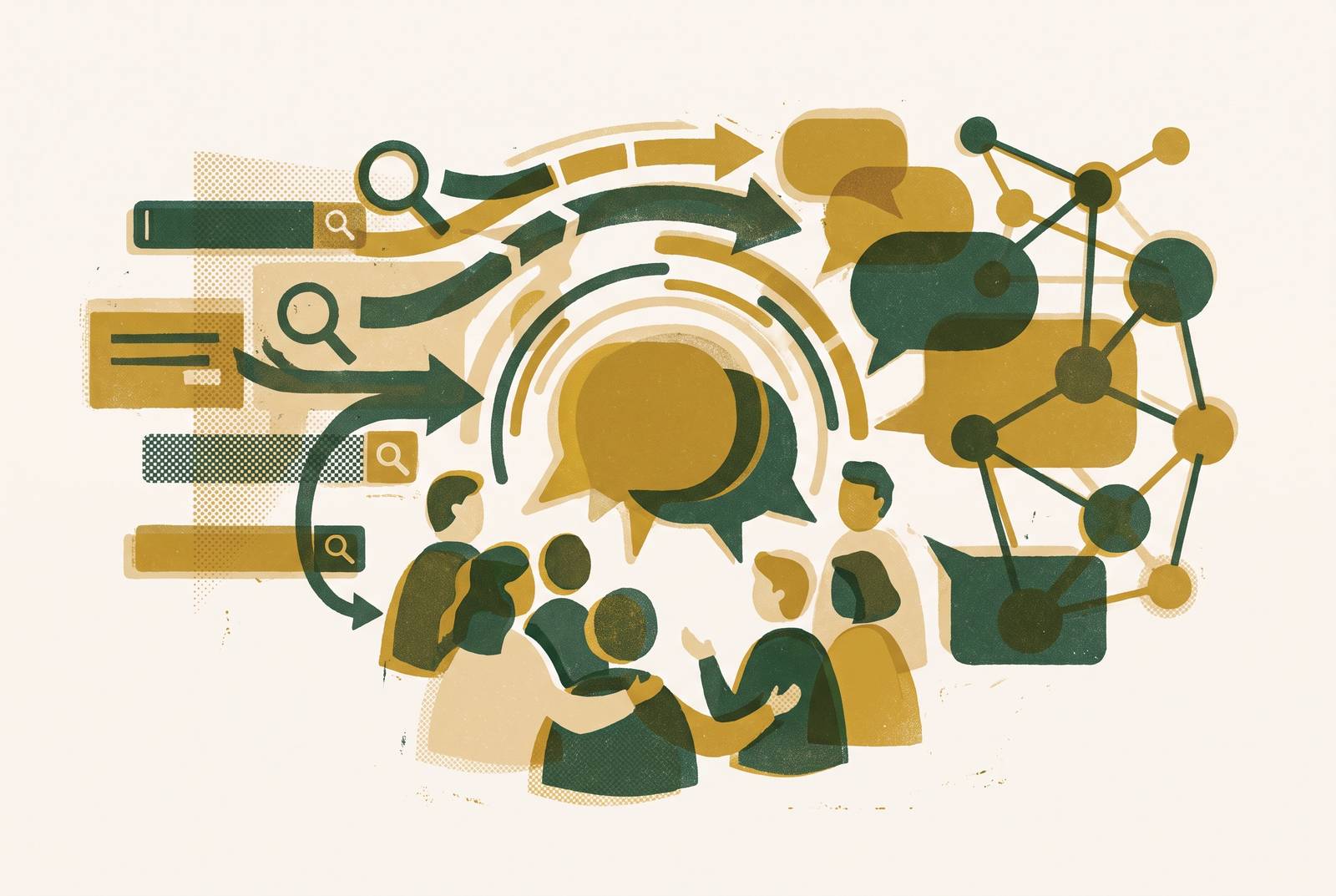
Paid search teams are being asked to buy conversational AI placements in 2026, and the assumption that their existing skills transfer cleanly is wrong. Some competencies carry over directly, but three core habits produce poor results in this channel and must be rebuilt from scratch. The practical answer is a clean skills audit, structured in the order the channel's mechanics demand.
Why 2026 is the forcing moment for paid search teams
OpenAI launched ads on February 9, 2026, after three years of saying ChatGPT would never carry advertising. That reversal signals something more than a product change. It confirms that conversational AI has become a live commercial surface, one that paid search teams are now being asked to operate whether or not they have been trained for it. The mechanics differ from everything those teams learned in search.
Google and Microsoft already serve ads inside AI answers through campaigns advertisers are running today, with no opt-out available. The practical consequence is that many paid search teams are already active on these surfaces without knowing it. The question is not whether to enter the channel. The question is whether the team has the skills to operate it competently.
The scale argument explains why this is happening now. OpenAI had around 900 million weekly active users around the February 2026 launch, with only a small fraction on paid tiers. A buying surface of that size, arriving this quickly, forces the upskilling question from theoretical to urgent.
The structural difference that makes a clean skills audit necessary
The fundamental unit of targeting has changed from a keyword to a conversational situation, and that change cascades through every skill a paid search practitioner relies on. In paid search, intent arrives as a string, a query the advertiser can read, bid on, and match to a word or phrase. In conversational AI, intent is a trajectory. The targeting system interprets not just the current query but the entire conversational arc: what was asked three exchanges ago, how the AI responded, where the dialogue appears to be heading.
A user might never type "project management software" but spend a lengthy conversation on team coordination, deadline tracking, and remote collaboration. A sophisticated contextual system reads those as high-intent signals. Microsoft Copilot formalizes this logic as "ad voice", a brief explanation shown to users of how the ad section connects to their conversation. Ads are triggered based on the whole conversation within a single session, not just the most recent query.
The practical consequence is that a team arriving with keyword lists, match types, and negative keyword logic is holding tools that don't connect to the targeting layer. This is not a new interface for an old skill. It is a different targeting philosophy, and teams need to know which of their existing skills translate and which don't before they start building campaigns.
Skills from paid search that carry over directly
Several core paid search competencies apply directly to conversational AI placements, and teams that recognize them avoid re-learning what they already know. Auction literacy transfers cleanly. ChatGPT uses a relevance-weighted, second-price auction, the same economic logic as Google's auction. A more relevant ad can beat a higher bid, and the advertiser pays just above the next competing bid, not the full bid. A well-matched ad from a smaller spender can outcompete a vague ad from a larger one. This is an unusual property in paid media and an early-mover advantage while the field is still inexperienced with context hints.
Landing page discipline transfers as well. OpenAI's ad system reads the landing page as a relevance signal and crawls it during review. Campaign architecture thinking transfers too. Structuring ad groups around distinct audience needs, writing distinct messages per angle, and testing creative variants are practices that apply directly to this channel.
Feed and asset management transfers for Google and Microsoft specifically. AI Overviews and Copilot serve ads from existing Search, Shopping, and Performance Max campaigns, with logo extensions for Copilot. The team's feed quality, broad match settings, and AI Max configurations determine whether those campaigns appear inside AI answers. The performance analysis mindset also transfers. Reading CPM, CPC, CTR, and conversion rate data, running holdout tests, and evaluating creative variants are the right analytical habits for this channel.
Skills that don't transfer and must be rebuilt
Three paid search habits actively produce poor results in conversational AI buying and must be replaced with distinct, new skills. The first is keyword thinking. The primary targeting control in ChatGPT ads is a context hint, a freeform, natural-language description of the conversations where the ad belongs, capped at 280 characters. A context hint asks what the person is trying to accomplish and whether the offer is useful in that moment. That is a different cognitive task from identifying the string someone typed. The skill to build is writing situation descriptions that capture the problem narrative a user is in, not the product category an advertiser wants to reach. The practical test is the project management software example: the context hint must describe a person wrestling with team coordination and deadlines, not a person shopping for software.
The second habit that must be dropped is match type and negative keyword logic. There is no keyword layer to sculpt. The system matches against the live conversation, and the advertiser's only input is the context hint and the ad copy. Teams that look for a negative keyword solution to irrelevant placements are looking for a tool that does not exist in this channel.
The third rebuild is attribution and measurement. The progression of intent that once appeared across multiple search queries and retargeting cookies now happens inside a single conversational thread that is invisible to traditional ad platforms. OpenAI expanded measurement on October 5, 2026 with Pixel and Conversions API, an Event Quality Score, a one-day view-through window, and incrementality experiments through partners including Haus, Measured, and WorkMagic, alongside full-funnel measurement through Fospha, Measured, and INCRMNTAL. The infrastructure is arriving, but teams need to know to use it. The replacement skill is creative-level tagging, holdout testing, and incrementality measurement, approaches borrowed from brand advertising rather than from search. Google's AI Overviews and AI Mode offer no segmented reporting, so teams cannot isolate what their ads did inside AI answers from what the same campaigns did in standard search. The measurement gap exists even in the platforms the team already knows.
The B2B constraint that the skills audit must surface explicitly
The tier architecture of AI assistants creates a B2B reach problem that no amount of targeting skill can overcome, and upskilling programs must surface it explicitly rather than leaving teams to discover it in campaign reporting. The implication is that buyers whose employers pay for their AI tooling are on plans where an advertiser's ad never appears. This is not a targeting failure. It is a platform design decision, and no optimization corrects for it.
Microsoft Copilot is a meaningful alternative for B2B reach. Its position inside Microsoft 365 workflows means it reaches business users in professional contexts, and Microsoft reports Copilot placements delivering stronger CTR and higher conversion rates than traditional search ad placements. The practical upskilling task is that teams managing B2B accounts need to audit which surfaces actually reach their buyers before building context hints and creative. Platform choice precedes targeting craft. The categories where conversational AI ads perform strongly, B2B software, financial services, education, travel, and health and wellness, do so only where the buyer is reachable on the surface.
What the conversational intent signal demands from creative
Conversational AI placement rewards creative that enters an ongoing problem narrative rather than interrupting with a product claim, and paid search copywriting habits produce the wrong output by default. In a conversational interface, the ad sits adjacent to an answer the user asked for. The creative must feel like a useful next step in the conversation, not an interruption of it.
The craft shift is writing toward the problem narrative the context hint describes, not toward the product category. On September 16, 2026, OpenAI announced opt-in text customization that adapts headlines and descriptions to the conversation. The landing page extends the conversation. The page the user lands on must continue the problem narrative the ad entered, not reset to a generic product page. That skill transfers from paid search in form but requires different content judgment in practice. The practical implication for stack design is distinct creative per angle, not per keyword variant. Each angle addresses a different buyer need or conversational situation, and the test teaches which situation converts.
How to structure the measurement layer when last-click fails
Because conversational AI placements sit inside a thread that traditional attribution cannot see, teams need a measurement architecture built for the channel before they can evaluate whether their targeting and creative skills are working. The attribution gap is structural. The multi-turn conversation that shaped a purchase decision generates no referral URL, no cookie, and no click trail visible to standard analytics. What once appeared as a sequence of search queries and retargeting touchpoints is now invisible to last-click models.
The replacement architecture has three components. First, creative-level UTM tagging. Tag at the ad and angle level so that when a click does occur, the source is identifiable down to the context hint and creative variant. Second, holdout testing. Withhold the conversational AI placement from a matched control group to measure incremental impact, since last-touch models will undercount assisted conversions. Third, incrementality measurement. OpenAI's October 2026 measurement expansion includes early-stage geo-based incrementality experiments through Haus, Measured, and WorkMagic. These are the right tools, and teams need to know to activate them.
A concrete signal that conversion quality is real even when volume is low comes from referral behavior. Users referred from ChatGPT convert at a substantially higher rate than other referral channels, and AI search traffic accounts for a small share of total visits but a disproportionately large share of signups. The channel's value is in conversion quality, not volume, and measurement must be calibrated to capture that. The Google and Microsoft gap compounds the problem. Incremental measurement is the only reliable signal available even in platforms the team already knows.
The organic AI visibility dependency that upskilling programs overlook
A paid placement in a conversational AI interface sits adjacent to an AI-generated answer. If the brand is absent from that answer organically, the ad is paying to sit next to a competitor's recommendation. The key insight is that organic AI citation and paid placement are interdependent. Buying placement while invisible organically means the AI is recommending something else and the advertiser's card appears below it, a context that may reduce rather than build trust.
This creates a new cross-functional dependency that did not exist in paid search. In search, paid and organic competed for the same SERP real estate but neither required the other to function. Here, the paid placement's effectiveness depends on the organic layer. Paid search teams being asked to buy conversational AI placements need a working relationship with whoever manages the brand's organic AI presence, whether that is content, SEO, or brand. The practical audit question the upskilling program should prompt is whether the AI recognizes the brand organically before the team builds paid campaigns around it.
What a working upskilling program actually covers, in the right order
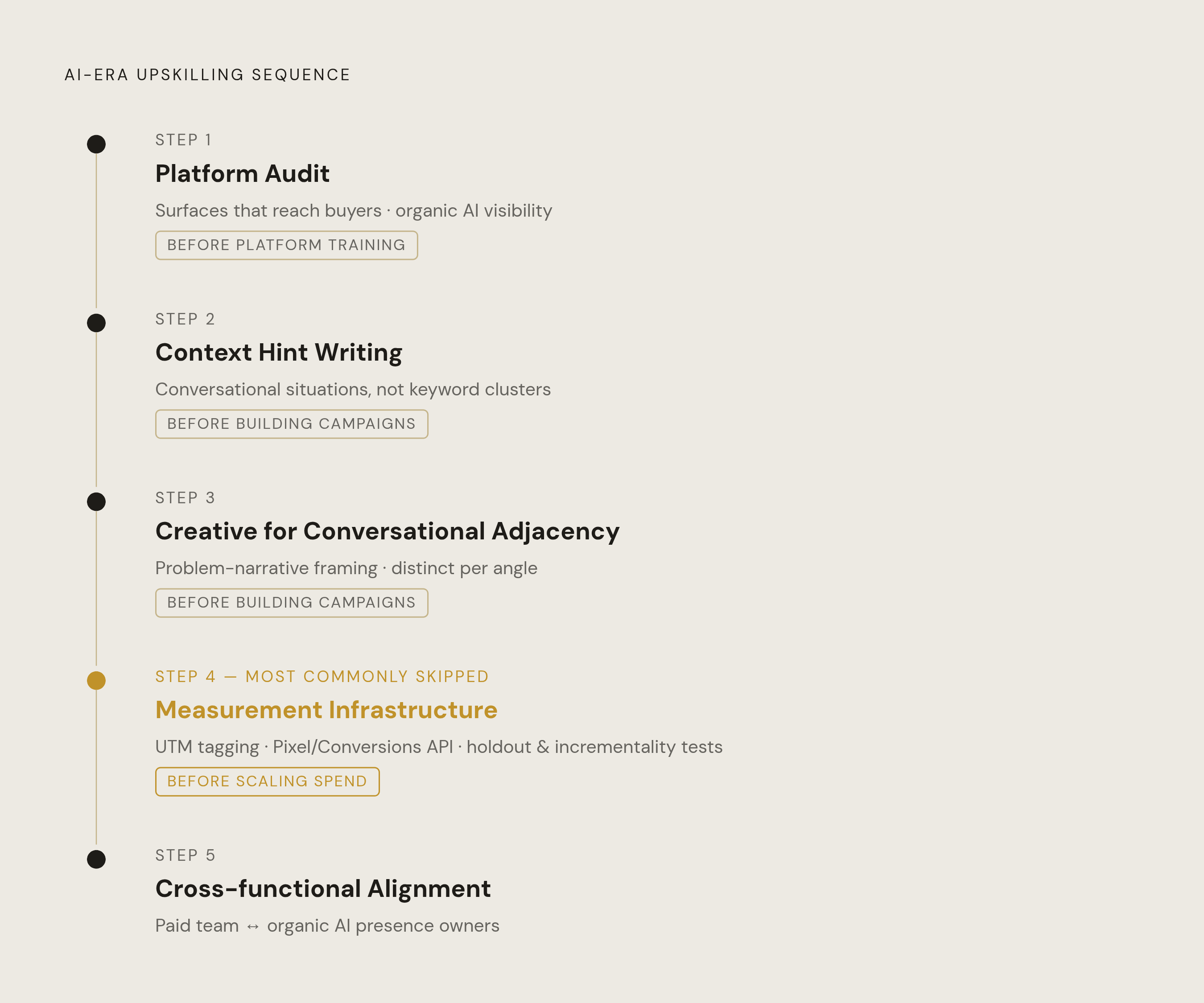
An upskilling program that works starts with the audit, not with platform training, and sequences the skill-building in the order the channel's mechanics demand. Step one is a platform audit before platform training. Establish which surfaces reach the team's target buyers, because the B2B tier constraint on ChatGPT means platform choice precedes targeting craft. And establish the brand's organic AI visibility before building paid campaigns.
Step two is context hint writing as a distinct skill. This is the highest-leverage new skill to develop. Train the team to describe conversational situations and problem narratives rather than keyword clusters. Build a library of hints organized by conversational situation rather than by product line.
Step three is creative written for conversational adjacency. Retrain copy habits away from query-match headlines toward problem-narrative framing. Write distinct creative per conversational angle, not per keyword variant. Build landing pages that continue the conversation rather than resetting to a product page. Step four is measurement infrastructure before scaling spend. Implement creative-level UTM tagging, Pixel and Conversions API where available, and holdout or incrementality tests before evaluating channel performance. OpenAI's Ads Manager now supports Pixel, Conversions API, and incrementality experiments through named measurement partners as of October 2026. These tools exist and should be activated from the first campaign. Set expectations internally that volume metrics will be lower than search benchmarks, and that conversion quality, not click volume, is the right early signal.
Step five is cross-functional alignment. Establish a working relationship with whoever manages organic AI presence, because the paid team needs visibility into whether the brand is cited in AI answers for the categories they are buying against. This is a program design requirement, not an individual skill, and the upskilling program should name it explicitly and assign ownership. For independent agencies and programmatic teams, this structured approach is itself a service offering: a channel audit and upskilling framework that clients cannot get from generalist DSPs without conversational context capabilities, or from single-surface AI ad networks without cross-surface reach.