New Roles Marketing Teams Need for AI Channel Operations
Marketing teams need specialized AI roles to target conversational intent effectively.

Advertising inside AI conversations runs on mechanics that have no real precedent in search or social, and that mismatch is the reason most marketing teams are not set up to run the channel well. In search, the thing being targeted is a keyword, a string someone typed into a box. In conversational AI advertising, the thing being targeted is live intent inside an ongoing, multi-turn dialogue: what a person is actually trying to get done, what they asked three exchanges earlier, and where the conversation seems to be heading next. A user might never type "project management software" into ChatGPT, yet a long back-and-forth about team coordination, deadline tracking, and remote collaboration can generate exactly the kind of high-intent signal that a keyword match would miss. Placement in this environment comes from a relevance-weighted auction that reads four inputs: the context hint, the ad title, the ad copy, and the landing page. There is no keyword match type sitting underneath it. The context hint, a short, plain-language description of the conversations, topics, or problems where an ad belongs, becomes the highest-leverage piece of creative work in the entire channel. That's a feature specific to ChatGPT (OpenAI) Ads, and writing one well is a different craft entirely from picking a keyword or building an audience segment. Attribution compounds the difficulty: a user may ask several follow-up questions, close the session, and convert days later, and a conversation gap of that kind breaks last-click models that search and social teams have relied on for years. None of this is theoretical. Microsoft Copilot's session-context targeting already works meaningfully better than traditional search placements for click-through and conversion, and ChatGPT crossed 1 billion weekly users before it opened self-serve advertising in May 2026. The channel is live, it is growing fast, and the people running it need a different set of operational skills than the people running search and social campaigns today.
Existing Marketing Roles Were Not Designed for These Mechanics
The gap here is a functional transition, because the core decision-making unit in this channel, conversational intent, has no equivalent in search, social, or programmatic display. Writing a context hint is not a variant of writing ad copy, and it is not the same skill as choosing a keyword match type. It requires reasoning about what someone is trying to accomplish in the moment and whether a given offer is genuinely useful to that goal. Teams that treat context hints as comma-separated lists of topics consistently get weak matching, because the actual craft is describing a problem narrative and a moment of relevance, not assembling a category label. Most marketing organizations also lack the measurement infrastructure the channel demands: clear conversion event definitions, attribution logic built to account for the conversation gap, and data warehouse hygiene precise enough to tell a multi-turn assisted conversion apart from a direct one. Faced with this gap, many organizations reach for a familiar fix: stand up a separate AI department, or a siloed centre of excellence, and let it run the channel apart from the rest of marketing. That response is wrong, because it pulls AI channel operations away from the function that owns strategy, budget, and accountability for results. The better model folds new AI-specific roles into the existing marketing team. AI is replacing team structures in this transition, because AI automates execution, not strategy, judgment, or accountability, and the team left standing needs sharper, more specialized skills rather than fewer people stretched across broader remits. These are identifiable, fillable gaps, and the roles that fill them follow a clear order.
The AI Configuration and Prompt Engineering Lead: the role that owns how the channel is targeted
The single most consequential hire for running this channel is a specialist who owns context hint strategy, builds and maintains the team's prompt libraries, and governs the configuration of every AI tool the team touches. No traditional paid media team has an equivalent position, because no traditional channel asks anyone to describe conversations in natural language so an auction can interpret them. The job centers on building and maintaining context hints, the freeform descriptions that tell the auction which conversations an ad belongs in, and it also covers brand voice configurations and AI tool integrations across the full channel stack. It is not a developer role and does not require writing machine learning code. It calls for deep marketing knowledge paired with real fluency in how AI systems interpret natural-language instructions, which is a different combination of skills than either marketing or engineering alone usually produces. Many teams will find it faster to upskill an existing content lead or marketing operations staffer into this role than to hire externally, because the marketing judgment behind a good context hint takes longer to build than AI tool fluency does. UK salary benchmarks for 2026 already put this role at a clear premium over non-AI equivalents, a sign of how scarce the combined skill set still is. The obvious objection is that a generalist paid media manager can pick up context hint writing on the job, the way they picked up a new ad platform in the past. In practice, teams that try this underperform, because writing for conversational intent asks for a different kind of thinking than writing for keyword match, and the learning curve costs real budget while it runs. This role is not a luxury addition. This role is what makes the channel's core targeting mechanic work.
The Campaign Orchestrator: the role that manages AI-driven execution without losing strategic control
Once context hints are in place and campaigns are live, a second function becomes necessary almost immediately: someone has to watch what the AI systems are doing with the budget and the targeting, and step in when automated optimization starts drifting away from what the business actually needs. Picture the start of a working day built around reviewing overnight AI optimizations across search campaigns, email sequences, and social content, then deciding which of those automated moves to keep, which to reverse, and which pattern deserves a new workflow built around it. That is the job of the Campaign Orchestrator, sometimes called an AI Workflow Architect. The role reviews AI-generated optimizations, picks out patterns the system has surfaced on its own, and launches new automated workflows in response to signals that emerge mid-campaign. None of this replaces strategic judgment. It translates that judgment into terms an AI system can act on, which is a genuinely different task from running a single platform's campaign dashboard. Left unsupervised, an optimization system will chase whatever metric it has been given rather than the outcome the business actually wants: a campaign that maximizes clicks inside a conversation can still underperform on real purchase intent if the attribution logic behind it is flawed. That is precisely the failure mode this role exists to catch. What separates the Campaign Orchestrator from a traditional paid media manager is scope: the job spans AI-native workflows across tools and channels, not one platform's interface, and it demands enough working knowledge of how these systems behave to tell a genuine optimization apart from a drift pattern that looks like one.
The AI Auditor: the role that catches when AI output goes wrong before it reaches the market
AI systems now produce marketing output faster than any single senior marketer can review all of it, and that volume creates a specific need: a function whose entire job is validating that output, across creative, platform data, and attribution logic, before a mistake reaches a client, an executive, or the market. AI Auditors watch AI agent outputs for drift, check attribution logic for accuracy, and flag anomalies before they land in an executive dashboard or an external report. In conversational AI advertising specifically, the role also checks that AI-generated ad creative and context hints are factually correct and brand-safe, which matters more here than in most channels because the ad sits inside a generated response and cannot afford to contradict or undercut the content surrounding it. This does not need to be a senior hire. What the role actually requires is current platform depth, someone recently enough immersed in the tools to spot when an AI system has produced something that reads as plausible but is in fact wrong. That requirement makes the AI Auditor one of the clearer entry points for people moving into AI-native marketing roles for the first time, rather than a position reserved for a decade of strategic experience. The accountability case for this role is structural as well as operational: advertisers in conversational AI environments receive only aggregated, non-identifying performance data and cannot inspect individual conversations, so the auditor has to work from output signals and anomaly patterns. Advertisers have no access to individual chats, chat history, or memories in ChatGPT's current model. Brand safety validation has to happen at the creative and configuration stage, before a campaign ever goes live.
The Memory Curator and Data Infrastructure Owner: the role that determines what the AI channel knows
Every AI advertising system is only as good as the data running through it, and someone on the team has to own the accuracy of that data: conversion event definitions, tracking implementation, attribution logic, and the general hygiene of the data warehouse feeding every measurement decision. The Memory Curator keeps AI systems supplied with current, accurate context for the work in front of them, maintaining the ground truth for what counts as a valid conversion, what discrepancy thresholds are acceptable, and what attribution logic actually applies in a channel where last-click measurement badly undercounts real performance. In conversational AI advertising specifically, this means building measurement infrastructure that can handle the conversation gap directly: a user who converts after several follow-up questions and a break between sessions still needs to be credited correctly, or the channel will look weaker than it is and get starved of budget it has actually earned. Much of this builds on a function that already exists inside most marketing operations teams, but the conversational AI channel adds real complexity on top of it. Attribution modeling for this channel is still being built out industry-wide, and a team that pretends the measurement problem is already solved will make budget decisions that are systematically wrong. Owning that uncertainty honestly, rather than papering over it with a borrowed last-click model, is most of the job.
The Compliance Liaison and Brand Gatekeeper: the roles that prevent AI scale from becoming a liability
Running AI advertising at scale without dedicated governance and brand oversight creates two separate risks at once: legal and data-protection exposure from how the AI systems handle inputs, and brand damage from AI-generated content that sounds right but is inconsistent or factually off. Two functions address these risks, and depending on team size, they can be one person or two. The Compliance Liaison function sits with Data Governance Leads, who enforce compliance, manage access permissions, and make sure AI systems are not creating privacy or security exposure the team didn't intend. That role connects marketing to legal and data protection, so not every marketer on the team has to become a privacy specialist. In conversational AI advertising, the job also means staying current on platform-level policy: what content is restricted, how advertiser data gets handled, and what disclosures are required, because these policies are changing quickly and falling out of compliance carries consequences at the platform level. The Brand Gatekeeper function covers the other risk: content that reads as fine on the surface but drifts from brand voice or gets a fact wrong. If roughly five content professionals are actively using AI tools, you need one senior editorial voice to validate that output for brand consistency and accuracy. That gatekeeper is usually the most senior writing voice already on the team, moved into a governing role. Smaller teams don't need four separate people to cover compliance and brand oversight. They need both mandates assigned to someone, even if it's the same person wearing two hats.
Fitting These Roles into an Existing Team Structure
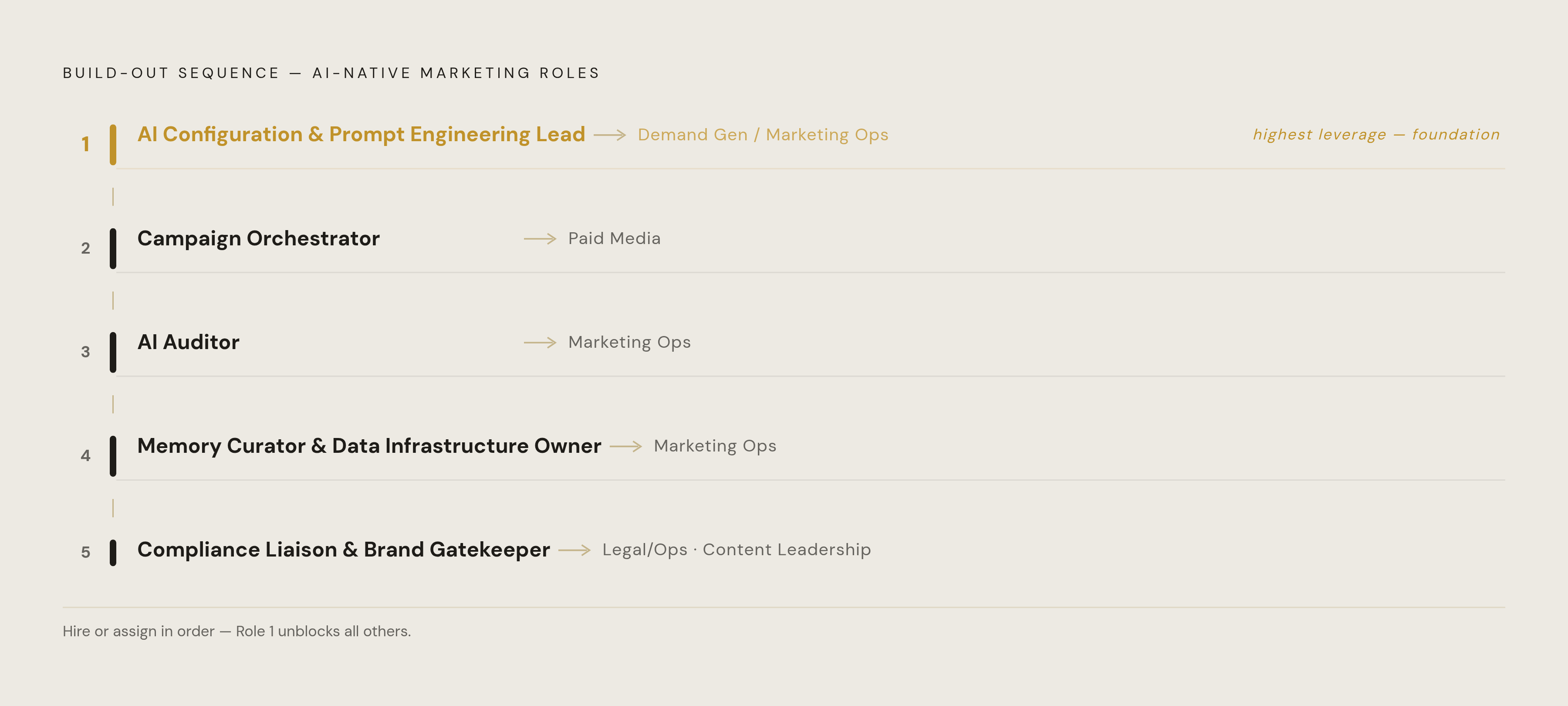
None of these five functions calls for a new department. The right model distributes them across the marketing team that already exists, demand generation, marketing operations, content, and brand, rather than building a parallel AI structure that sits apart from the function accountable for strategy and budget. The structural principle is simple: no separate AI department, no siloed AI Centre of Excellence. Each new role maps onto an existing area and reports through the leadership lines already in place. The AI Configuration Lead belongs inside demand generation or marketing operations, not inside a standalone technology function. The Campaign Orchestrator extends the paid media function already running it. The Auditor and the Memory Curator both report through marketing operations. The Brand Gatekeeper extends content leadership, and the Compliance Liaison extends legal and operations. Team size changes how these mandates get distributed, not whether they need to exist. Smaller teams, under roughly eight marketers, will combine several of these mandates into one or two people, but the responsibilities still need an explicit owner even when headcount is shared across them. You can also track the appearance of genuinely new entry-level roles built around AI workflow support, performance auditing, and governance coordination, junior positions that didn't exist a few years ago and that now feed a pipeline into the more senior AI-native functions as the channel matures. For a team building this out from nothing, the sequence that follows the leverage: start with the AI Configuration Lead, since targeting is the mechanic everything else depends on. As campaign volume grows past what a single person can review by hand, add the Campaign Orchestrator and the Auditor. Formalize the Memory Curator and the compliance and brand functions once the channel represents a real share of the budget, not a pilot. That order mirrors where the risk actually sits at each stage, and it keeps the team's own strategy and accountability intact the entire way through.