ROI Measurement Frameworks for Conversational AI Ad Campaigns
Track conversational AI ad value through post-session revenue instead of inherited click metrics.

Conversion pixels, UTM strings, and last-click attribution were built for a world where the customer journey shows up as a trail of clicks between pages. Conversational AI breaks that assumption at the root, because discovery, evaluation, and decision can all happen inside a single chat session that never touches a tracked URL. Research suggests only a small minority of companies have measured their AI investment's business impact in any meaningful way, and that gap traces back to method, not motivation. Marketers know they need to measure this. They just inherited a toolkit that doesn't fit the shape of the thing it's measuring.
Three specific breakdowns explain why. Pixels don't fire inside a closed chat session, because there's no page load event to hang them on. UTM parameters require a click to a tagged URL, so a recommendation a user acts on hours later, through a different app or a plain search, arrives with no tag attached. And last-click attribution hands full credit to whatever touchpoint happened last, which in a conversational flow is almost never the AI conversation that actually did the persuading. The conversation did the work. The spreadsheet gives the credit to something else.
What a conversational AI ad impression is, and why the click was never the right unit to track
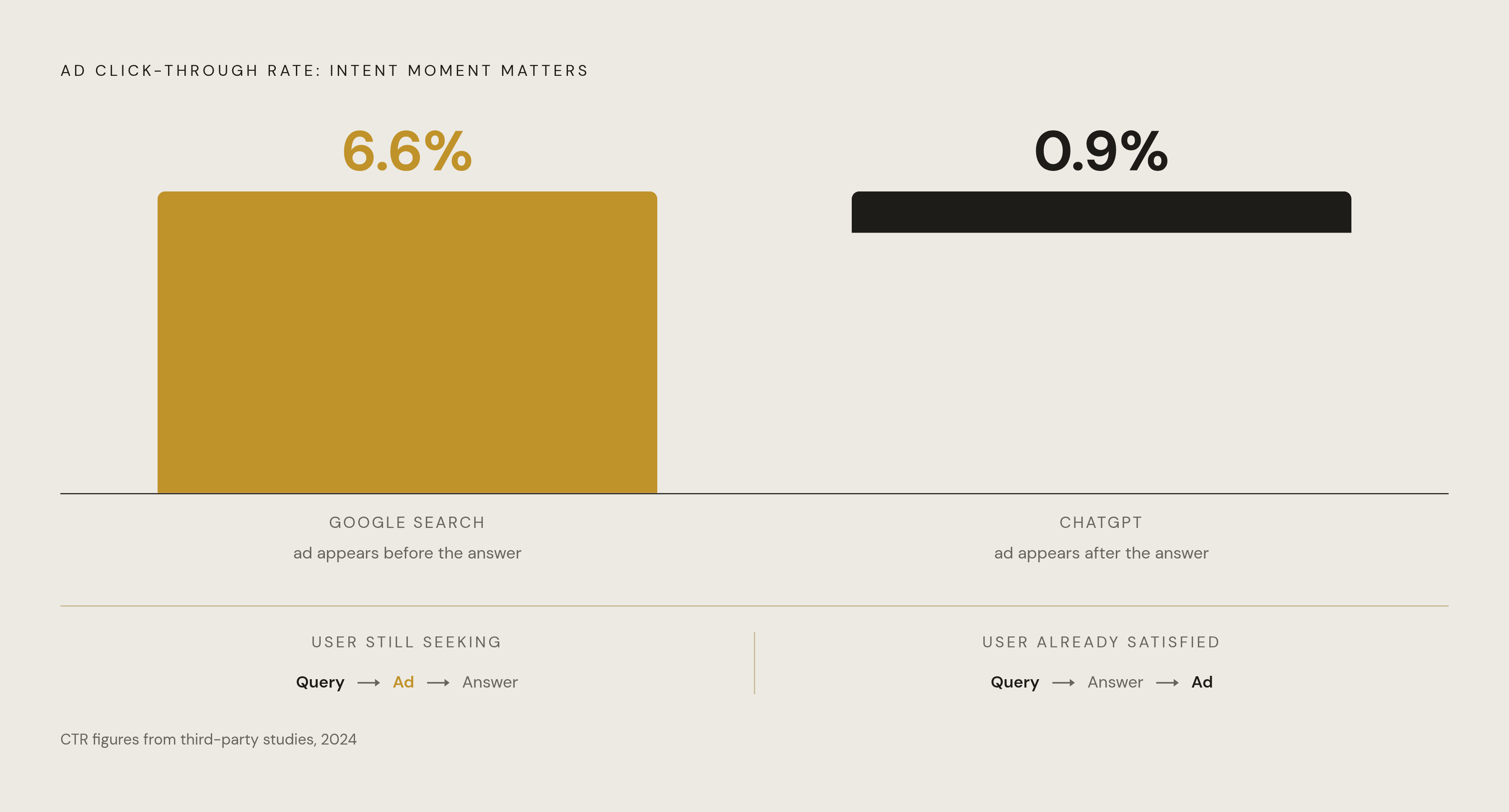
As of its February 2026 launch, ChatGPT's ad format showed a single labeled sponsored box beneath a complete answer. The core structure holds: the answer comes first, and the ad follows.
That sequencing changes what a click even means. By the time a sponsored unit appears, the user has typically already received a full recommendation from the model. Anyone who clicks past that point isn't hunting for information they lack, they're someone who read the answer and decided they wanted to go further anyway. That's a meaningfully different intent signal than a click on a search ad, where the user hasn't gotten an answer yet and is actively scanning for one.
This explains, without indicting the format, why ChatGPT ad click-through rates are around 0.9% against roughly 6.6% for Google search ads. Stacking those two numbers side by side and calling one a failure misreads the mechanics. A search ad occupies space the user has to scroll past on the way to an answer. A chat ad appears only after the answer has already landed. Comparing raw CTR across the two is like comparing a doorbell to a phone call that's already been answered.
The metrics that do hold up in conversational environments
The metrics worth keeping are the ones that don't depend on a click chain surviving intact. They're organized around what kind of signal they actually capture, not around whatever legacy label they used to carry.
Post-session conversion tracking is the most portable of the old signals, and it still works: a user leaves the chat and converts on the brand's own site within a defined window. The window itself needs rethinking. Search behavior tends to compress the gap between click and action; a user who's just absorbed a detailed, conversational recommendation may sit on it for hours before acting. The attribution window has to reflect deliberation time, not click latency, or it will systematically undercount everything that isn't impulsive.
Revenue-per-session and revenue-per-matched-conversation give a cleaner read on value than conversion rate alone. A 12-month analysis of 973 e-commerce websites (arXiv:2605.18673) found that organic ChatGPT referrals produce conversion rates and revenue per session that beat paid social, though they still trail other established channels. That's a useful benchmark: conversational referral traffic isn't yet the top of the channel stack, but it's already outperforming a channel most marketers treat as core spend.
Recommendation-rate and inclusion-rate signals track something further upstream: whether a brand gets surfaced, shortlisted, or actually selected inside conversations that match its category. Where platforms expose impression and response data, this becomes trackable, and it may end up being the metric that matters most, since it captures influence before a user ever reaches a purchase decision.
Attribution approaches worth testing
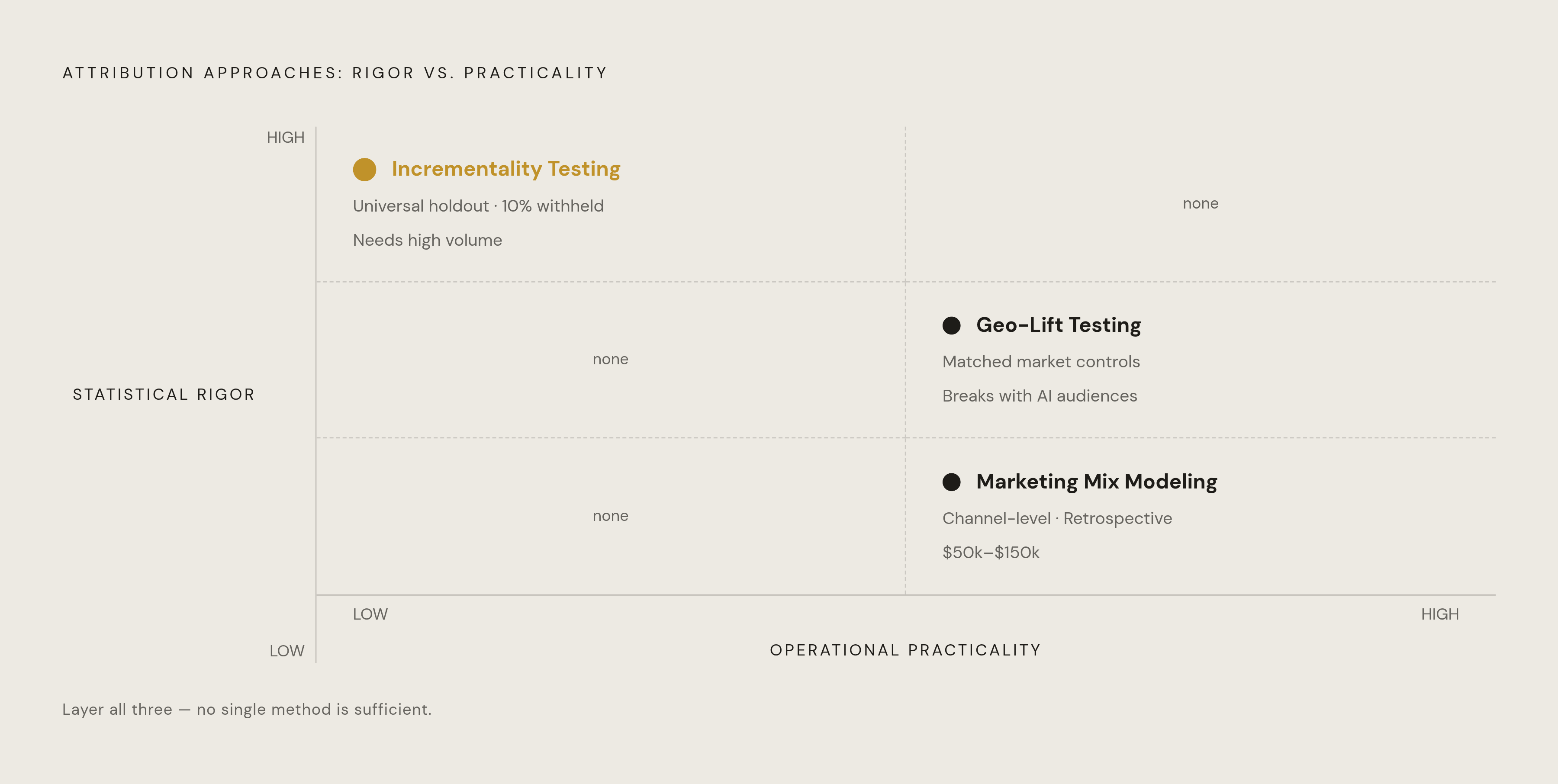
No single method delivers a complete picture here, and treating this as a triangulation problem, rather than a search for one correct number, is the realistic 2026 approach. Layering multiple sources and looking for where they agree tends to reveal a more realistic picture.
Incrementality testing with a universal holdout group is the most statistically defensible of the three. The method: hold back roughly 10% of the addressable audience so they never see AI ads at all, then compare their lifetime value against the exposed group over time. The gap between the two is attributable lift that can be traced to the holdout comparison, not modeled or inferred. Everything else on this list involves more estimation than this does. The limitation is practical rather than conceptual: it needs enough volume to power a statistically sound holdout, and that holdout has to stay clean across every channel a brand touches, not just the one being tested.
Marketing Mix Modeling works at the channel level and doesn't need user-level tracking to function, which makes it durable against cookie deprecation and against chat sessions that never generate a trackable event. It costs somewhere in the range of $50,000 to $150,000 to run properly, and it was reported as the top measurement investment area in 2026, with around 40% of marketers putting resources behind it. Its weakness is timing: MMM is retrospective by design. It tells a brand what happened last quarter, not what to change next week.
Geo-lift testing runs the campaign in a set of matched markets and compares results against markets held back as controls. It functions as the ground-truth layer in a triangulation stack, the number the other two get checked against. But geographic separation gets messy fast when the audience is spread nationally across AI platforms that don't respect market boundaries the way a local ad buy does.
The trust and disclosure layer: why attribution is also a transparency problem
Deployed systems today keep a visible line between sponsored content and organic answers: clearly labeled units, set apart visually from the model's own response (arXiv:2605.18673). That line determines what can be measured. A labeled ad a user clicks is attributable. It's contestable. It can be audited.
The same research names influence categories that sit on the other side of that line, where none of that holds. Product mentions folded into an otherwise organic response. Framing choices about which evidence gets emphasized. Behavioral nudges toward one action over another. Preference shaping that plays out over many sessions rather than one. None of these appear as a labeled unit, so none of them generate a clean, attributable event.
The research is blunt about what this looks like in practice: ads woven into chatbot responses often go undetected, can match or even beat ad-free outputs on perceived helpfulness, and remain vulnerable to adversarial amplification through prompt or content manipulation. That's not a hypothetical risk, it's a documented finding.
For anyone building a measurement framework, the consequence is direct. Influence that isn't disclosed can't be attributed. Influence that can't be attributed can't be measured. The visible-boundary model isn't just an ethical guardrail, it's the precondition for ROI tracking to function.
What remains genuinely unsolved
Some of this doesn't have a clean answer yet, and pretending otherwise does more damage than admitting it.
Closed-session attribution sits at the center of the mess. A user discovers a product inside a chat, weighs the options, closes the app, and buys three days later after a plain search for the brand name. No framework in current use connects those two events reliably. Incrementality testing addresses this at the population level, since the holdout group's aggregate behavior still shows the lift, but it can't trace credit back to that one individual journey, and it was never built to.
Cross-surface reach makes holdout design harder than it looks on paper. A user excluded from ChatGPT ads might still get reached by the same brand through Copilot or Google's AI Mode, which contaminates the holdout unless every AI surface is controlled at once. Current tooling doesn't support that level of coordination.
The recommendation-rate signal is sound in concept but immature in practice. Whether a brand gets "recommended," "shortlisted," or merely "mentioned" is a real and useful performance event, but it isn't yet a standardized metric with a consistent definition across platforms. Two brands running the same campaign on two different surfaces may be counting entirely different things and calling them the same name.
None of this is unique to advertising. Enterprise AI investment reached $644 billion in 2025, and yet 72% of that spending is estimated to be destroying value through waste. Fifty-six percent of chief executives say they've gotten essentially nothing out of their AI investments. Measurement failure is a defensible explanation for that gap given the evidence, and the advertising use case is where the failure is most visible, because it's where the dollars are counted line by line.
Building a practical measurement stack for a conversational AI campaign in 2026
Before launch, success needs to be defined in terms the channel can actually deliver, not terms borrowed from search. Set a marketing efficiency ratio (MER) as the top-line number everyone gets held to. Define the post-session conversion window with deliberation time built in, longer than a search campaign would use, shorter than what a pure brand campaign might tolerate. Then pick the primary performance events by business type: post-session conversion and revenue-per-session for e-commerce, recommend-rate and return-visit rate for considered purchases, cost-per-qualified-lead measured against the holdout for lead generation.
The holdout itself has to exist before the campaign goes live, not get bolted on afterward as an afterthought. A universal holdout group needs to stay excluded from every AI ad surface the brand touches, not just the primary platform being measured, or the comparison collapses the moment a user gets reached somewhere else. Document the design in enough detail that another team could audit it and reproduce the comparison independently. A holdout nobody can explain after the fact isn't evidence; it's a number with no paper trail behind it.