Media Mix Modeling Without Historical AI Channel Data
Synthetic priors and proxy variables let brands model AI channels without years of spend history.

Media mix modeling runs on one hard rule: no channel gets a stable coefficient without roughly 24 months of spend history behind it. AI advertising can't meet that bar anywhere, because meaningful inventory in the channel has existed for under two years in most markets. That gap does not close with patience, and the practitioners still waiting for "enough data" before they touch it are making the wrong call. Closing it takes synthetic priors, proxy variables, and incrementality tests working together, deployed now, not a calendar filled in later.
Per Presenc AI's 2026 research, 77% of brands running MMM are stuck in exactly this position, with only 23% having introduced AI search as its own channel variable. Presenc AI calls this "the single largest measurement debt in marketing as of mid-2026." Treat that as an accounting term, not a slogan: the debt accrues every quarter a brand can't trace where its AI-driven demand actually came from, and it compounds against the brands doing nothing about it while the channel scales underneath them.
What "no historical data" actually means inside an MMM, and what it does not mean
MMM works by regressing outcomes, sales, revenue, conversions, against spend and a set of external variables: seasonality, pricing, macro factors, using regression techniques. For any channel to produce a usable coefficient, its spend needs to move around over time. Flat spend, or spend that sits near zero for most of the window, gives the regression nothing to grab onto. The coefficient comes out noisy, or it drops out of the model entirely.
That is a different claim from "the channel doesn't work," and the two get confused constantly, usually by whoever is running the budget meeting. A missing or near-zero AI coefficient means the model can't separate the channel's effect from the baseline intercept or from other correlated channels. It does not mean the effect is zero. A finance team looks at a model output, sees nothing attributed to AI search, and reads that as proof the channel isn't pulling weight. That reading is wrong, full stop. The model is blind to the channel, and blindness isn't the same as absence, no matter how convenient the confusion is when someone's trying to cut a budget line.
Two separate problems sit underneath that blindness, and each needs its own fix. The prior problem: what should a modeler assume about the channel's likely contribution before real data can confirm anything? The proxy problem: what observable signal can stand in as an exposure variable while spend history is still thin? These call for different tools entirely, and conflating them is exactly how teams end up with a coefficient nobody trusts, including the person who built it.
Building synthetic priors when the channel has no spend history
Bayesian MMM exists for exactly this situation. A standard frequentist regression needs the data to speak for itself. A Bayesian model lets a practitioner encode a belief about a channel's likely effect before the data confirms anything, then update that belief as evidence arrives. The prior is a disciplined, defensible starting point expressed in mathematical form, built to move once real numbers show up, not a permanent stand-in for measurement.
Two approaches build that prior, and they are not interchangeable. The first borrows from analogy: take the coefficient distribution from a channel that was structurally similar when it was new, early paid social, or native display in its first couple of years, and use that as the prior for the AI channel. The second generates data synthetically, using Gaussian processes or bootstrapping to simulate plausible spend-and-outcome series. Some teams have started calling this a "privacy-friendly crystal ball," simulating performance in markets or channels where no real sales history exists yet.
The mechanics matter more than the label. In open-source tools like PyMC-Marketing or LightweightMMM, the prior on the AI channel's beta coefficient gets specified as a weakly informative distribution, a Half-Normal or log-Normal, centered on whatever the analogous-channel estimate suggests. Width matters more than people expect: the prior needs enough spread that real data can overrule it quickly once spend history accumulates. A prior that's too tight anchors the model to an assumption instead of letting it learn, which defeats the entire point of running Bayesian in the first place. Adstock and saturation parameters, the carry-over rate, the shape of the hill function, deserve the same treatment as priors rather than fixed point estimates, since AI channels likely saturate differently than search does.
Arimadata's published guidance frames synthetic data as making MMM "more actionable," letting modelers simulate performance before real history exists rather than defaulting to nothing. That's a description of sound method, not vendor talk: synthetic priors don't manufacture new information, and nobody claims they do. They stop the model from ignoring a channel entirely while spend is thin. Every coefficient built this way needs a provisional label until real spend variance shows up.
Cadence changes the outcome more than most teams expect. Presenc AI's 2026 research found that brands running weekly Bayesian updates paired with quarterly major refits, 37% of MMM-running brands fall into this group, are more than twice as likely to have already built in the AI search variable: 38% versus 14% for brands on an annual refresh cycle. Faster loops mean the prior gets tested against reality more often, which is the whole reason to use a prior instead of a guess.
Using analogous channels as proxies for the AI ad variable
When AI spend itself is too thin to regress against, a correlated proxy can stand in as the exposure variable until real spend data deepens. Not every proxy that looks plausible on paper actually resembles what AI advertising does to a buyer's decision, though, and picking the wrong one just launders bad assumptions into cleaner-looking numbers.
Paid search is the closest structural analogue, and most teams reach for it first, but that instinct undersells where AI chat actually operates. Funnel position matters more than most people assume: a lot of AI chat exposure happens at category exploration, before a user has settled on brand names to search for, so channels that operate earlier in the consideration journey may better reflect where AI chat exposure actually occurs. Structural similarity to the AI channel's role in the purchase journey is what makes a proxy workable.
Search-based proxies carry a flaw they can't get around. AI chat surfaces intent with far more precision than a keyword ever could. Per eMarketer research, a user's consideration set inside a chat conversation runs around 1.96 brands, against the much wider field competing for attention on a search results page. Any proxy borrowed from search will understate how concentrated, and how consequential, AI's influence becomes once it operates at scale. That flaw does not need fixing. It's a limitation to disclose every time the number gets used.
A second kind of proxy sidesteps spend entirely: AI visibility metrics, specifically how often a brand gets cited in responses from ChatGPT, Claude, or Perplexity. Citation frequency moves week to week even without a media budget attached, which gives a model something to regress against without years of paid history behind it. Vendors including Presenc AI have started positioning this visibility data as an input layer compatible with Robyn, LightweightMMM, PyMC-Marketing, Recast, Northbeam, and Aryma. It's an imperfect proxy, since citation frequency blends paid and unpaid sources of brand presence, making it an imperfect stand-in for a pure spend variable. Still, it captures more of the channel's demand-intercept effect than treating the variable as zero, which is the actual alternative on the table.
Handle the proxy carefully in the model spec. Introduce it as its own variable sitting alongside the spend variable, not as a replacement for it, and flag the resulting coefficient as a composite blending earned and paid effects until it can be decomposed later. The point of laying it out here is to make it repeatable for the 77% of brands that haven't yet introduced AI search as a discrete variable.
Incrementality experiments as the ground-truth anchor for models built on thin data
Priors and proxies are useful, and they're both still assumptions dressed up as inputs. Incrementality experiments carry more weight, not less, when a model runs on synthetic data, because an experiment produces an observed lift number that doesn't depend on historical spend variance at all. Nothing else in this sequence substitutes for it, and treating priors or proxies as good enough on their own is where the whole approach quietly breaks.
A geo-lift test for a new AI channel follows a familiar design: matched markets, with test geographies receiving AI ad spend and holdout geographies receiving none. Duration is the open question. Conversational AI's adstock tail, how long its effect lingers after exposure, isn't well established yet, so practitioners typically borrow a starting assumption from a structurally similar channel and adjust once real results come in. The outcome variable needs to be revenue, not clicks or impressions, because the MMM being calibrated is trying to explain revenue, and the experiment has to speak the same currency or the calibration is worthless.
Haus ColdStart is a named example of tooling built for precisely this condition, using comparable KPIs to test incrementality for new products, markets, and channels with no historical data to lean on. It proves the infrastructure for cold-start testing already exists commercially. Nobody has to build this from scratch.
Feeding the experiment result back into the MMM is where the real calibration happens. The geo-lift estimate can function as an informative prior, or, in Bayesian tools like PyMC-Marketing, as an informative constraint that anchors model solutions closer to the experimentally observed lift. Some practitioners call this "experiment-calibrated MMM." It isn't a new methodology so much as a discipline, one that matters far more when the starting priors are synthetic rather than historical.
Sequence matters here: run at least one geo experiment before the first major model refit that includes the AI channel, then plan a follow-up experiment to check whether the coefficient has settled as real spend history builds. Geo experiments for AI channels are also harder to isolate cleanly than they are for TV or out-of-home, since AI interfaces aren't geographically bounded the way a broadcast market is. Targeting by DMA approximates containment, but AI interfaces are not geographically bounded the way broadcast markets are, which complicates clean isolation.
How to sequence these three techniques as data accumulates over the first 12 months
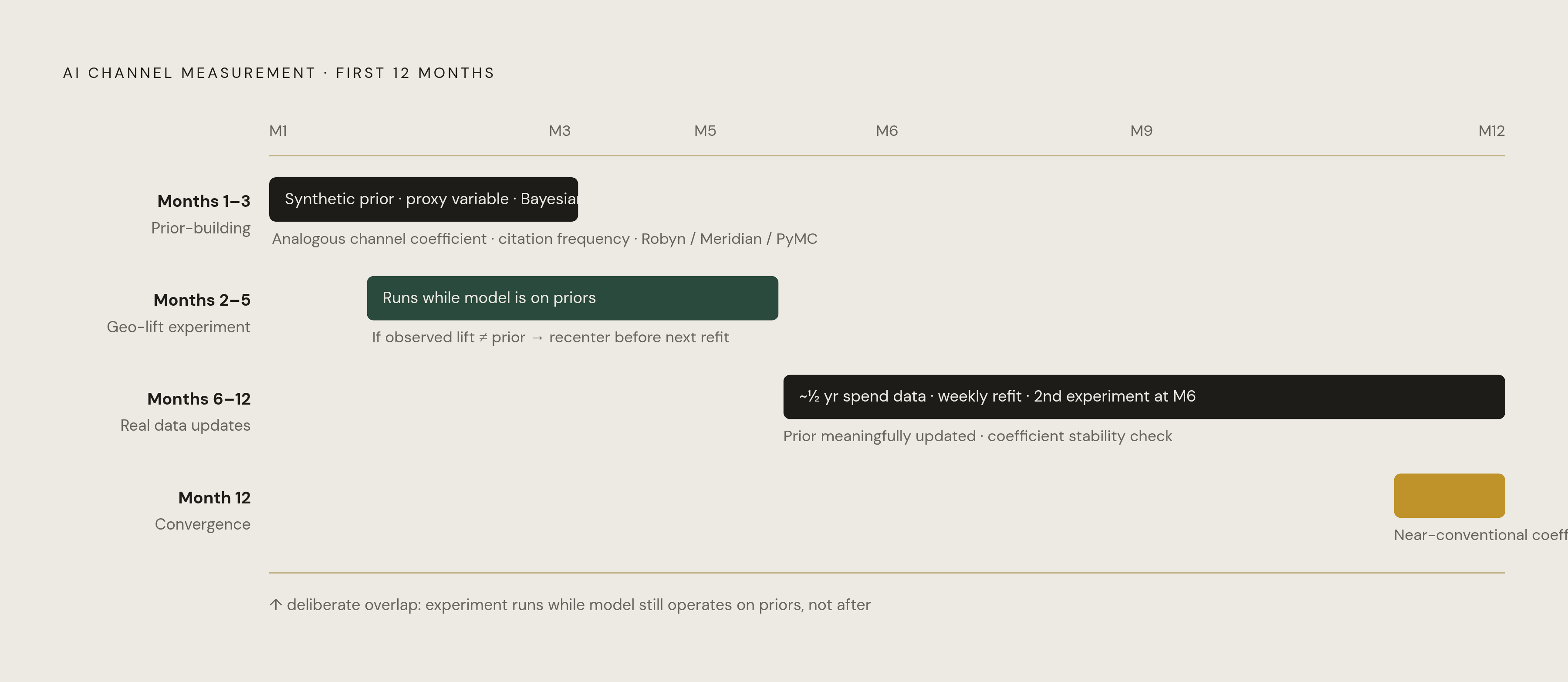
None of this works as a menu to pick from, and treating it that way is the most common mistake in the whole exercise. Synthetic priors, proxy variables, and incrementality tests are stages in one sequence, each feeding the next, and skipping a stage just means recalibrating later under worse conditions.
Months one through three are about setup. Pull the closest analogous channel's coefficient distribution and use it as the starting prior for the AI variable. Bring in AI visibility metrics, brand citation frequency, as the proxy exposure variable running alongside it. Build the model on Bayesian tooling, Meta Robyn, Google Meridian, or PyMC-Marketing, all of which support modern sampling infrastructure that makes weekly refreshes realistic instead of aspirational.
Months two through five overlap deliberately with phase one: run the first geo-lift experiment while the model still operates on priors, not after. The experiment and the model run in parallel, on purpose. When the observed lift comes back materially different from the analogous-channel prior, that's the signal to recenter the prior before the next major refit, not to wait for a cleaner moment that isn't coming.
By months six through twelve, real spend data starts accumulating, roughly half a year's worth by month six. That's not enough to support a standalone model, but it's enough to meaningfully update a Bayesian prior. Update cadence should tighten to weekly here. The 37% of brands already running weekly Bayesian updates paired with quarterly major refits are the ones positioned to catch the prior-to-posterior transition as it happens, not after the fact. Run a second experiment at month six to check whether the coefficient has stabilized. By month twelve, spend should carry enough variance to support something closer to a conventional coefficient, at which point the proxy variable gets demoted from primary regressor to a robustness check running quietly in the background.
What gets told to stakeholders during those first six months matters as much as the modeling itself. Present coefficient ranges, not point estimates, and state that the range is expected to narrow as real data arrives. Anything more confident than that overstates what the model can support right now, and overconfidence here is how measurement debt turns into a bad budget decision.
What the AI channel's scale trajectory means for how urgently this matters
Standalone chatbot ad spending is projected to grow more than 1,600% year over year, reaching $0.96 billion in 2026, according to Beet TV. A channel growing at that rate clears the "thin data" threshold fast, but only for brands that started measuring it early. Everyone else inherits the same 24-month blind spot at the exact moment the channel has already scaled past it, which is close to the worst possible timing a measurement gap can have.
That's the compounding problem hiding inside this whole discussion. A channel invisible to an MMM for its first two years gets systematically underfunded at precisely the point its reach expands fastest. The measurement debt and the opportunity cost aren't separate line items. They grow together, and every quarter of delay widens both at once.
The consideration-set numbers sharpen the stakes further. Over 20% of users now start their pre-purchase research inside AI chat, and once they're there, the consideration set narrows to roughly 1.96 brands. A brand absent from that layer gets excluded from consideration before a search results page ever loads. Travel feels this hardest: queries in the category begin inside an LLM for 37% of users, per eMarketer, which means travel brands sitting outside the AI measurement layer are losing consideration-set placement in a category where that placement decides the outcome before a click happens.
U.S. AI-driven search advertising sat at $1.1 billion in 2025, and forecasts put it at $26 billion by 2029, a roughly 23-fold jump. The window for building measurement infrastructure while the channel is still young is measured in quarters, not years. A Bayesian MMM running on synthetic priors, calibrated against geo experiments, is not a stopgap to be replaced once "real" data shows up later. It's structurally sound measurement from day one, the kind that sharpens as data accumulates but works while it's still rough, which is the only condition that matters when a channel is compounding this fast.
The tooling and data layer decisions practitioners need to make before running the first model
The choice between open-source and commercial platforms shapes everything downstream, and treating it as a minor implementation detail is a mistake. Meta Robyn, built in R with a Python beta port, and Google Meridian, built in Python, are the two most accessible open-source options. Meridian carries a specific advantage here: it's available globally with direct access to Google Query Volume data and YouTube reach-and-frequency figures, both genuinely useful for constructing AI-adjacent channel variables instead of approximating them from outside sources.
PyMC-Marketing offers the most flexibility for specifying custom priors, which matters directly for the synthetic-prior approach described earlier, since a modeler needs fine control over distribution shape and width to keep the prior honest about its own uncertainty. On the commercial side, Recast has published detailed thinking on MCMC-based modeling at scale. Co-founder Michael Kaminsky has written about the shift from models with a few hundred parameters to ones running into the tens of thousands, a shift modern MCMC sampling makes computationally realistic in a way it wasn't a few years ago.
None of these tools close the underlying measurement debt by themselves, and buying one is not the fix. They're the layer that makes the sequence in this piece, synthetic priors, proxy variables, experiment calibration, actually executable on a weekly cadence instead of a theoretical one. The debt Presenc AI describes doesn't resolve on its own. It closes when practitioners start running the model this year, on the data that exists this year, instead of waiting on a data set that won't exist for another eighteen months.