Social Paid Media Efficiency Decline and AI Channel Alternatives
Meta's CPAs jumped 38% year over year while engagement fell.
The economics of paid social have broken, and no amount of better targeting or sharper creative fixes it. CPMs, CPCs, and CPAs on Meta and its peers are climbing together, year over year, with no matching gain in return on ad spend. The cause isn't seasonal. User growth on the major platforms has flattened, so the pool of impressions marketers bid on is no longer expanding, and advertisers are stuck fighting each other over a fixed supply while budgets keep growing.
Meta's CPM climbed 20.1% year over year, from $11.82 to $14.19, according to get-ryze.ai's 2026 benchmarks. CPC rose 11.4%, to $0.78, and CPA jumped 38.1%, to $38.19. A 38% CPA increase in a single year means the same acquisition budget now buys meaningfully fewer customers than it did twelve months earlier, and that gap widens every budget cycle it goes unaddressed. Media buyers describe the same thing from inside the auction, with reported ROAS falling 20 to 40% over two months, according to Gupta Media. Cost and return moving in opposite directions at the same time is not a targeting problem. It's an efficiency problem, and optimization doesn't touch it, because every major surface is getting more expensive at once. Cheaper platforms exist but come with their own constraints, from regulatory uncertainty to limited reach.
What the per-industry CPA numbers reveal about which advertisers are most exposed
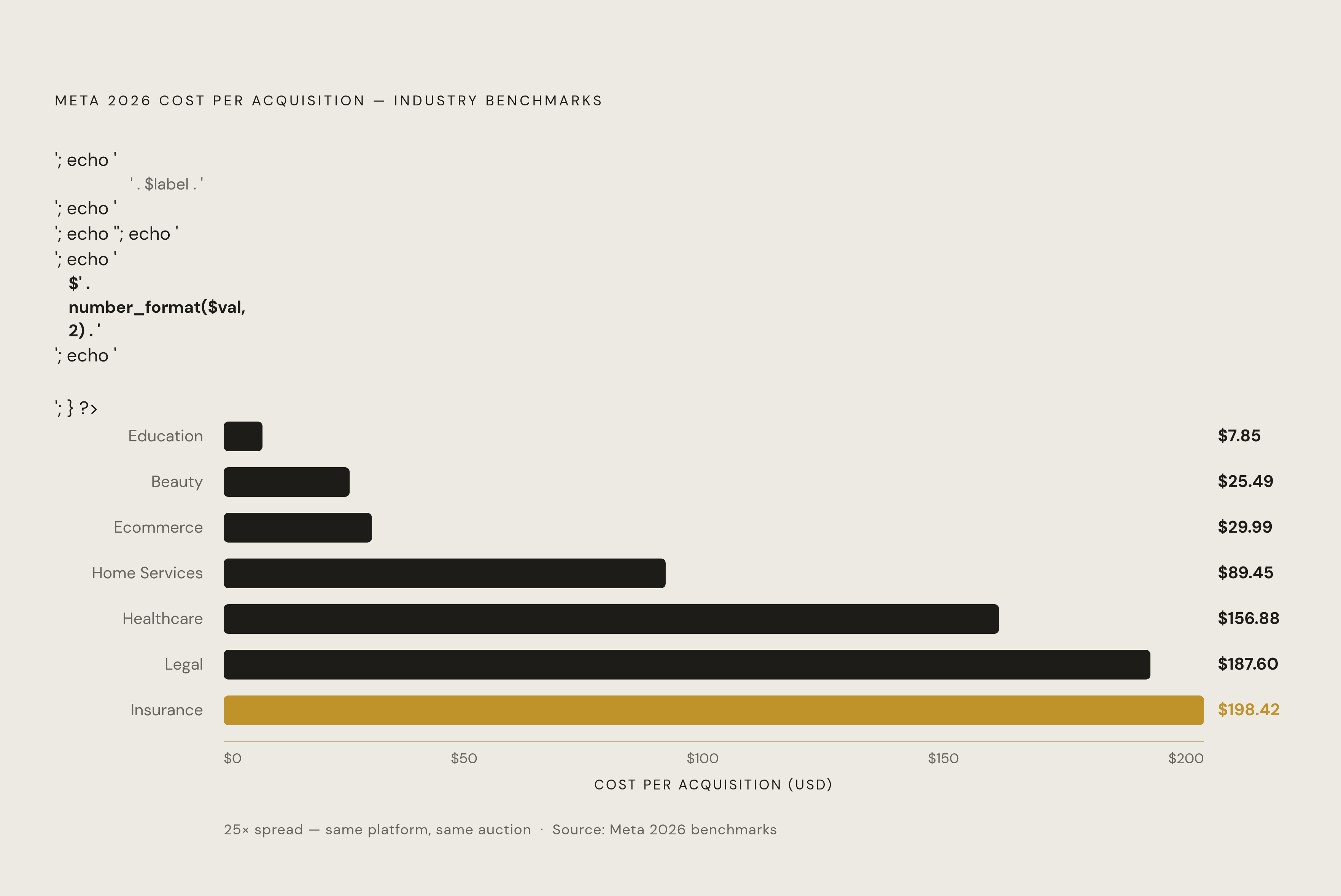
The average hides more than it shows. Meta's 2026 CPA benchmarks, per get-ryze.ai, range from $7.85 in education to $198.42 in insurance, a spread of more than 25x on the same platform, the same auction, the same targeting tools. Legal is $187.60, healthcare at $156.88, home services at $89.45. Ecommerce runs $29.99, beauty $25.49. The crisis lands unevenly across advertisers. It's concentrated almost entirely in one class of them.
CPC confirms it from another angle. Finance averages $3.77 per click, B2B and professional services typically run $2.50 or higher, apparel is $0.45, all on identical infrastructure. High-ticket, high-consideration categories, the ones where a single conversion carries thousands of dollars in lifetime value, pay the steepest tax on every click and every acquisition.
This is really about something other than vertical economics. It's a signal-quality problem, and it's the whole argument. Social platforms target who someone is: age, income bracket, homeownership status, inferred interests. They don't target what someone needs right now. A user searching for the best term life insurance for a 40-year-old with two kids is expressing intent precise enough to act on immediately. A profile that reads "male, 35 to 45, homeowner" isn't. Insurance, legal, healthcare, and finance pay the highest CPAs on the channel because demographic targeting is the weakest available proxy for the kind of intent those categories actually need to find.
How engagement collapse on Instagram and Facebook compounds the cost problem
Rising cost would be tolerable if engagement kept pace with it. It hasn't. Emplifi's Social Media Benchmarks 2026 shows Instagram engagement falling from roughly 17% in early 2024 to around 10% by late 2025. Facebook's organic engagement has held at 1 to 2%, which isn't stability so much as a floor that was already low to begin with.
Put the two trends side by side and the compounding effect is obvious: costs climb while the audience on the other end gets less likely to engage with what advertisers are paying more to reach. Platforms have pushed brands toward Reels, carousels, and live video as the workaround, but that shift carries its own price tag. Producing short-form video at the cadence the algorithm rewards means creative spend stacked on top of media spend that was already rising. Total campaign cost goes up even in a world where the media buy itself stayed flat.
TikTok looks like the exception on paper. Median engagement peaked at 35.9% in the third quarter of 2025 before easing to 27.6% by the fourth, per Emplifi, well above Instagram or Facebook. But its CPMs are projected to rise 15.6% year over year, the steepest of any major platform, and regulatory uncertainty around the app has been a persistent planning risk for anyone building a media plan more than a quarter out.
LinkedIn and Snapchat don't offer relief either. LinkedIn is close to mandatory for B2B, used by 97% of B2B marketers per the evokad guide, but its CPMs run $33 to $65, an already premium channel with reach limited to professional audiences. Snapchat's October 2025 CPM came in at $12.84, per Gupta Media, not meaningfully cheaper than Meta. There's no platform left to rotate budget into. Costs are elevated everywhere, and engagement on the two largest surfaces is shrinking at the same time.
Two compounding forces making social's efficiency problem worse: zero-click search and brand safety erosion
Search was supposed to be the intent-driven complement to social's reach. That relationship is fraying too. Nearly 60% of all Google searches ended without a click in 2024, according to DAC Group's 2025 media inflation report. U.S. search ad spend is projected to grow more than 12%, reaching $144 billion, even as impressions fall 15% year over year, per the same report. More dollars, less inventory, the identical dynamic already playing out in social, now showing up in search. AI-generated overviews sitting atop the results page answer the question directly, which removes the reader's reason to click through to an ad at all.
Brand safety is the second erosion point, and for regulated advertisers it may be the more serious one. Meta's own documents suggest that roughly 10% of 2024 ad revenue, close to $16 billion, came from scam-linked ads, with an estimated 15 billion high-risk scam ads running daily, according to the Brand Safety Institute's 2026 report. Brands have responded by pulling back from riskier adjacencies: news, political content, social generally. That migration is itself inflationary, per DAC Group's 2025 report, because it pushes up prices in the "safe zones" everyone is now fleeing toward at once.
For healthcare, finance, legal, and insurance, the categories already carrying the highest CPAs on the platform, adjacency risk is a material business threat. It's a compliance exposure. A financial product ad surfacing next to a scam post is the kind of adjacency a compliance officer has to answer for, not just a bad look. Search and social used to be each other's safety valve. Now search clicks less, social carries more reputational risk, and costs on both are peaking at the same time.
What conversational AI advertising is, and what it is not
Conversational AI advertising means paid, clearly labeled commercial messages placed inside an AI assistant or LLM interface, matched to the intent of the conversation actually happening, not to a page, a keyword, or a stored profile. The term gets used loosely enough to cover things it isn't, so the boundaries matter.
It is not conversational marketing, the practice of using chatbots to sell products, which predates large language models by years and describes a sales workflow, not an ad-placement mechanism. It is not AI-generated ad creative either; a tool that writes or designs an ad using AI is a production tool, with nothing to say about where or how that ad gets placed. And it is not simply an AI-generated summary with a search ad parked next to it. That's still search advertising wearing a new interface, still running on the same keyword auction logic that has long governed search.
The structural difference from search comes down to who's driving. On a search results page, a user scans ads and organic listings side by side and decides, on their own terms, whether to click. In a conversational interface, the platform is actively generating a response in real time, and the ad has to be placed within or alongside content the system is writing as it goes. The user came for an answer, not a results page, and the ad has to live inside that expectation.
The difference from display and social comes down to where relevance originates. Display and social infer relevance from a demographic profile or a browsing history, a proxy built up over time. Conversational AI derives relevance from the conversation happening right now, evaluated fresh, as a discrete targeting context. That distinction matters for anyone deciding whether to test the channel, because the signal type, the auction mechanics, and the measurement approach are all different from what a media buyer already knows. Treating this as search with a chatbot skin, or social with a sharper algorithm, sets the wrong expectations and points a campaign at the wrong KPIs from day one.
How targeting and bidding actually work inside an AI conversation
Search and display auctions run against predefined ad slots: a query matches a keyword, a slot fills. Conversational AI doesn't get that luxury. The platform has to decide, mid-generation, whether an ad belongs in the response at all, and if so, how to fold it in without breaking the flow of the answer. Academic research published on arXiv frames this as an auction problem that can't be separated from language understanding itself: you can't price the ad slot until you know what the response is actually saying.
One framework, referred to as LERA in arXiv research from 2026, folds the LLM's own assessment of relevance into the auction as an "organic compatibility score," paired with bidding designed to stay incentive-compatible, meaning advertisers get rewarded for bidding what the placement is actually worth to them rather than gaming the mechanism. That pattern stems from what researchers call a generative externality, where inserting an ad can change the tone, length, and specificity of the entire response, not just the sentence the ad occupies. Keyword and display auctions never had to account for that. A banner doesn't rewrite the page around it.
In practice, contextual targeting here means relevance drawn from what's being discussed in that specific conversation, not from a browsing history or a stored profile. No persistent identifiers, no cross-site tracking. The conversation itself is the signal. This approach means ads respond to semantic understanding and live intent, rather than keyword matching against prewritten copy.
Inventory is scarce by design, not by accident. Most platforms currently support only a handful of ad placements per session, so each one carries far more weight than a single display impression, which changes how frequency and reach even get calculated. Auction design inside these systems must also account for how retrieval and generation interact, since placement decisions cannot be made independent of the content being surfaced.
None of this works with a repurposed banner or a 30-second script bolted onto a new surface. The creative has to be context-rich enough to sit naturally inside a generated answer, closer to a clearly labeled recommendation than to an ad unit as traditionally understood. That closes the loop on the CPA problem from earlier: social targets who someone is, conversational AI targets what they're actively asking about, live, in the moment they're asking it. For an insurance or legal advertiser paying $150 to $200 per acquisition against a demographic guess, that's not an incremental gain. It's a different kind of signal.
Where AI advertising inventory actually exists today and how open each surface is
The map of where this inventory lives is still forming, and the players on it are pulling in opposite directions. Some are opening the door. Others are walking away from it on purpose.
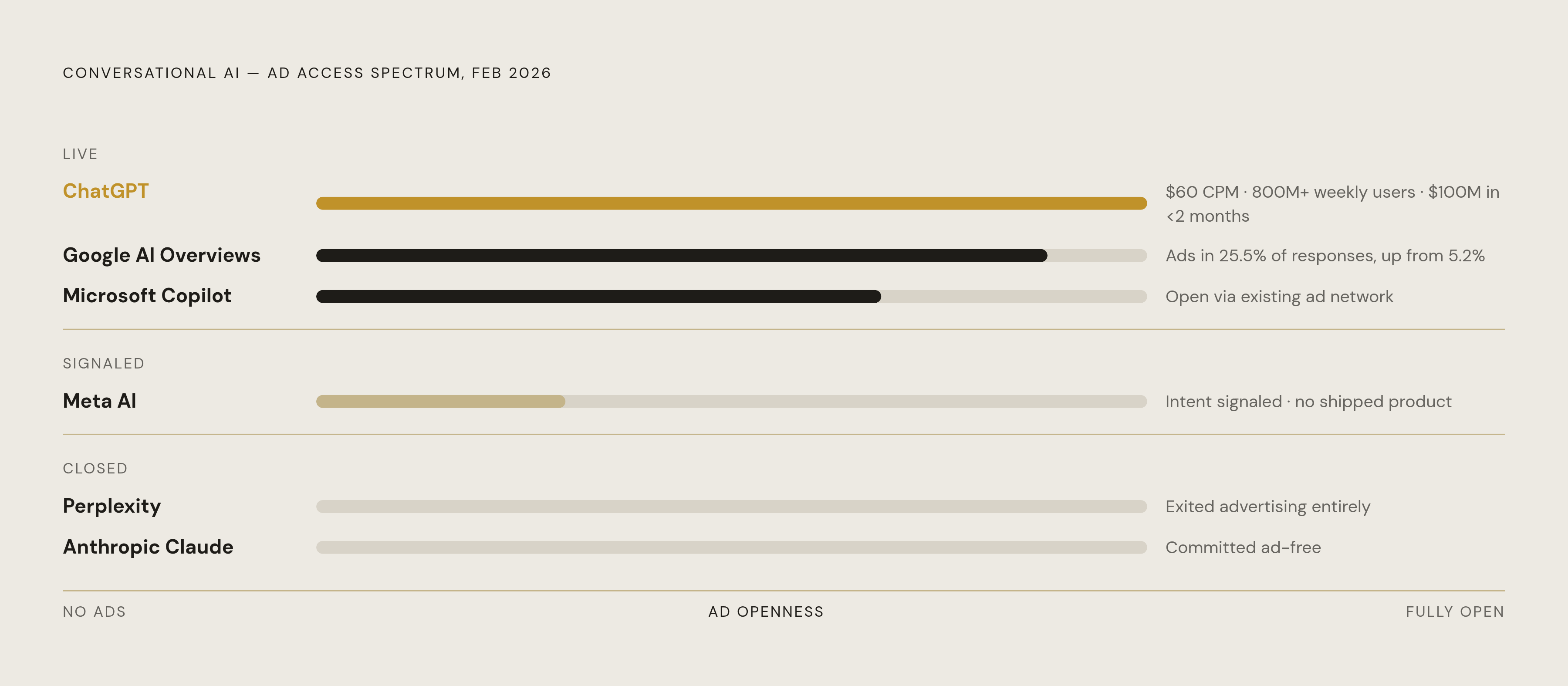
OpenAI announced plans to test ads in one key market on January 16, 2026, with the pilot launching February 9, 2026. Within under two months, it had reportedly generated $100 million in annualized revenue, running at a $60 CPM against more than 800 million weekly users, a pace digitalapplied.com describes as the fastest-growing new ad platform since TikTok. The ads run for logged-in adult users on both the free tier and the $8-per-month Go tier, with Criteo signed on as the first technology partner. OpenAI's stated position is that the ads are clearly labeled, visually separated from the assistant's answers, and don't shape what ChatGPT actually says in response.
Google has moved on two fronts at once. Ads now appear alongside 25.5% of all AI Overview responses, up from 5.17% in early 2025, according to digitalapplied.com. Google extended ads into AI Overviews on desktop in May 2025 and has since launched ads inside AI Mode, its fully conversational search experience, where Shopping ads with Direct Offers monetize at the same rate as traditional search ads. Early signals from AI Max for Search campaigns suggest conversion gains for some advertisers, though independent figures have not been confirmed in the evidence reviewed here.
Microsoft Copilot serves ads automatically through the existing Microsoft Advertising network, so advertisers already running campaigns there don't need a separate buy to show up in Copilot placements. Meta AI has signaled intent to monetize its assistant through ad-supported responses tied to Instagram and Facebook data, though that hasn't shipped as a formal ad product yet.
Perplexity is the cautionary tale, and it's worth taking seriously as one. It launched sponsored follow-up questions in November 2024, ads appearing as suggested prompts in the "Related Questions" area, with launch partners including Indeed, Whole Foods, Universal McCann, and PMG. By October 2025, it had stopped onboarding new advertisers. By February 2026, it had walked away from advertising entirely, according to Financial Times reporting relayed by Search Engine Land. It's chasing $500 million in annualized subscription revenue instead, positioning itself as the ad-free alternative to ChatGPT and Google. The retreat, came down to a plain worry: a sponsored answer sitting next to organic output makes the whole response feel bought. Answer purity is the product, in that framing, and it's not a position taken lightly given the revenue left on the table. Anthropic's Claude has held the same line from the start, committing publicly, and through its own marketing, to staying ad-free.
A second layer of infrastructure is building around the assistants rather than inside them. ZeroClick feeds advertiser context into the model's reasoning process before a response gets generated, rather than inserting an ad afterward, converting landing pages and Google Ads data into what it calls "Ad Story Units" evaluated for relevance in real time. Per getchatads.com, it counts more than 10,000 advertisers, including Walmart, Target, Expedia, and DoorDash. Dappier sits on the publisher side, monetizing through sponsored prompts embedded directly in AI conversations and through content licensing, with partnerships tying it into Sovrn for ad delivery and LiveRamp for identity activation, a bridge into infrastructure the ad industry already trusts.
The surface map, as it stands, is split down the middle. ChatGPT and Google's AI Mode are open and scaling fast. Microsoft Copilot is open by extension, through its existing ad network. Meta AI is signaling intent without a shipped product. Perplexity and Claude have gone the other way entirely, betting that staying ad-free is worth more to their users, and to their revenue, than the ad dollars would have been.