Buying Ad Inventory Inside AI Conversational Interfaces
Conversational context replaces keywords as the targeting signal that wins ad auctions.

Advertising inside ChatGPT, Copilot, and Google's AI surfaces now runs on rules that owe nothing to search or social. The targeting signal is the conversation itself, the auctions read intent in real time instead of matching a keyword, and the supply sits behind three separate front doors with no single key that opens all of them. Marketers who treat this as another Google tab to check will misprice their bids and misjudge their reach. Skip Google's AI placements for now: they carry the most reach and the least accountability of the three, since there's no way to isolate their performance from the rest of a Search campaign. Copilot, by contrast, has published performance numbers worth trusting, and that alone should move it higher on the list than its user base would suggest.
How the active platforms have structured their ad inventory and who can actually buy it
OpenAI started testing ads on February 9, 2026, for logged-in adult users in the United States on the Free and Go tiers. Anyone paying for Plus, Pro, Business, Enterprise, or Education sees no ads at all. What does show up gets labeled "Sponsored" and kept visually apart from ChatGPT's own answers, and OpenAI says the ads have no pull on what the model actually writes back. The business moved fast: a $1 billion annualized revenue run rate inside 200 days, tens of thousands of advertisers spread across more than 40 countries, according to Beet.TV. Access opened up just as fast. A pilot that once required $200,000 minimum commitments turned into a fully self-serve platform in roughly three months, open now to businesses of any size through a dedicated account at ads.openai.com. Campaigns run on three objectives: Reach priced by CPM, Clicks priced by CPC, or a conversion-optimized option. Advertisers only ever see results added up across users, never a single person's conversation or personal detail.
Google took an earlier, quieter path. Ads inside Gemini-powered AI Overviews launched in October 2024, reached desktop in May 2025, and expanded into 11 more countries by December 2025. AI Mode ads are still in test with US users, and Google Marketing Live announced new formats including Conversational Discovery ads and Highlighted Answers. Every ad carries a "Sponsored" tag, English only, and Google keeps a list of categories it won't touch: adult content, alcohol, gambling, finance, healthcare, politics, and more. Here's the part that should give any planner pause: advertisers cannot buy an AI Overview or AI Mode placement directly. Eligibility comes only from running Text or Shopping ads through existing Search campaigns on broad match or AI Max, or through Shopping and Performance Max campaigns. There's also no way to pull segmented reporting; performance on these placements sits buried inside the broader Search numbers, unlabeled and unrecoverable. Google has continued expanding its Direct Offers pilot inside AI Mode, and the share of AI Overview responses carrying ads has grown substantially since the format launched. A surface growing that fast with zero standalone reporting is not a small gap. It's a blind spot advertisers are being asked to fund without evidence of what it's actually doing.
Gemini itself carries no paid ads. Treat it as an organic surface for now, one where visibility depends on content authority and generative engine optimization instead of a media budget.
Microsoft Copilot announced two new formats, Showroom ads and Dynamic Filters, in March 2025, with Showroom ads piloting with select clients that April and still rolling out globally. Showroom ads sit at the bottom of a Copilot answer and surface rich sponsored content, images and product details, once a user signals buying intent inside the conversation. Dynamic Filters let a user refine results by interacting with the ad directly instead of typing a new prompt, and Microsoft has said it plans to add brand agents so users can talk to something like a virtual sales rep through the unit itself. Every Copilot user over 13 sees ads (over 18 in some regions); users under 18 only get non-personalized, contextual versions instead of anything targeted off their profile. These buys run through Microsoft Ads inventory generally, with no way to target Copilot specifically and no opt-out. Reporting covers impressions, clicks, CTR, conversions, conversion rate, CPC, and ROAS.
Claude carries no ads either, and Anthropic used its 2026 Super Bowl spot to make that a selling point, positioning Claude as the ad-free alternative squarely aimed at users wary of OpenAI's launch. Perplexity went further: on February 18, 2026, it announced it was dropping advertising altogether, having already stopped accepting new advertisers back in October 2025, choosing instead to lean on subscription and enterprise revenue. For now, Perplexity isn't a buying surface at all.
Line these up and a pattern falls out fast. Access routes differ (a dedicated ad account versus a media buy through an existing platform versus no access whatsoever), audience segmentation differs, and reporting depth differs sharply from one surface to the next. Treat this as one channel with three names, and it'll cost a buyer both efficiency and accuracy, since none of it is actually interchangeable.
Why targeting inside a conversation works differently from keyword or audience bidding
Search and social ads get matched against a keyword string or a user profile, both of which are indirect guesses at what someone actually wants. A conversational interface skips the guesswork. A prompt like "I'm comparing project management tools for a 20-person remote team" hands over more targeting precision in one sentence than any keyword a planner could bid on in Google Ads.
OpenAI built its system around that fact. Advertisers use what OpenAI calls "context hints," descriptions of the kind of conversation where a product is relevant, rather than bidding on an exact keyword. A campaign might target "users comparing project management tools" instead of bidding on "SaaS," and that's a fundamentally different input than anything a search planner is used to feeding an ad system. ChatGPT campaigns can also layer in geographic targeting, custom audiences, and product feeds, but the contextual layer, not the demographic one, is what actually separates this from search. The auction weighs the conversation's context and intent alongside the ad's landing page, its copy, the advertiser's context hints, and the targeting choices made at setup; when a user has ad personalization turned on, a few additional signals from inside ChatGPT can factor in too.
Microsoft runs Copilot auctions on what it calls "a relevance-weighted, second-price auction to find the best ad for eligible conversations," language that ties the mechanic explicitly to conversational relevance rather than to the page a user happens to be on. Google's approach for AIO and AI Mode goes further in the other direction: its automated campaign systems read intent inside AI-generated contexts on their own, and advertisers give up keyword-level control entirely in exchange for AI-matched placement. Success there comes down to strong audience inputs, clean product feeds, and clear conversion signals, not picking the right exact-match term. That trade is worse than most buyers realize going in.
The old mental model, find the keyword that triggers the ad, doesn't carry over here. The real input now is a description of a conversational moment. And as third-party cookies keep fading out of the picture, that conversational context is fast becoming the signal that fills the gap: a prompt exposes purchase intent in real time in a way no cookie or demographic bucket ever managed to reconstruct.
Bidding mechanics on each platform and what signals actually drive auction outcomes
ChatGPT's CPM bidding for reach objectives runs roughly $25 to $60, moving through a relevance-weighted second-price auction with two available modes: an automatic Maximize Results setting or a manual Max CPC. Direct-response advertisers can bid CPC instead, including a conversion-optimized CPC option where OpenAI steers delivery toward a chosen conversion event but still charges per click. There's also outcome-optimized bidding, which uses conversion data to shift spend toward the users most likely to actually buy, submit a lead form, or sign up. Full tracking runs through a measurement pixel plus a server-side Conversions API, so an advertiser can trace which clicks turned into a phone call, a form fill, or a booked appointment. The auction itself weighs conversational context and intent, landing page, ad copy, the advertiser's context hints, targeting choices, and, when a user allows it, a handful of additional ChatGPT signals.
Copilot's auction runs on a relevance-weighted, second-price structure, keyed to conversational relevance instead of keyword match quality. It's bought through Microsoft Ads, so campaign-level signals feed straight into the auction. Showroom ads fire when a conversation reaches a declared buying moment, not when a keyword gets matched.
Google offers no dedicated bidding layer for AIO or AI Mode at all, and this is where a lot of buyers get the strategy backwards. Existing Search, Shopping, and Performance Max campaigns simply compete for eligibility to appear there, through broad match, Performance Max, AI Max for Search, or Shopping campaign types, which means a tightly scoped exact-match keyword strategy, the instinct that serves a buyer well in ordinary Search, actually cuts the odds of showing up in an AI Overview. That's backwards from how most search teams are trained to think, and it's costing them placement they don't know they're losing. Advertisers running AI Max for Search saw 14% more conversions at a similar cost per acquisition, rising to 27% among campaigns that had leaned heavily on exact match before switching. Smart Bidding and Performance Max are already central to how the platform operates, with AI-powered bidding accounting for a large and growing share of Google Ads spend. The AI surfaces are simply stretching an automation logic Google had already built, not introducing a new one.
Across all three active platforms, the auction runs on some version of relevance-weighted bidding with conversational context as an explicit input. Where that context gets read with precision, ChatGPT's context hints being the clearest case, advertisers keep a real lever to pull. Where it's inferred by an automated system instead, as on Google's AI surfaces, buyers trade granular control for algorithmic matching, and that trade should worry anyone who built their whole practice on keyword-level control. None of these three buys travels across platforms: a ChatGPT campaign needs an OpenAI ad account, Copilot needs Microsoft Ads, Google's AI placements need an existing Google Ads campaign. No single purchase covers all three.
The reach and supply fragmentation problem, and what cross-surface buying actually requires
Every major surface demands its own buying relationship. An OpenAI ad account gets a marketer into ChatGPT, Microsoft Ads gets them into Copilot, Google Ads gets them adjacent to AI Overviews and AI Mode. Nothing today spans all three natively, and nobody buying media should expect that to change soon.
The surfaces with the richest conversational signal, ChatGPT's context hints and Copilot's buying-moment detection, both demand platform-specific campaigns built for that surface alone. The surface with the broadest potential reach, Google, offers the least targeting precision for its AI placements and hands back almost no segmented reporting in return. That's the trade a buyer is stuck making right now: precision on one surface, scale on another, no overlap between them.
Fragmentation shows up on the supply side too, and it cuts two ways. Generalist demand-side platforms have reach across plenty of ad surfaces but no ability to read conversational context. AI-specific ad networks can read that context precisely but stay locked to a single environment. Neither one solves both the reach problem and the context problem at once, so a marketer working across all three active surfaces today is running three separate media plans in parallel, not one consolidated buy.
The supply itself is also thinning at the edges, which raises the stakes here. Perplexity exited advertising entirely as of February 18, 2026. Claude has never carried ads and used its Super Bowl spot to say so in front of a national audience. That leaves fewer surfaces actually selling conversational AI inventory, which makes whatever cross-surface access does exist more valuable going forward, not less.
Programmatic buyers watching from the sidelines shouldn't assume the infrastructure gap closes on its own. AI-surface inventory isn't flowing through standard programmatic pipes at any real scale yet, and closing that gap is exactly what a demand-side and supply-side layer built for conversational AI would need to do. Until that infrastructure catches up, a marketer planning a conversational AI buy today faces a real choice: manage three separate platform relationships directly, wait on unified buying tools to arrive, or work with a specialized partner that already holds direct publisher relationships across surfaces.
What the early performance data shows, and where the benchmarks are still thin
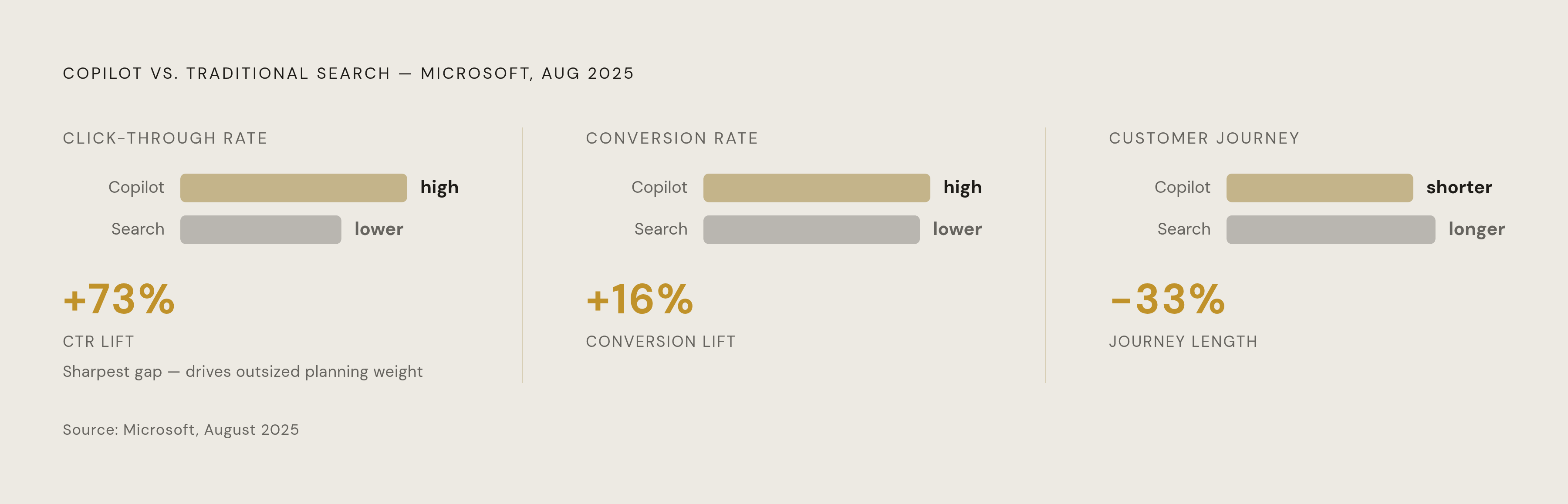
Microsoft's own data, published in August 2025, gives the clearest early number on the table: Copilot users produce 73% higher click-through rates and 16% stronger conversion rates than traditional search, with the customer journey running 33% shorter start to finish. It's a real, vendor-published figure rather than a projection, making it the strongest performance claim any of these platforms has put behind its ads so far. Nobody else has shown this kind of work.
ChatGPT's picture is thinner and comes from outside sources rather than OpenAI itself, since OpenAI hasn't published an official cross-advertiser benchmark of its own. The most cited figure as of mid-2026 comes from a First Page Sage research, which found conversion rates ranging from 0.2% up to 5.8% depending on the vertical, with commercial categories clustering between 4% and 7% and top performers clearing 8%. Set that against equivalent Google Search conversion rates, which run 2% to 4%, and ChatGPT's commercial-vertical numbers look genuinely strong. But it's one third-party survey, not a benchmark verified by the company that built the underlying technology, and treating it as settled fact rather than an early read would be a mistake.
That gap matters for anyone building a media plan around these figures. Copilot has a vendor-published benchmark with real specificity behind it. ChatGPT has a promising outside estimate that hasn't been confirmed at scale by the platform itself. Google's AI Overview and AI Mode placements have no isolated benchmark at all, since performance still can't be separated from the rest of a Search campaign's results, and that absence should count against Google in anyone's planning, not get waved away as a rounding error. The auction mechanics behind these three platforms are well documented at this point. The performance data proving out those mechanics is still catching up, across the board, and Copilot is the only one of the three that's actually shown its work.