Why Live Prompt Data Outperforms Cookie and Keyword Signals in Programmatic Bidding
Live prompts reveal intent as it forms, not after the fact like cookies do.

Live prompt data beats cookies and keywords in programmatic bidding because it captures intent at the moment it forms, not after the fact and not in fragments. Cookies were built to answer a backward-looking question: what has this person already done. Behavioral targeting reads browsing history, prior purchases, and past content consumption, which places it on one side of a temporal line, looking at the past rather than the present. Contextual targeting, by contrast, reads what a user is consuming right now, a different position relative to the purchase decision but still a page-level reading rather than a window into the person's actual reasoning. Keyword signals share the same limitation in a different form: a string of two to five words names a topic but says nothing about budget, timeline, or how close the searcher stands to making a decision. Both signals are also shrinking in supply. Major browsers now restrict third-party cookie use and privacy regulations around the world limit cross-site tracking, so the raw material behind behavioral targeting is already smaller and less reliable than it was built to be.
What a natural-language prompt contains
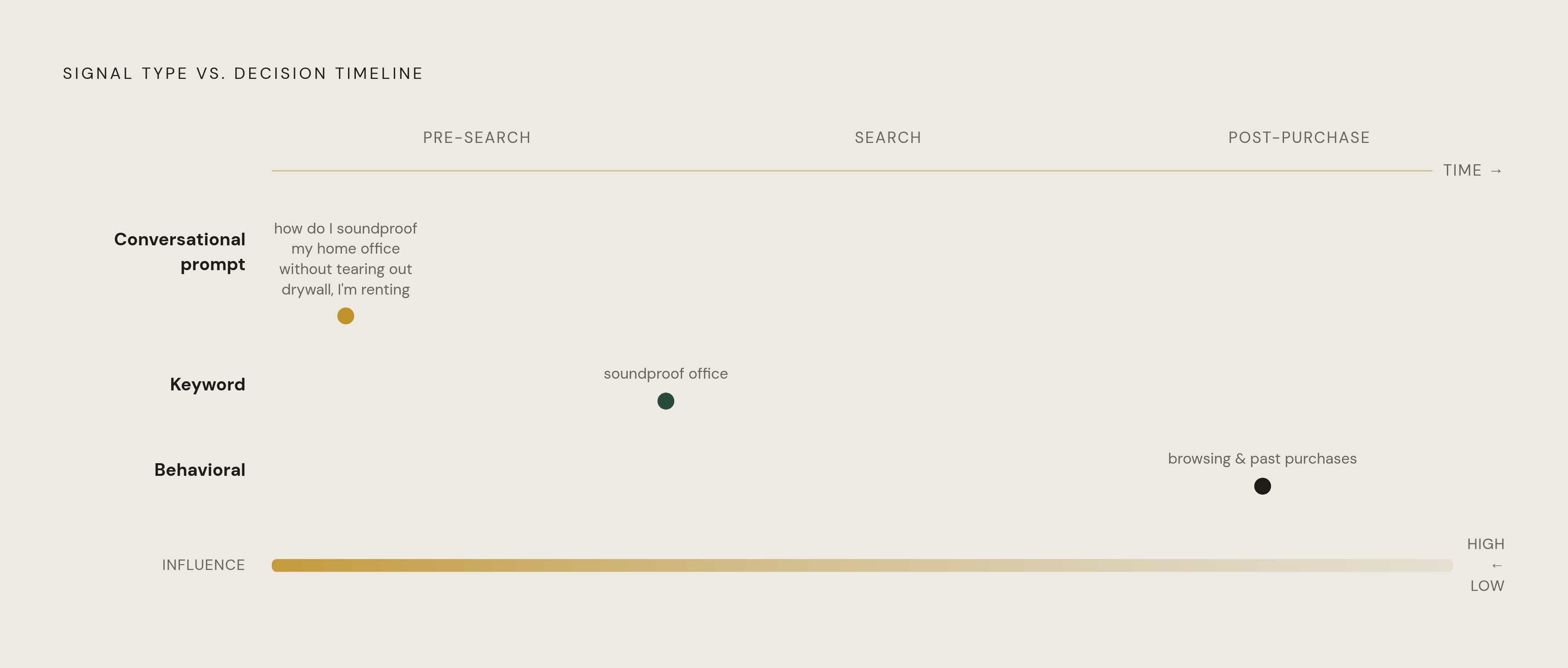
A natural-language prompt is a different kind of object than a keyword, one that encodes the reasoning behind a request rather than just its topic. A keyword names a category, something like "soundproof office." A conversational prompt explains a situation: how do I soundproof my home office without tearing out drywall, I'm renting. That single sentence tells a system that the budget is constrained, that the fix has to be reversible because the person doesn't own the walls, and that the application is a home office rather than a studio or a commercial space. None of that is recoverable from a keyword, no matter how much historical browsing data sits behind it. Research classifies this kind of conversational signal as high in richness, against a keyword's status as a general topic indicator arriving in the middle of the funnel. The gap between the two isn't a matter of degree. A prompt also tends to arrive earlier in the decision process than a search query does, often at the pre-search discovery stage, before the user has even settled on which products or brands to compare. A system reading that prompt is working with a formative moment, one where influence on the eventual decision runs higher than it does once a user has already narrowed the field down to a short list typed into a search bar. The same sentence that expresses what the person wants also contains, almost as a byproduct, the specific objections and conditions a generic ad could never anticipate: a renter's constraint, a cost ceiling, a timeline. A bidding system that can read that context has something to match against that a keyword auction never offers: a reason, not just a topic.
Turning prompt signals into a real-time bid
Turning that richer signal into an actual bid runs through a pipeline that looks nothing like page-based programmatic. On the sell side, when a conversation happens inside a publisher's own AI surface, an LLM SSP treats the exchange as a monetizable event, reads the conversational context and the intent inside it, and decides whether an ad placement even belongs in that moment, a judgment call with no real equivalent in the cookie-driven stack. On the buy side, an LLM DSP targets based on what a person is actively asking about right now, rather than reconstructing a demographic profile or a browsing history, which anchors the bid to intent that the user has declared rather than intent inferred from a pattern of past clicks. The infrastructure connecting the two sides is being built out in public. The Ad Context Protocol, launched by Yahoo, PubMatic, Scope3, Optable, Swivel, Triton Digital, and others, was described in SmartBrief's analysis as a blueprint for how AI agents transact in digital media, a bridge meant to let buyers and sellers operate on conversational context instead of cookie-based identity. Verve Group moved to industrialize the signal-capture side of that same shift in March 2026, becoming the first ad technology provider to activate conversational intent signals for targeting drawn from major LLM ecosystems, combining zero-party data, search intent, and pseudonymized AI chat activity into one privacy-first intelligence layer. OpenAI's own ChatGPT advertising product, launched in February 2026, runs its targeting off three signals: the topic of the current conversation, the user's past chat history, and any prior ad interactions, a framework built around full conversational context rather than an isolated search term typed into a box. Each of these systems, in its own way, is solving the same problem: getting a bidder close enough to the actual conversation to price the moment correctly, in real time, before the window on that intent closes.
What the early performance evidence from conversational placements shows
The mechanics only matter if they produce better outcomes, and the early data is genuinely mixed rather than uniformly favorable. Criteo, OpenAI's first ad-tech partner, reports that traffic referred from LLM platforms like ChatGPT converts at a higher rate than traffic from other referral channels, based on a sample of 500 U.S. retailers measured in February 2026. In materials tied to OpenAI's expansion, one e-commerce advertiser reported a return on ad spend over a measured period that beat typical display benchmarks by a wide margin, and a technology partner in the same materials said the large majority of its ad-driven ChatGPT traffic came from customers it had never sold to before. Format-level click-through data from Whitebox monitoring points the same direction at a more granular level: inline product cards placed inside e-commerce conversations outperform companion display units by a meaningful margin, which fits the basic logic of the argument here, that the tighter the match between an ad and the intent expressed in the prompt, the stronger the response.
Not every data point lines up behind that story. A B2B practitioner, Windmill Strategy, ran a test that generated impressions and clicks and zero conversions. A hotel-focused practitioner reports click-through rates and cost-per-click figures sitting in a range that isn't clearly better than what search already delivers. OpenAI told advertisers directly that it has no cross-advertiser, cross-industry performance benchmarks yet, an admission that matters because it means every favorable number cited above describes a specific advertiser in a specific category, not an industry norm. Signal richness raises the ceiling on conversion when the creative and the offer are built tightly around the intent the prompt expressed. It does nothing on its own for an advertiser who drops a generic ad into a high-intent conversation and expects the context to do the work. A strong signal paired with a weak match still produces a weak result, which is what the Windmill Strategy test suggests happened.
Why prompt signals outlast cookies
Beyond the present-day performance comparison sits a longer-running structural one, and it favors prompt signals by a wide margin. Cookie-based targeting faces a set of pressures that compound rather than level off: major browsers continuing to restrict third-party cookie use, privacy regulations around the world continuing to limit cross-site tracking, and consumers themselves increasingly expecting more transparency about how their data gets used, all of which chip away at both the scale and the reliability of the behavioral signal at the same time. Prompt signals are captured as a direct consequence of a consumer actively opting in to use an AI tool, carrying none of that same exposure. They don't inherit the fragmentation risk that comes with a third-party identifier slowly losing coverage across browsers and jurisdictions. Verve Group's model shows what that looks like in practice: the signals it works with come from users inside major LLM ecosystems who have consented to share pseudonymized AI chat activity through apps they already use day to day, a consent structure built around the direction regulation has been moving rather than against it. There's a timing advantage layered on top of the consent advantage. Because prompt signals are captured in real time, as the intent is actually forming, a brand can see a purchase signal as it forms rather than waiting on an aggregated report, delivered weeks later, describing behavior that may have already resolved into a purchase, a cancellation, or indifference by the time the report lands. The combination of these two structural facts, durable opt-in and real-time arrival, is why the gap between the two signal types looks set to widen rather than narrow as the cookie-based ecosystem keeps contracting.
Where the signal advantage does not automatically translate
None of this makes prompt data self-executing, and the honest version of this argument has to say so. A richer signal can tell a bidder precisely what a user wants without fixing any of the plumbing that sits between a winning bid and an actual sale. A high-quality prompt signal bid against a stale product feed, a broken tracking link, or no frequency cap performs worse than a mediocre signal paired with infrastructure that actually works. The signal sets a ceiling on what's possible. It does not set a floor under the result.
Some in the industry argue the whole category may be drifting toward something that looks less like hyper-targeted precision and more like a return to pre-digital contextual advertising, prioritizing placement quality over granular targeting volume. Generation Media's argument, cited in SmartBrief's analysis, holds that the industry is moving toward quality over quantity in placement, which, if it plays out, means hyper-precise prompt matching converges back toward something close to broad contextual placement, narrowing the marginal value of chasing ever-finer signal precision. Taken together, these two points sharpen the thesis rather than undercut it: prompt signals are structurally superior to cookies and keywords as a source of intent, and realizing that advantage depends on whether the tracking, the catalog, the frequency management, and the attribution around the bid are built to capture what the signal makes possible.
Programmatic bidding strategy built around conversational intent
Taking prompt signals seriously as the foundation of bidding changes the architecture of a campaign at nearly every level, starting with how intent itself gets defined. Instead of organizing a campaign around audience segments or keyword lists, the unit that matters becomes the conversational moment itself, the specific thing a user is actively trying to decide right now, rather than a demographic label or a record of what they browsed last week. That shift in definition carries a pricing logic with it: a user mid-deliberation, stating real constraints and a specific use case in a single prompt, justifies a higher bid than a pageview from someone who once skimmed an article on a related topic, because the richness of the signal earns the premium.
Where to prioritize that spend isn't uniform across categories. OtterlyAI's study across multiple industries found that shopping-intent prompts in Finance and Insurance returned an ad the large majority of the time, while Healthcare came back as the least ad-saturated category of those studied; brands willing to move early into less-contested conversational spaces face a lot less competition for each impression than they would in a category already crowded with advertisers. Competitive exposure cuts the other way too. Whitebox's monitoring data found that a meaningful share of brand-name questions don't surface that brand's own ad at all, and most repeat queries return a different advertiser entirely, handing a competitive opening to whoever does show up in that conversational inventory.
Measurement has to be built rather than borrowed, at least for now. Finally, the platforms that can read conversational context across more than one AI surface, rather than being locked into a single publisher's interface, compound the entire advantage described above, because the same intent-matching logic then travels with the user wherever the conversation happens to take place. That cross-surface reach is where the structural case for prompt data over cookies and keywords turns from a present-tense performance edge into a durable one.