Brand Lift Studies Adapted for Conversational AI Environments
Researchers must redefine exposure and metrics to apply brand lift studies to AI conversations.

A brand lift study compares exposed and control groups to measure whether an ad campaign moved awareness, recall, or purchase intent. Built for static inventory, the method produces mismatches when run unmodified against conversational AI ad placements, which advertisers must understand and correct before trusting results. This piece breaks down where the mismatches sit and what adapting the methodology actually requires.
Traditional Brand Lift Methodology and Conversational AI Ad Placements
Brand lift methodology assumes a fixed URL, persistent page-level context, and a discrete ad slot a third party can independently audit. That structure is what makes the control/exposed panel design work in the first place. Taking away the fixed placement makes the whole scaffolding start to wobble.
Conversational AI responses lack a persistent URL or page-level context, a fundamental departure from display and search measurement. That's a significant structural break, not a minor technical footnote. It's the foundation the methodology sits on, and it isn't there anymore.
Three structural gaps follow from that absence. First, defining what "exposure" even means when the ad lives inside a dynamically generated response instead of a fixed placement. Second, picking metrics that actually capture conversational influence rather than recall of a static creative someone glanced at once. Third, building a control group that holds up when the conversation itself, not just the ad within it, is part of what's being tested.
None of this means the methodology is beyond repair. It means the mismatches have to be named precisely before anyone can fix them, and that precision is the point of what follows.
What "ad exposure" means inside a dynamically generated response
Exposure in traditional lift studies is binary and auditable. The ad either loaded into the slot or it didn't, and an independent tag confirms which. Conversational AI breaks that binary since ads live inside LLM-generated text, and research identifies two competing ad architectures with different implications for exposure.
One approach weaves ad content directly into the token stream, so it's distributed across the response and hard to isolate from the rest of the answer. The other appends a pre-defined ad unit after the response finishes generating. OpenAI uses this second approach, activating the ad only after the response completes without influencing the answer, making exposure more bounded, though still inside a chat interface rather than a taggable page⟀c7⟧.
That distinction cascades into real fielding problems. Impression logging can't rely on a page-level tag firing against a URL, because there is no URL to fire against. Viewability, as display advertising defines it, meaning pixels in a viewport for some minimum duration, doesn't translate to text rendered inside a back-and-forth conversation. And the ad often gets read in the middle of a response the user already trusts, which changes the character of the exposure itself, not merely whether it registered.
Blended insertion carries a risk with no static equivalent: when ad content sits inside organic text without a clear boundary, what a respondent recalls as "the ad" may be indistinguishable from the model's own assertions. Before fielding anything, practitioners need a platform-specific exposure standard: which insertion architecture is running, what the logging mechanism actually captures, and what minimum engagement counts as a served impression.
The platform landscape's divergent monetization approaches
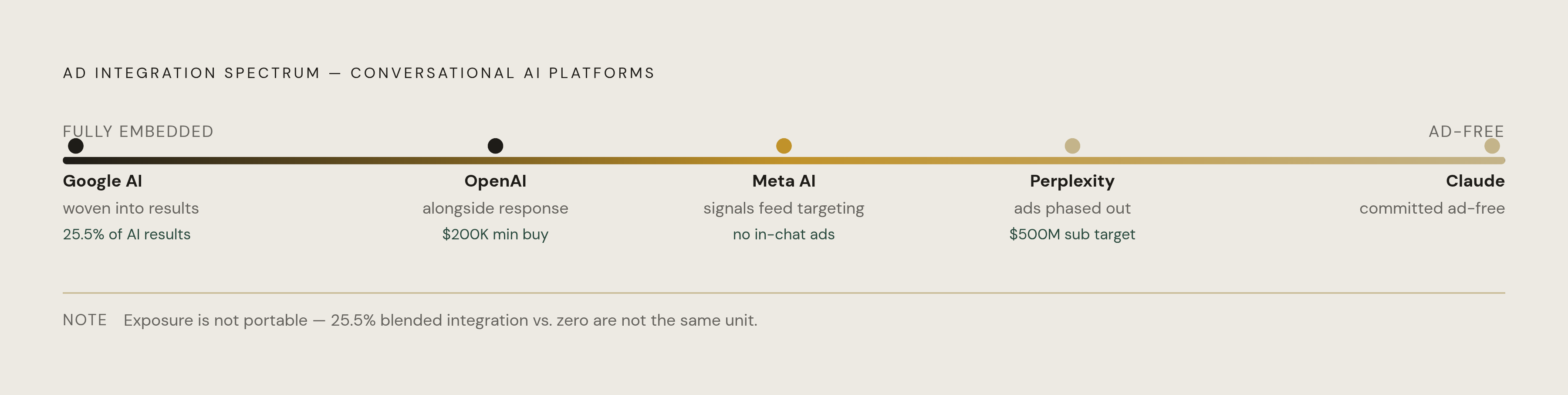
Every major surface has picked its own ad architecture, and that means exposure isn't just hard to define in the abstract, it's defined differently platform by platform.
OpenAI launched ads inside ChatGPT in February 2026, generated independently of the ad system, with ad units delivered alongside the response stream rather than strictly after it. Initial access required $200,000 minimum commitments before self-serve, and the platform now handles 2.5 billion prompts a day, so the exposure surface is enormous despite being bounded and adjacent rather than embedded.
Google's AI Mode and AI Overviews took the opposite path, weaving ads into generated results themselves, present in 25.5% of AI results as of the research date, up sharply from 5.17% in early 2025 Digital Applied. That's semi-integration, closer to blended than adjacent, so exposure on Google looks nothing like exposure on OpenAI Digital Applied.
Perplexity moved the other direction. Anthropic has taken the same stance with Claude, committing to keep it ad-free. Both matter here less as monetization stories and more as design tools: a no-ad surface is a candidate control population, at least in principle.
Meta AI sits somewhere else again. It places no ads inside the conversation, but since December 16, 2025 has used conversational signals to inform ad and content targeting across Facebook, Instagram, WhatsApp, and Messenger. The exposure happens elsewhere entirely, on feeds visited after the conversation ended, making a unified cross-surface lift study considerably harder to build.
Across those five surfaces, a cross-surface study must define exposure separately for each one. One can't assume someone "exposed" on Google received a stimulus comparable to someone "exposed" on OpenAI Digital Applied. Measurement vendors already active in adjacent markets — Dynata, Intage, Macromill, and Kantar, all listed on Google's Ads Data Hub vendor table — built their frameworks for display and video and are now stretching them to cover AI surfaces. Whether that stretch holds is the question this piece is built around. Perplexity began phasing ads out in late 2025, paused new advertisers by October 2025, and by February 2026 executives said they'd stopped pursuing ad deals, citing trust erosion, now targeting $500M in annualized subscription revenue — effectively a no-ad surface relevant to control-group design.
Conversational Context and Brand Lift Metrics
Standard lift metrics — unaided awareness, ad recall, favorability, purchase intent — were calibrated for a user who glanced at a creative and moved on. That's a moment of attention. Conversational AI puts users in dialogue with something they tend to treat as a trusted, unbiased advisor, changing how brand influence moves.
A Semrush study found AI chatbots talked 57.5% of users out of a considered purchase. That's a striking number, and it cuts against the instinct to treat conversational intent signals as automatically richer than a static ad glance. The same trust that makes a chatbot's recommendation persuasive also makes its hesitation persuasive, unlike keyword search, where the platform mostly stays out of the way. A lift study measuring purchase intent right after a conversation may see movement that has nothing to do with whether the ad was recalled.
Disclosure timing matters here too. Users often fail to notice embedded or personalized ads, but clear disclosure shifts both trust and perceived intrusiveness. The identical ad content produces different attitudinal results depending on how and when it's flagged. A lift study that doesn't hold disclosure format constant is measuring a confound, not a clean effect.
That argues for a different metric set, or at least an expanded one. Brand recall in context — asking which brands come to mind for a category, not whether someone recalls an ad — tests whether the mention lodged in memory even unregistered as advertising. Consideration shift tends to be more sensitive than intent in a trust-mediated environment, since trust can lift consideration even as intent drops. Information attribution — whether the user credits a brand claim to the AI, a sponsor, or prior knowledge — has no real counterpart in display or video. Conversation continuation — whether exposure prompted a brand follow-up question — is a behavioral signal native to the format, unavailable elsewhere.
None should be bolted onto an existing display or video questionnaire by simply swapping the platform name. They need to be piloted and cognitively tested on their own terms.
The control group construction problem when the conversation is part of the treatment
The logic of a lift study rests on one assumption: control and exposed groups had otherwise equivalent experiences, with the ad the only meaningful difference. In a conversational AI environment, that assumption doesn't just weaken, it breaks structurally.
The reason: the AI's own organic response is itself shaping brand perception, and two users asking the identical question can get meaningfully different generated answers, with no way to hold that variation constant. Worse, a control-group user who never saw the ad might still get a response mentioning the brand organically, contaminating the comparison without any actual ad exposure.
Recent research on ad-serving architecture adds another wrinkle. A genre-based decoupling approach described by Xu et al. in January 2026 partitions ad bidding by coarse semantic clusters rather than individual prompts. So the targeting unit is a topic, not a query, and control members may not have landed in the same cluster as the exposed group, with no guarantee both populations competed for the same inventory.
So what are the options? A within-session holdout — withholding the ad from a random share of sessions on the same platform — keeps context distribution intact but usually needs the platform's cooperation. A between-surface holdout uses a no-ad platform like Perplexity or Claude as a stand-in control, but users' own platform choice introduces self-selection bias hard to fully strip out. Synthetic control via matched-query analysis — pairing respondents by the semantic cluster of their queries — cuts confounding from organic response variation but depends on query-level data platforms don't always share.
The control condition in a conversational AI lift study should mean "received the conversation without the ad," not "never visited the platform". Getting there is less a survey design problem than a negotiation problem, requiring platform-level cooperation that isn't yet standardized.
What real-time measurement infrastructure makes possible
The measurement industry is already moving toward faster, in-flight lift reporting, and that shift matters for conversational AI even if it wasn't built with this environment in mind. Cint's Director of Product Management Stephanie Gall said on EMARKETER's Behind the Numbers that advertisers can't wait until a campaign ends to learn which creative worked, calling real-time lift a baseline expectation now, not a premium feature.
Cint's Study Creator, launched in 2024 inside Lucid Impact Measurement by Cint, lets users launch a brand lift study in minutes, pointing at the category's direction: faster, self-serve, oriented toward optimizing campaigns in-flight rather than grading them afterward. That's directionally useful for conversational AI measurement, though it isn't a purpose-built answer to it yet.
What can this kind of infrastructure actually do for conversational placements today? It can field surveys faster to people already identified as platform users. It can support in-flight creative and message tweaks, assuming exposure logs can be tied back to the right survey respondents. And it can spot trends across campaigns once enough sample accumulates.
Tagging infrastructure across AI surfaces isn't standardized, so exposure definition remains unresolved. It can't hold the organic response constant either. No current tool has a mechanism to freeze the AI's answer so it's identical across respondents. Nor can it cleanly separate attribution within a session: if intent shifts mid-conversation, a standard pre/post survey can't say whether the ad or the AI's own response moved them.
Companies that actively run brand lift measurement see 1.5x higher marketing ROI, per a HubSpot report. The incentive to make this work for AI surfaces is obvious. The infrastructure to do it properly is still under construction, and pretending otherwise just produces confident-looking numbers that don't mean what they claim.
Adapting a brand lift study design for a conversational AI placement today
Treat this as a measurement pilot. The goal now is learning how a brand performs in this channel and building institutional knowledge to measure it better as platforms mature, not delivering a definitive verdict.
Start by defining the exposure standard before anything gets fielded. Identify which insertion architecture the target surface uses — blended into generation or appended after — and specify the logging mechanism confirming a served impression, rather than assuming the platform's reported numbers match respondents' actual experience. Write this down as part of the study design itself, since platform architecture will keep shifting and the documentation needs to be revisable.
Next, build the control condition to match the real treatment. Favor a within-platform holdout over an off-platform proxy wherever the surface allows it. Where unavailable, name the selection bias risk explicitly rather than hiding it in a footnote, and record the topic cluster of exposed users' queries, even coarsely, so control respondents can be matched to a comparable distribution.
Then adapt the metric suite so it actually captures conversational influence. Keep standard awareness and favorability items for comparability with display and video benchmarks, but add information attribution — whether respondents credit the AI, a sponsor, or neither — and consideration shift rather than leaning on intent alone. Pilot the questionnaire independently; an instrument borrowed from video lift studies with the platform name swapped won't hold up under cognitive testing.
Set survey timing to the conversational session itself. The relevant exposure window is that one exchange, not days or weeks of media rotation, so timing should track conversation recency, not page-visit recency. This is where faster fielding tools like Cint's DIY tooling earn their keep: quick surveys cut recall decay for an exposure that's inherently brief and easy to forget.
Finally, be explicit, in the study's own documentation, about what the design can and can't claim to prove. A conversational AI lift study run today, however carefully built, still works against exposure standards that vary by platform and control assumptions platform cooperation hasn't caught up to. Naming those limits isn't a weakness in the study. Naming those limits makes the number mean something rather than merely look like it does.
Sources
- How real-time brand lift helps advertisers thrive in uncertainty
- Generative AI Advertising as a Problem of Trustworthy Commercial Intervention
- Evaluating and Pricing Advertisements in AI-Generated Responses
- TeamCMU at Touch\'e: Adversarial Co-Evolution for Advertisement Integration and Detection in Conversational Search
- What is brand lift and how can I optimize it?