Incrementality Testing Design for AI Chat Ad Placements
Measure ChatGPT ads using geographic splits when user tracking isn't possible.

Ad measurement on ChatGPT has a problem nobody's stack was built to solve: there's no cookie to deprecate because there was never a persistent identifier to begin with, no query-level data to slice, and a conversion path that routinely detours through a branded search two days after the actual persuasion happened. This piece lays out how to build an incrementality test for AI chat placements from scratch, using geo-splits as the backbone and a handful of supplementary methods to close the gaps geo-splits leave open.
A genuinely new measurement problem, not a harder version of an old one
ChatGPT started running ads in February 2026. By the time self-serve access opened in May, the channel had already crossed a substantial sum in ad revenue, growing at a pace that left most advertisers' measurement stacks several steps behind. That's the practical bind here: teams are being asked to prove incrementality on a channel that barely existed when their attribution models were designed.
The scale is not a rounding error, either. ChatGPT counts roughly 800 million weekly active users, and something like one in five conversations carries shopping intent. That's a real audience with real purchase behavior sitting inside a product that was never built for advertiser visibility.
Three things separate this from search or social, and they compound rather than stack neatly. First, there's no query-level, demographic, or placement data exposed to advertisers at all, and that's not a beta limitation waiting to be patched; it's a structural privacy choice baked into the product. Second, the conversion journey is assistant-mediated in a way click tracking was never built to handle: someone researches a purchase in a chat session, closes the app, and buys two days later via a branded Google search, so the click-based tracking ends up crediting the channel that harvested the already-formed intent, not the one that created it. Third, paid and organic presence overlap inside the same interface. A brand might already show up in ChatGPT's organic answers, and paying for a placement on top of that may just be re-buying demand it already had, similar to bidding on your own branded search terms, except platform reporting has no way to see the organic side of that equation.
None of this resolves with time. The privacy design is a product decision, and every measurement choice downstream has to be built around it rather than waiting for it to change.
Platform reporting: capabilities and structural limits
Ads Manager reports exactly seven native metrics: impressions, clicks, spend, click-through rate, average cost per click, average cost per thousand impressions, and one rolled-up conversions figure, available at the campaign, ad-group, and ad level. That's the whole dashboard.
What isn't there affects how confidently results can be trusted and reported upward. No query-level rows. No demographic breakdowns. No device or placement detail. No visibility into which conversational context triggered a given ad to show. These aren't gaps in an early product; they're the deliberate shape of a platform built to protect conversation privacy first.
The audience the numbers describe is also narrower than most advertisers assume. Ads only reach Free- and Go-tier accounts; Plus, Pro, Business, Enterprise, and Education users never see them. So every number in that seven-metric dashboard describes a specific slice of ChatGPT's user base, not the full population people usually picture when they hear "800 million weekly users."
GA4 makes things worse before it makes them better. Referrer-policy headers, noreferrer link attributes, in-app WebViews, and copy-pasted URLs all strip referrer data on the way from an AI assistant to a landing page, so GA4 undercounts traffic driven by that assistant by construction, not by error. The fix isn't a GA4 setting; it's OpenAI's oppref click identifier paired with static UTM parameters, set up before spend goes live.
Why standard incrementality test designs break on this surface
User-level holdouts, the default in mature digital channels, need a stable identifier to split users into test and control groups. ChatGPT exposes no stable identifier that advertisers can use to split users into test and control groups, so there's nothing to hold constant across the test.
Platform-native lift tests carry the same conflict of interest they've always carried on Facebook and Google, where the platform grades its own homework. It's just sharper here, because the reporting surface underneath the lift claim is thinner to begin with. Marketing mix modeling, meanwhile, needs quarters of spend variation to isolate a channel's contribution, and a channel that launched in February 2026 simply doesn't have that history yet for anyone. In year one, controlled experiments are the only causal evidence available; there's no MMM shortcut.
Conversion lag adds another wrinkle. AI chat ads, ChatGPT's in particular, tend to convert slower than direct-response search: conversion windows vary meaningfully by category, with some closing quickly and others stretching out considerably longer. Running the test too short undercounts conversions that haven't happened yet, which quietly distorts the iROAS number at the end.
Then there's the session itself. A single ChatGPT conversation can move from high commercial intent ("best running shoes for marathon training") into ambient browsing and back into comparison-shopping, all in the same thread. The intent signal an ad matched against at the moment of placement may look nothing like the user's state by the time they actually convert.
Organic overlap drives all of it. Measured.com frames the real question as: not whether conversions followed ad exposure, but whether the ad added conversions beyond what organic answer presence would have delivered anyway. No platform-side test can answer that, because the platform has no way to observe its own organic answers as a variable.
Geo-split holdouts as the primary test design for AI chat placements
Geo-split testing is the standard for incrementality measurement in privacy-constrained channels heading into 2026, mainly because it sidesteps the problem entirely: it measures market-level revenue, not individual users, so cookie deprecation and iOS privacy restrictions don't touch it.
The design itself is simple to state. Comparable geographic markets are split into a test group, where AI chat ad spend runs as normal, and a holdout group, where spend is paused or withheld entirely, and outcomes are compared at the market level over a fixed window.
Picking those markets takes more care here than it does on an established channel like paid search. ChatGPT's ad rollout is staged by geography: as of August 2026, self-serve campaigns run in the US, Canada, UK, Australia, New Zealand, Japan, South Korea, Mexico, and Brazil. Holdout markets need to sit either outside that footprint or in a market where spend can genuinely be turned off, not throttled. A brand that already appears constantly in ChatGPT's organic answers in one market and barely at all in another has a confound baked into the test before a single dollar of spend moves, because markets also need to be comparable on organic AI answer presence going in.
Duration matters just as much as market selection. Both user-level tests and geo-split experiments need enough runway to capture the full conversion lag described above; cutting either short undercounts real results.
Measuring incrementality against organic AI answer presence, not just against a no-ad baseline
Strip the jargon: a brand that ChatGPT already recommends organically, and that then buys ads inside the same interface, is partly paying to reinforce demand it would have captured anyway. A brand that ChatGPT already recommends organically, and that then buys ads inside the same interface, is partly paying to reinforce demand it would have captured anyway, the same dynamic as bidding on branded search terms, transplanted into a chat window.
Sound measurement practice holds that earned presence has to be treated as a variable inside the experiment, measured directly, not waved away as background noise the test doesn't need to touch. That means the work starts before spend goes live: audit how often the brand already appears in relevant ChatGPT answers in each target market, with no paid placement involved. That audit becomes the baseline every paid lift number gets measured against.
That baseline splits advertisers into two rough camps, and each one changes how the test results should be read. A brand with weak or nonexistent organic presence is in the more favorable position: paid placements there are more likely to be genuinely incremental, since the ad is reaching users who'd never have encountered the brand through an organic answer. A brand that ChatGPT already cites constantly is in the murkier position, where paid placements risk real duplication with earned reach. Test design for that second group needs to segment outcomes by whether the paid ad and the organic answer showed up in the same response, otherwise the lift number just blends genuine incrementality with demand the brand already owned.
Supplementary methods that fill the gaps geo-splits leave open
Geo-splits carry the main weight, but they don't answer every question alone, and a few supplementary methods pick up what's left.
Time-based holdouts, sometimes called on/off pulse tests, pause AI chat spend for a set stretch and watch what happens to market-level outcomes during the gap. They're useful when a geographic holdout isn't logistically possible, and they double as a secondary check against whatever the geo-split found. Alongside geo-holdouts and self-reported attribution surveys, pulse tests are among the only sources of causal evidence available in year one of this channel; Digital Applied describes survey-based attribution as directional, not causal, and that distinction matters when the numbers get reported upward.
Budget-in/budget-out experiments answer a slightly different question: does incremental spend produce incremental results, or does it just pull conversions that would have happened through some other channel anyway? That's a cannibalization check across the full media mix.
Post-purchase surveys earn their place as an early instrument. Adding "an AI assistant like ChatGPT" as an explicit answer option gives a directional read on assisted influence well before geo-split results are ready to interpret; it serves as an early-stage tool that runs before geo-split results are ready to interpret.
Branded search volume is the cheapest proxy of the group. Because assistant-mediated journeys so often end in a branded search or a direct site visit days later, tracking branded search volume in test markets against holdout markets picks up the downstream footprint of AI chat demand creation that platform reporting can't see.
Instrumentation decisions that must be made before the test goes live
Conversion tracking through OpenAI's Ads Manager has to be implemented and verified against a known test path on day one of the test, not week two. Without a working conversion event, there's no platform-side number to check the experiment's results against, and no carry-forward ratio to calculate later.
The Conversions API versus the pixel is a real decision, not a formality. OpenAI positions the Conversions API as more reliable than pixel tracking alone, but it comes with sharp edges: a single malformed event can fail an entire batch, custom event names need exact string matches, and there's no backfill available once history and naming fall out of sync. The safer path is instrumenting both and validating one against the other before the test window opens, not trusting either in isolation.
UTM structure needs to be locked down early too, ideally paired with channel-specific landing paths so traffic driven by that assistant stays cleanly separable inside analytics. Skipping this step lets GA4's referrer-stripping problem, driven by in-app WebViews and noreferrer link attributes, make ChatGPT traffic functionally invisible in the data.
Last, the organic answer presence baseline needs to get pulled before spend starts, not after. That audit can't be reconstructed retroactively once the test is running, and without it there's no way to separate paid lift from organic overlap in the results that come out the other end.
Tooling that supports incrementality measurement on AI chat channels in 2026
Marketing mix modeling tools aren't ready to serve as the primary measurement method on AI chat, simply because the channel hasn't accumulated the quarters of spend history MMM needs to work. They're the right long-term destination once that data exists, just not the tool for year one.
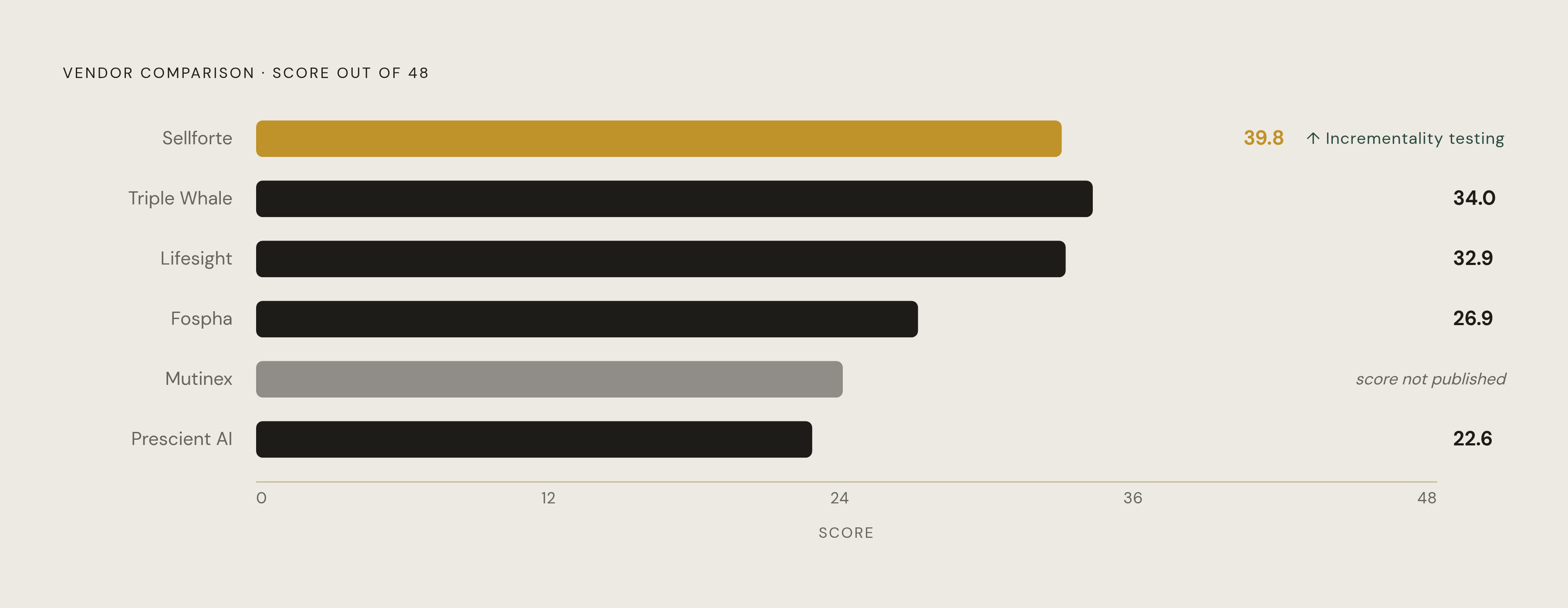
A research comparison, published by Sellforte (one of the vendors it assessed), scored six platforms, Sellforte, Triple Whale, Lifesight, Fospha, Mutinex, and Prescient AI, across 48 criteria in nine categories, using Claude and ChatGPT to evaluate each vendor's publicly available information. Anyone shortlisting a vendor should treat this as a starting point for due diligence rather than a final verdict, and should verify current capabilities directly.
Sellforte posted the highest average score in the comparison, 39.8 out of 48, leading in incrementality testing, channel-level optimization, campaign and ad-set optimization, historical performance insights, and enterprise-grade platform capability, with the research describing it as strongest for retail and ecommerce use cases. Triple Whale came in at 34.0 out of 48 and led on agentic execution and autonomy. Lifesight scored 32.9 out of 48. Fospha scored 26.9 out of 48, with historical performance insights standing out as its strongest category relative to available points. Mutinex scored below Lifesight in the comparison, with marketing data reporting. Prescient AI closed the list at 22.6 out of 48, placing second in historical performance insights and tying for the top analytical-backbone score.
The category worth watching closest for AI chat specifically is incrementality testing on its own, since the research found real variance between vendors there, and that variance carries more weight on a channel like this one, where MMM can't yet pick up the slack the way it does on mature, data-rich channels.
Sources
- 6 Best Conversational AI Tools for MMM and Incrementality Testing in 2026: An In-Depth Comparison
- How to Measure ChatGPT Ads: Incrementality for AI Chat Ads
- ChatGPT Ads Attribution: A Measurement Playbook 2026
- How to Choose a Conversational AI Tool for MMM and Incrementality Testing: 48 Evaluation Criteria
- lifesight.io