Prompt-Level Intent Signals as a Measurement Input
Prompts reveal intent signals that keywords never could.

A Google search runs three or four words. A ChatGPT prompt is a paragraph, sometimes several, laying out a budget, a timeline, a life circumstance, and a half-formed objection all in the same breath. That difference in shape means the intent signal advertisers have relied on for two decades, the keyword, is being replaced by something structurally different: a piece of reasoning captured mid-thought, not a query string. It means the intent signal advertisers have relied on for two decades, the keyword, is being replaced by something structurally different: a piece of reasoning captured mid-thought, not a query string typed into a box. Reading that signal correctly, classifying it, and weighting it inside an auction is quickly becoming its own discipline, separate from targeting and separate from creative. This piece is about that discipline: what a prompt's structure reveals, how it gets classified, why the old measurement stack misses it, and what changes once you treat it as an input rather than a trigger.
What the structure of a prompt tells you about where a buyer is in their decision
A keyword declares a topic. A prompt reveals a process. When someone types "best SUVs under $40k for a family of five, need good highway mileage since we drive to Tahoe every winter," they've handed over a budget ceiling, a use case, a seasonal constraint, and an implicit safety concern in one turn. None of that appears in a search query, because search doesn't reward you for typing more.
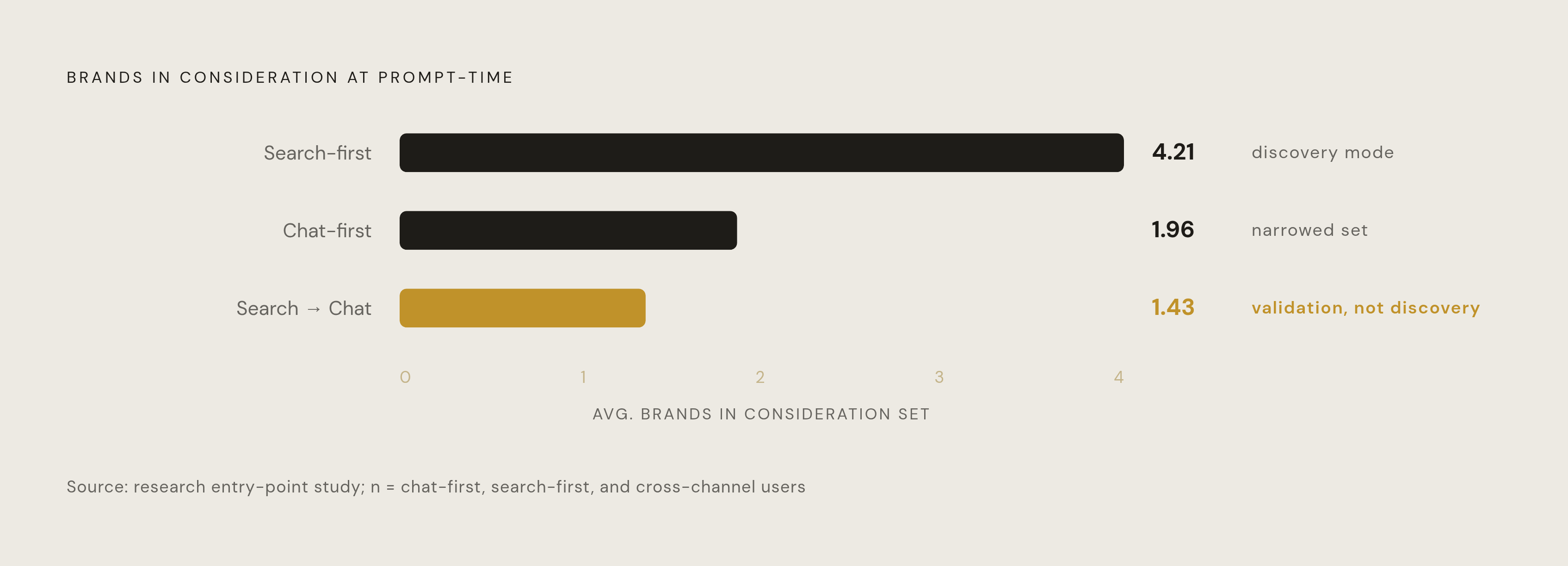
Verve's analysis of multi-prompt consumer behavior found that the first prompt in an AI chat session tends to be unbranded. Users are still working out the category, not yet comparing named products. In the auto category specifically, someone who starts their research in a chat interface arrives with a consideration set of roughly 1.96 brands, on average; the same research found this. Someone who starts in search carries a wider set, about 4.21 brands. Chat users show up already narrower. They've done some filtering before they ever open the conversation.
The order matters, too. Users who search first and then bring their shortlist to an LLM arrive with an average of 1.43 brands already in mind, according to the same research. At that point, the chat is doing validation, not curation work. It's doing validation. The model becomes a sounding board for a decision that's mostly made. Same interface, same product category, completely different intent signal depending on which stage of the funnel the prompt is in.
An AI chat window can host both of these moments, sometimes minutes apart, and they look nothing alike, which is the practical catch for anyone trying to read prompts as signal. Figuring out which one you're looking at has to happen before the signal is worth anything downstream.
Classifying prompt intent in practice: the trigger layer as a measurement input
Underneath any LLM ad system are roughly four layers: demand and auction, context and targeting, creative generation, and measurement and attribution. Prompt classification lives inside context and targeting, but it feeds all three of the others. Get the classification wrong and the auction bids on the wrong thing, the creative answers the wrong question, and the measurement layer reports on an event that never happened the way it thinks it did.
The mechanism that does this classification, often called the trigger layer, is usually a lightweight process: a cheap classifier call, or a set of heuristics run against the prompt text, that decides whether an ad opportunity exists at all before any ad gets fetched. Most systems today treat this as a yes-or-no gate: commercial or not commercial. That's a mistake, or at least a missed opportunity, because a binary gate throws away almost everything useful in the prompt.
Treated as a scored, multi-dimensional output instead of a gate, that same classification step becomes a genuine measurement input. Worth capturing, at minimum, is funnel stage (exploration versus comparison versus validation versus transactional), whether the prompt names a brand or stays at the category level, how specific the stated constraints are (a budget number, a deadline, a narrowed use case), whether the user is voicing friction or a negative reaction to a competitor, and how deep the conversation has gotten, since intent tends to sharpen the longer someone stays in a thread. None of these dimensions require reading the user's raw words back to them later. They just require scoring the prompt once, at the moment it arrives.
The disappearing signal problem: what traditional measurement misses when intent moves into AI chat
Consumer research puts the scale of this shift in plain numbers. 53% of US consumers now use AI tools to research products, and 28% turn to AI for shopping research on a daily basis, based on survey data covering a large sample of US consumers. For a meaningful share of shoppers, over 20% by some estimates, the entire pre-purchase journey now begins inside an AI chat window rather than a search bar.
That's a problem for anyone trying to measure what's working, because the old breadcrumb trail, the sequence of search queries, page visits, and comparison clicks that used to let a marketer reconstruct a customer's path, doesn't get generated when the whole decision plays out in one conversational thread. Clickstream data assumes a series of discrete, observable actions. A conversation doesn't produce that. It produces one long, continuous exchange, most of which no ad platform can see into.
Reported return on ad spend and actual incrementality are diverging, and the gap is widening. More conversions are happening in places platform attribution can't reach: offline, inside an AI assistant, or at the end of a consideration window long enough that any cookie-based system loses the thread. That gap was already present a few years ago. It's larger now, and it grows every quarter that AI chat keeps taking share of the research process away from search.
Privacy architecture and the consent question: what makes a prompt signal usable
None of this works if it requires reading someone's actual conversation. Verve Group's approach to conversational intent is built around that constraint directly: the underlying data comes from users who've opted in through connected applications across major LLM ecosystems, and the methodology is built on a strict privacy-first architecture. The approach is designed so that individual conversations are not exposed to advertisers. In production, that architecture processes over 1 billion signals a day, which is a reasonable existence proof that scale and privacy compliance aren't in tension here so much as they're the same design problem solved once.
OpenAI's published ad policies point at the same boundary from a different angle. The requirement that paid placements stay clearly labeled and independent from the model's organic answer is a data architecture decision. The prompt belongs to the user's experience with the model, and the ad signal belongs to the auction, and those two things need to stay separated for the policy to mean anything.
What actually moves through the system, then, is classified metadata. It's classified metadata, including a funnel-stage label, a category tag, a constraint type, and a flag for whether a brand got named. That metadata can exist, and can drive an entire auction, without the underlying prompt ever leaving the environment it was typed into.
Weighting prompt signals inside an auction: how intent quality changes bid logic
OpenAI's advertising system runs a relevance-weighted, second-price auction, and relevance here comes from conversational context rather than keyword match. The variable deciding who wins the auction is already a classification derived from the prompt, not a bid against a term someone typed into a search box.
Academic work is starting to formalize this. Research by Dubey and colleagues lays out an auction framework meant to ensure that higher bidders get more prominent ad placement inside LLM-generated outputs. Separate work by Hajiaghayi and colleagues examines auctions built on retrieval-augmented generation, where allocation depends on both the relevance score coming out of the retriever and the bid itself. Different approaches, same underlying premise: intent signal quality is a formal input to who gets shown, not something bolted on after the auction clears.
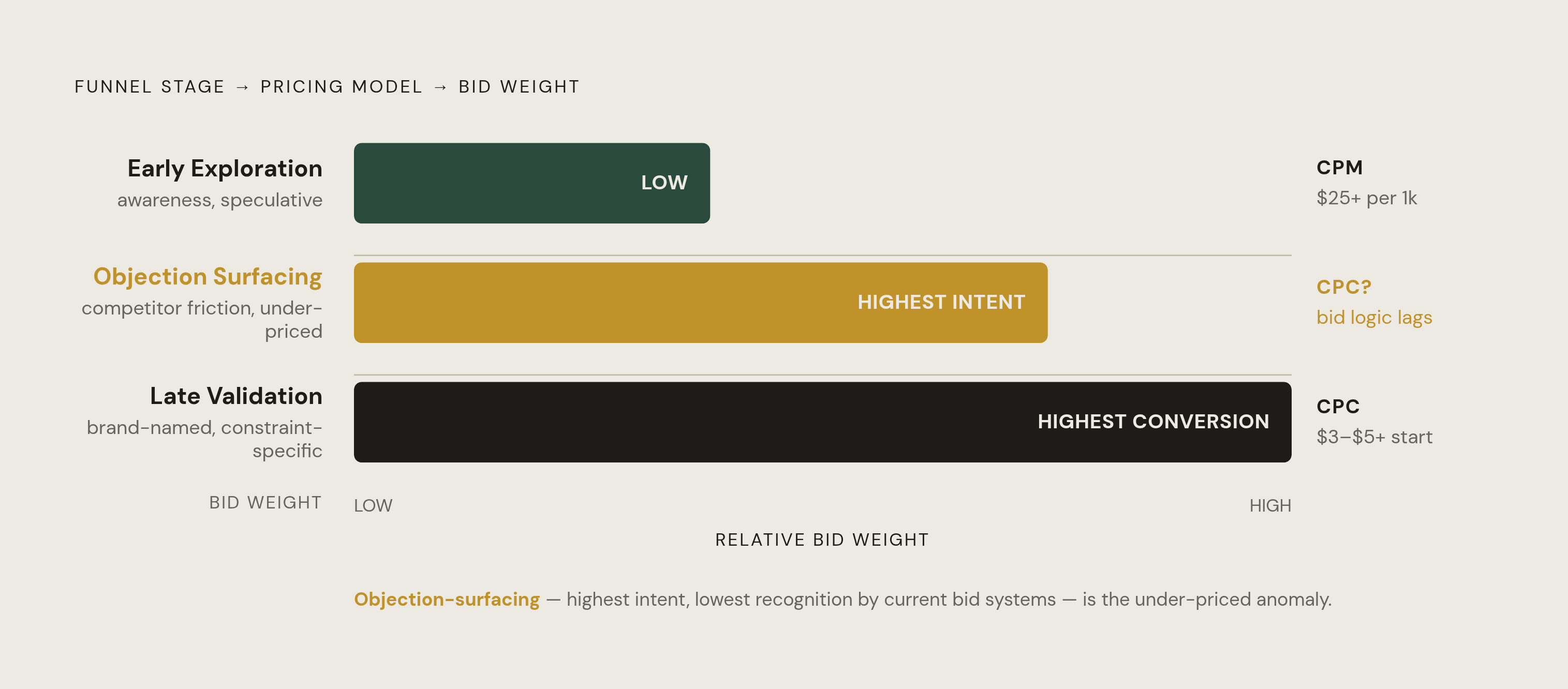
Pricing structure is catching up to this idea, too. ChatGPT's platform added CPC pricing in April 2026, with starting bids in the $3 to $5 range and competitive categories pushing well past that, aimed specifically at advertisers who want to pay for measurable engagement rather than impressions. CPM pricing runs $25 to well above that alongside that. Two pricing models means the same underlying prompt signal can be worth different amounts depending on what the buyer is actually trying to accomplish.
The bid strategy has to change shape depending on where the prompt is in the funnel. A late-stage validation prompt, constraint-specific and brand-named, should command a higher CPC bid, because the conversion probability sitting behind it is genuinely higher. An early exploration prompt is probably better served by CPM, since the awareness value is real even though conversion is still speculative at that stage. And there's a category that most bidding systems still score poorly: the objection-surfacing prompt, where a user voices friction or a specific complaint about a competitor. That's arguably one of the highest-intent moments in the entire funnel, and it's currently under-recognized by most bid logic in production today.
How prompt-level measurement changes campaign performance definition and evaluation
Standard performance metrics, click-through rate, ROAS, last-click conversion, all carry a hidden assumption: that the ad itself was the legible cause of whatever happened next. Prompt-level classification adds a variable that was previously invisible, the intent state of the user at the exact moment the ad was served, and that variable changes how you should read every other number sitting next to it.
A 0.5% click-through rate on a late-funnel validation prompt and a 0.5% click-through rate on an early-funnel exploration prompt are not the same result, even though they're the same number. One might represent underperformance against a highly qualified audience. The other might represent a perfectly normal outcome for a cold, top-of-funnel impression. Treating them identically, which is what most measurement dashboards do today, means optimizing against noise.
Measurement and attribution stays a distinct layer in the stack, but it can't function correctly anymore without ingesting classification data from the context layer upstream of it. A measurement system that sees only impressions and clicks is missing the one variable that explains why those numbers look the way they do.
A few new measurement primitives fall directly out of this. An intent-qualified impression: an ad exposure tagged with the funnel stage and constraint specificity of the prompt that triggered it. An intent-to-outcome conversion rate: conversions segmented by the intent state at the moment of exposure, rather than lumped together by creative or placement alone. A consideration-entry rate: how often a brand shows up inside an AI conversation despite not being named in the user's original prompt, measurable wherever session-level data exists. And a friction-interception rate: how often an ad gets served against a prompt where the user is raising an objection, and what happens downstream from that moment, a performance signal that has no real equivalent in search advertising because search was never built to notice when someone is arguing with themselves mid-decision.
Sources
- Verve Group launches industry-first targeting capability activating conversational intent signals from major LLM environments
- Generative AI Advertising as a Problem of Trustworthy Commercial Intervention
- TeamCMU at Touch\'e: Adversarial Co-Evolution for Advertisement Integration and Detection in Conversational Search
- emarketer.com