Conversational Intent Data as a Leading Indicator of Purchase Demand
People move from research to purchase through conversations with AI chatbots, not search boxes.

Purchase research has started moving out of the search box and into the conversation window, and the shift changes what a demand signal actually looks like. ChatGPT crossed 1 billion weekly users, and standalone chatbot ad spending is expected to hit $0.96 billion in 2026, up more than 1,600% year over year. eMarketer forecasts that 31.3% of the US population will use generative AI search in 2026, which puts this well past the point of a niche habit confined to early adopters Beet.TV emarketer.com OpenAI, 2026 emarketer.com.
This is not "AI-assisted search," a distinction that matters here." A user typing three words into a search bar is doing something structurally different from a user describing a problem to an assistant, naming constraints, and asking follow-up questions in the same breath https://www.emarketer.com/content/why-llm-conversations-next-big-source-of-consumer-intent-data. That difference in signal richness is the argument this piece is built around.
None of this means the money has caught up to the behavior yet. More than 80% of AI ad spending in 2026 still sits adjacent to AI-generated content, things like Google AI Overviews, rather than inside pure chat interfaces. That gap between where attention has moved and where ad dollars still sit is exactly where the rest of this argument lives, and it starts with what a prompt contains that a keyword never could.
What a keyword tells you versus what a prompt tells you
A keyword is a compressed fragment. It strips away budget, timeline, motivation, and context so it can fit inside a search box, and whatever nuance the user had in mind gets flattened into two or three words a query engine can match against an index https://www.emarketer.com/content/why-llm-conversations-next-big-source-of-consumer-intent-data.
A prompt carries none of that compression. Users describe a problem, name constraints, volunteer a budget, and ask follow-up questions, all in natural language, all inside a single session. Verve data cited by eMarketer shows that in sports and fitness categories alone, users average 23 prompts per session and sometimes share biometric data pulled from wearables emarketer.com. A single conversation like that reveals shoe preferences, dietary restrictions, location constraints, and training goals all at once, in a way no keyword was ever built to carry. A behavioral profile assembled over weeks of browsing might eventually approximate that picture. The conversation just gets there in one sitting.
Verve's analysis cited by eMarketer found that roughly 60% of LLM prompts are informational and about 40% are transactional Beet.TV emarketer.com. That split sounds like it should favor keyword-style search, where informational and transactional queries are also common. It doesn't, because the depth inside a single LLM session dwarfs what a traditional search log captures Beet.TV emarketer.com. Even the "informational" prompts, the ones that look like pure research on the surface, tend to carry purchase-adjacent detail that a keyword search never would. That's a different category of signal, not a marginal improvement in data quality.
How a Prompt Reveals the Stage, Specificity, and Urgency of a Purchase Consideration
Some patterns recur often enough to be treated as reliable markers. Analysis from getchatads.com identifies a cluster: a specific brand and model named, price or deal language, action verbs like "buy" or "order," and explicit constraints such as a stated budget or use case. When these elements appear together in a session, the intent behind them is not ambiguous.
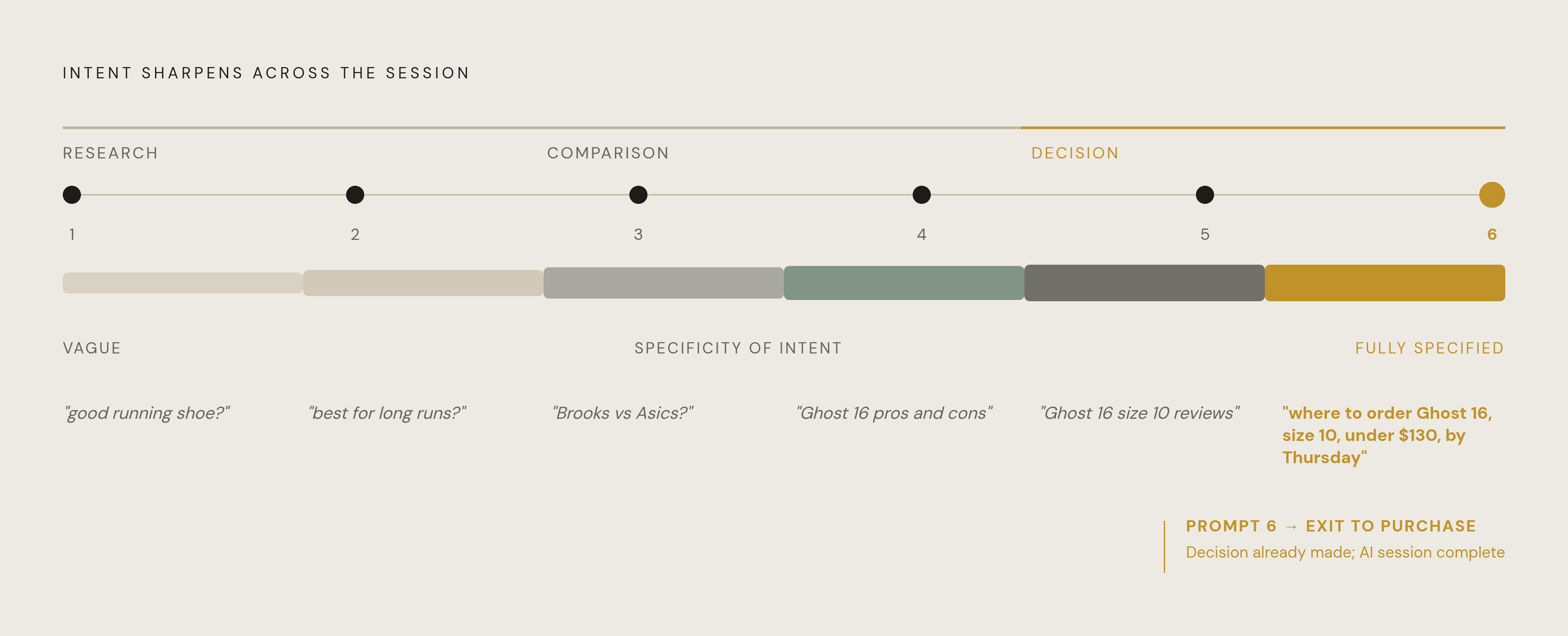
Specificity itself is the tell. A user asking "what is a good running shoe" is still researching. A user asking where to order the Brooks Ghost 16 in a size 10 for under $130 by Thursday has an imminent decision already half-made Beet.TV Salesforce State of Marketing, 2026. The sentence structure alone makes it audible, no inference required.
Verve data cited by eMarketer puts the typical arc at about 6 prompts before a consumer moves to an ecommerce site to complete a purchase. That 6-prompt window is where intent matures from vague interest into something actionable, and it gives advertisers a rough clock to work against.
Behavioral profiling, by contrast, has always been an exercise in inference. A profile guesses at intent from past clicks and demographic proxies. A prompt states intent outright, in context, in the user's own words. It's declaration standing in for inference, and it changes where in the funnel an advertiser should actually be paying attention: not after the decision (retargeting), not before the category even exists in the user's mind (awareness), but during the conversation where the decision is actively being formed. Conversion timing correlates with category: within 48 hours for high-intent categories like flights or new phones, and up to 2 weeks for considered purchases, so knowing which category a conversation belongs to tells you how urgently to act on the signal (emarketer.com).
Why conversational intent is structurally earlier in the buying cycle than any signal that preceded it
Search intent data has always mattered because it reflects a real stage in the path to purchase. But per Verve's own analysis, conversational intent inside AI chat environments happens even earlier in that path. The mechanism is straightforward once you see it: a user opens an assistant to figure out what they even want before they know what to type into a search engine. The conversation precedes the query, and the query precedes the purchase. The prompt sits at the leading edge of that whole sequence.
B2B intent analysis from dwmedia.com frames this as buyer intent moving past passive signals toward active, real-time indicators. The imperative that follows is to read intent out of unstructured conversation and anticipate need before a search query ever gets typed. A meaningful share of buyer intent in 2026 now originates in what gets called "dark intent," unstructured sources like private communities, dark social, and AI-driven conversational research that never appears in a search log at all. Search-based intent tools are structurally blind to that entire layer.
Intensity matters as much as origin. Launchleads.com's analysis of intent data finds that a sudden spike in research activity around a category tends to signal a decision closing in fast, while steady, low-level interest signals someone still in the early education phase. The same logic holds inside AI sessions, and prompt cadence makes that pattern visible in something close to real time. Digitalapplied.com's 2026 data shows intent-sourced opportunities carry 23% higher average contract value, because they enter the funnel later, with budget already approved emarketer.com. Signal quality translates directly into deal quality. It's not an abstraction.
How conversational intent data is collected and processed without exposing individual users
The collection model matters as much as the signal itself, and it works differently from anything search advertising built before it. Verve's own description, cited by eMarketer, states that opted-in users share pseudonymized AI chat activity through apps they already use, with signals flowing in from across major LLM-based environments. That data gets aggregated and pseudonymized before any insight is derived from it, and brands end up with modeled audience intelligence, not personal information. There is no one-to-one targeting in this model.
The signal is genuine, but it arrives as a population-level pattern rather than an individual profile, which is a fundamentally different object than a keyword bid tied to a search term or a behavioral cookie tied to a browser. OpenAI's own approach follows a similar logic: ads inside ChatGPT get shown based on the topic of conversation, past chats, and past ad interactions, but advertisers don't receive chat content or personal details, though limited identifiers such as cookie IDs may be shared, and advertisers do get aggregate performance data. OpenAI has stated that ads run on systems separate from the chat model itself and cannot influence the answers a user receives.
As third-party cookies keep fading out of the ecosystem, context is becoming the foundation targeting gets built on instead. Andrea Tortella, CEO, said in a Beet.TV interview: "the future of the cookie is actually context." For advertisers, that means targeting gets matched to the intent of the conversation happening right now, not pulled from a stored profile assembled over months. The signal is real-time and consent-adjacent by design, not something retrofitted onto old surveillance infrastructure after the fact.
What conversational intent data can reveal that legacy signals structurally cannot
A click tells you what a user did. A prompt tells you why they're considering doing it. Legacy signals reveal behavior after the fact; conversational signals carry motivation, constraint, and context volunteered directly in natural language, none of which can be reliably inferred from a URL or a demographic bucket.
Verve's approach combines on-site search, LLM interactions, and zero-party data into one view of the consumer journey, and the combination outperforms any single source because the LLM layer fills in the pre-search phase that search data alone simply can't see. A prompt that names a specific brand, model, price ceiling, and use case all at once collapses what would otherwise take several retargeting touches in a programmatic campaign down to a single conversational turn.
The prompt arc also carries a temporal dimension search never offered. The 6-prompt arc shows not just what a user wants, but how far along they've gotten in deciding it. A mid-arc prompt like "compare these two options" is a different commercial moment than a late-arc prompt like "where do I buy this," and the two should trigger different responses from an advertiser paying attention.
None of this is fully solved yet. Measurement and attribution in assistant-mediated discovery remain genuinely unresolved problems, and the path from a conversational ad exposure to a downstream conversion is harder to trace cleanly than a search click ever was, and that gap should not be glossed over.
Where this heads next is agentic. As agents start taking action on a user's behalf, Tortella has said the goal is to give those agents "as much information as possible" so they can act correctly, with LLMs exposing rich, real-time intent signals whenever a user asks for a recommendation or a decision. That framing implies the intent data layer becomes something like a briefing document for automated purchasing. Gartner predicts 60% of brands will use agentic AI for streamlined one-to-one interactions by 2028 emarketer.com. The intent signal feeds the agent, the agent closes the purchase, and the marketer's job becomes showing up at the exact moment the intent crystallizes rather than chasing it afterward.
How brands should read and act on conversational intent signals differently from how they use search or behavioral data
The core adjustment is replacing static intent categories with dynamic, context-aware profiles that anticipate need before a search query ever gets typed, a shift dwmedia.com documents in B2B contexts that applies just as directly to consumer buying. A brand still running static segments built off last quarter's search behavior is working from a stale map.
Engagement has to match where someone sits in the prompt arc. A user two prompts into a research session needs a different kind of creative than a user five prompts in who has already named a brand and a delivery deadline; the arc is a pacing signal as much as a targeting one. Category matters operationally too. The 48-hour urgency window on flights or phones demands a real-time response, while the two-week window on considered purchases calls for a slower, more deliberate follow-through cadence emarketer.com.
Creative has to change shape as well. Ads placed inside AI conversations need to be native to the answer format itself, since the user is reading prose, not scanning a feed, and generic display creative simply fails in that context. IAB's Outlook found that 96% of buyers are aware of agentic AI for ad buying and campaign execution, but confidence runs higher for performance analysis and creative optimization than for deal negotiation. The gap sitting unaddressed is in creative and measurement, not in awareness.
On the B2B side, dwmedia.com frames the requirement as orchestrating hyper-personalized engagement around micro-moments of buyer interest. The prompt is the micro-moment, and the response has to match the actual conversational context rather than recycling a generic campaign message. Meanwhile, Salesforce's State of Marketing report found that 88% of marketers have already begun optimizing for AI-generated responses Salesforce State of Marketing, 2026.
What a purpose-built conversational AI advertising platform does that legacy DSPs and single-surface networks cannot
Generalist DSPs have reach across a wide range of channels, but they were built to match against a page URL or a demographic profile, not against the intent inside a live conversation. That's not a knock on their design so much as a description of what they were built to do, and reading conversational context was never part of the brief.
Single-surface AI ad networks, the kind that buy inventory only inside one assistant, solve part of that problem. They can read context within their one surface, but they can't offer reach across the growing set of AI environments where purchase-adjacent conversations are actually happening. Between those two limitations, generalist reach without context, and contextual precision without reach, sits the category that conversational AI advertising is actually built to fill: cross-surface reach, matched to conversational context, backed by direct publisher relationships that make the context signal available in the first place.
Direct publisher supply is what makes the matching real rather than approximate. The ad request gets tied to the live conversation itself, not to a keyword the user typed on a different surface two minutes earlier, but to the actual prompt that triggered the ad slot. Format adds another layer of complexity. The four production surfaces in this space, the after-answer inline card, the sidebar, the sponsored follow-up chip, and the response-grounded brand mention, each carry different latency budgets, different UX costs, and different revenue ceilings. Operating across all four requires publisher relationships and technical infrastructure that legacy DSPs were never built to provide.
The AI-in-advertising market is projected to reach $36.34 billion by 2030, growing at a 26.7% compound annual rate Research and Markets, AI in Advertising Market Report, 2026. That scale is large enough to justify building purpose-fit infrastructure rather than retrofitting tools designed for a different era of the internet. The argument running through this entire piece, that the prompt is a structurally earlier and richer demand signal than anything that came before it, only pays off commercially if the infrastructure exists to intercept that signal at the moment it occurs, on the surface where it occurs, with creative matched to the conversation itself. That's not a marketing claim. It's the operational definition of what conversational AI advertising, as a category distinct from everything that preceded it, actually has to do.