Cross-Channel Attribution When AI Assists the Consideration Stage
AI assistants obscure the clicks and keywords traditional attribution relies on.

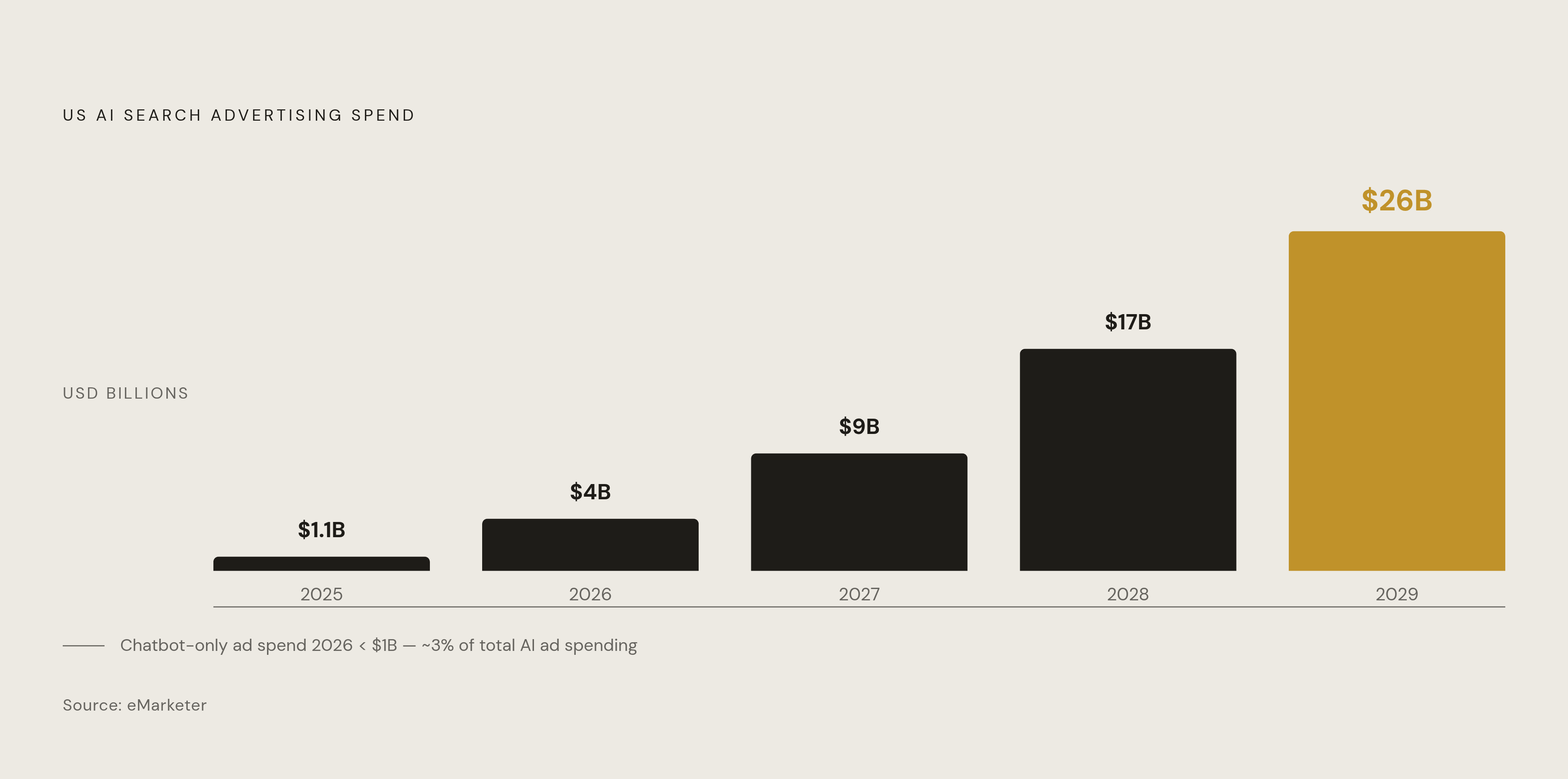
Attention is moving out of search boxes and social feeds and into conversational AI interfaces, and it's happening fast enough to measure in real time. eMarketer expects US AI search advertising spending to climb from $1.1 billion in 2025 to $26 billion by 2029, a trajectory that looks structural rather than a passing spike tied to one product cycle. Standalone chatbot ad spending is still a small slice of that total, with eMarketer putting 2026 revenues under $1 billion, roughly 3% of all AI advertising spending, but growth rates of that order don't appear in a channel that remains peripheral.
What matters more than the dollar figures is where in the buying process these tools get used. Users come to AI assistants mid-funnel (exploring options, comparing products, and working through decisions across multiple conversation turns), at the consideration stage. That's consideration-stage behavior, stretched across multiple turns of a conversation rather than compressed into a single query. It's a slower, more layered kind of intent than a keyword ever captured, and it's exactly the stage of the funnel where attribution has always mattered most.
What traditional cross-channel attribution assumes
Cross-channel attribution was built to reconstruct a path out of things that leave a trace: clicks, page visits, keyword strings, impression logs, UTM parameters. Last-click, linear, time-decay, data-driven, whichever model a team picks, they all share one premise. The channel produced a traceable event at the moment someone touched it.
They also assume the advertiser can see the touchpoint, or at least control it: a served impression, a landing page visit, a form fill. Take that assumption away and the model has nothing to work with. Multi-touch attribution exists precisely because customers don't convert on one touch. Improvado's analysis found that 73% of customers interact with multiple touchpoints before purchase. But the journeys these models are supposed to map were already getting harder to see well before AI assistants entered the picture. And the IAB's State of Data 2026 found that a large majority of US buy-side leaders already say core measurement approaches, attribution analysis, incrementality tests, MMM, underperform. AI assistants don't introduce a new problem so much as they arrive at a moment when the old one was already showing cracks. Privacy regulations, walled gardens, and cookie deprecation already obscure 42–65% of customer journeys, per the same source, meaning attribution was already under pressure before AI assistants entered the picture.
Where AI assistants break the attribution chain
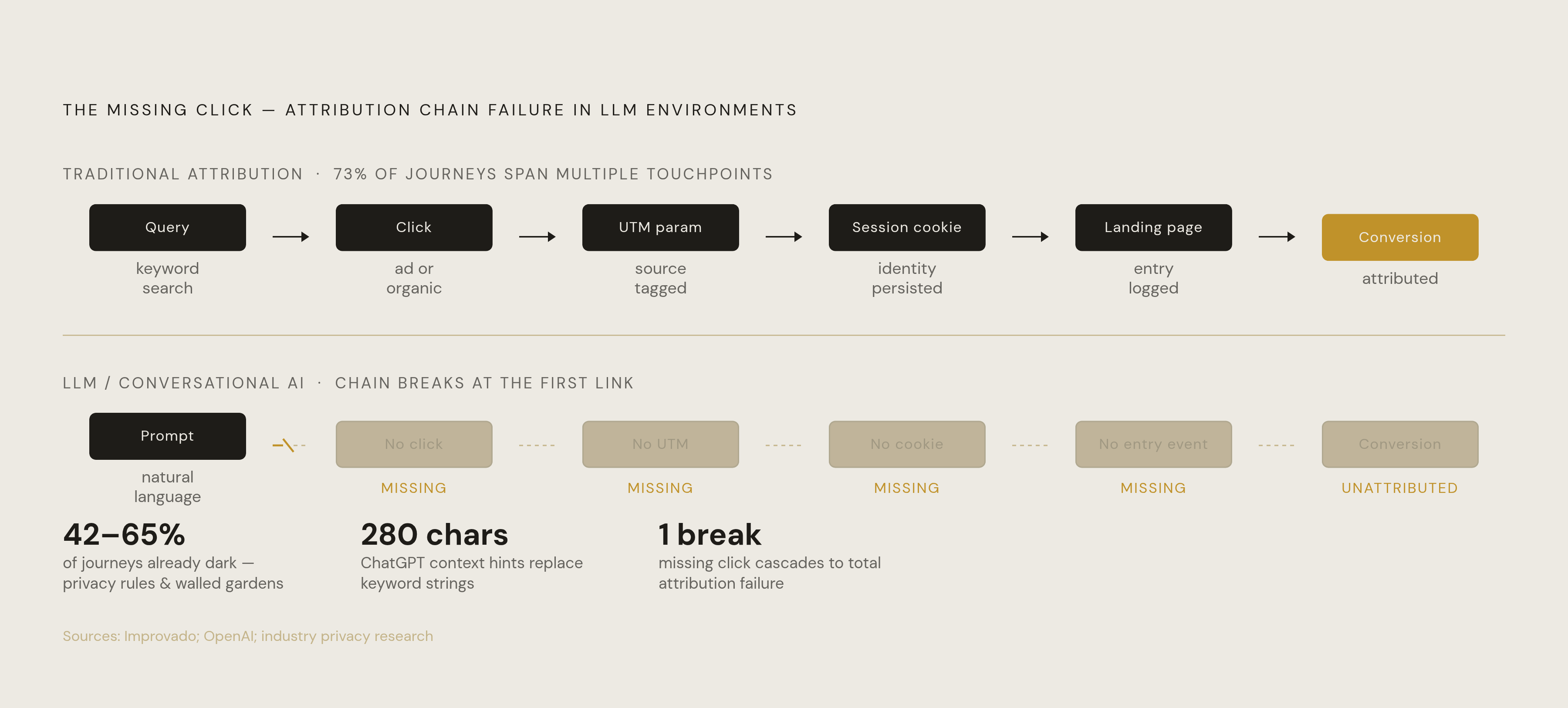
Start with the click, because that's where everything else in traditional attribution begins. LLMs are likely to stay largely clickless environments: the assistant reads the question, synthesizes an answer, and recommends something, and the user often never follows a link at all while still in the consideration stage. No click means no UTM parameter, no session cookie, no landing page visit. The entire event simply doesn't exist in the attribution record. Industry commentary reported by MMM Online frames this as a shift in what's actually monetizable: the unit of value moves from pages and impressions to intents, tasks, and decision moments inside a conversation, and none of those moments produce a signal that current attribution stacks know how to read.
The assistant weighs a few options and mentions one by name. That mention is a real touchpoint, the brand just entered consideration, but it generates nothing the advertiser can observe or claim credit for. Google's AI Overviews and AI Mode already show this pattern at scale, suppressing clicks while impressions keep piling up, so the gap between how much influence a placement has and how much of that influence is actually measurable keeps widening.
Keyword matching, the backbone of search attribution, doesn't survive the transition either. ChatGPT's ad targeting runs on 280-character natural-language context hints, a string array rather than a single keyword, resolved through a relevance-weighted second-price auction. There's no keyword string left to match back against a search query report, and nothing to reconcile against a keyword-level attribution model built for a different kind of query.
Timing compounds the problem. B2B buyers already average a long string of touchpoints across 45 to 90 days of research before they go dark during internal approval. AI-mediated consideration stretches that dark period further, because the research itself is richer and happens somewhere advertisers can't see. Even the audience data that does exist comes with a skew built in: ChatGPT ads currently reach only Free and Go tier users, since Plus, Pro, Business, Enterprise, and Education tiers are all ad-free. Whatever attribution data comes out of that platform reflects a subset of the audience, and it systematically excludes the users who are probably the most engaged. Layer on top of that the fact that Google AI Overviews and Microsoft Copilot serve eligible campaigns automatically, with no advertiser opt-out, only a user-level opt-out of personalized ads. Advertisers may already be showing up inside AI answers they never structured measurement for, so blind spots exist inside campaigns marketers think they already understand.
Conversational intent signals and their mismatch with legacy measurement
A keyword tells you what someone typed. A conversation tells you why they want it, how far along the decision they are, and what kind of answer would actually help, which is a far richer signal than anything a search query report ever offered. When someone asks an assistant for a recommendation or a comparison, that's a live intent signal, not something inferred later from a click pattern or a retargeting pixel.
Verve Group became, as of March 2026, the first ad technology provider to activate conversational intent signals for targeting drawn from leading LLM environments. The platform processes over 1 billion daily signals, pulling zero-party data, search intent, and pseudonymized AI chat activity into one intelligence layer, without cookies or IDFA. Data comes from opted-in users inside leading LLM ecosystems via connected applications, and only aggregated, high-level metrics and pseudonymized behavioral patterns get retained. No raw message content is stored.
None of that plugs neatly into the old attribution logic. Conversational intent is a targeting and qualification signal, not a conversion event, and it sits earlier in the funnel than anything traditional attribution was ever designed to give credit for. The performance events that actually matter in this environment are things like "recommended," "shortlisted," "mentioned in answer," or "chosen." They're closer to "recommended," "shortlisted," "mentioned in answer," or "chosen," and most of those events happen entirely out of view of any external measurement tool available today.
How platform architecture choices shape, and constrain, what marketers can measure
ChatGPT's ad targeting uses 280-character natural-language context hints resolved by a relevance-weighted second-price auction, so there is no keyword string to match back to a search query report or reconcile against a keyword-level attribution model. That separation means the model's actual response isn't observable as an ad event. ChatGPT supports both CPM and CPC buying through its relevance-weighted second-price auction, and OpenAI has rolled out conversion measurement along with a self-serve Ads Manager. But the auction itself reads context hints, landing pages, and ad copy, not keyword strings, so reconciling ChatGPT reporting with search-side attribution takes real work, not a simple export. OpenAI's pilot program required a substantial minimum spend commitment at a premium CPM, which signals the environment is being treated as high-quality and brand-safe. Still, premium CPM pricing paired with limited click events makes ROAS measurement, using the standard models most teams already run, structurally hard to pull off.
Google AI Overviews and Microsoft Copilot take a different path entirely. Eligible campaigns serve automatically, no opt-in required and no opt-out available to the advertiser, and the platform's own machine learning handles cross-surface optimization without exposing separate bidding or reporting for each AI surface. An advertiser can be running the same campaign it always has and simply find itself inside an AI answer it never set up separate tracking for.
Perplexity is the clearest evidence that measurement isn't the only obstacle here. The platform reached significant scale in monthly queries and users, then shut down its ad program entirely in February 2026, citing concerns about user trust, and pivoted toward subscription and enterprise revenue as an ad-free product. Perplexity reached tens of millions of monthly queries and users before shutting down its ad program. The channel closed anyway. Perplexity's own executives told the Financial Times that once ads started appearing, users began questioning whether the answers themselves were still neutral, a trust problem that would complicate any attempt to measure lift from AI-mediated consideration even if the ad program had survived. Anthropic, for its part, sells no ad placement inside Claude at all, which marks one end of the range of positions platforms are taking on this question.
OpenRTB 2.6 is emerging as the programmatic plumbing for these environments, but the auction dynamics differ enough from display and search that the standard itself doesn't yet come with matching measurement conventions built on top. The pipes exist. The reporting layer that should sit on top of them mostly doesn't yet.
Updated attribution frameworks built around conversational intent
The starting point has to be acceptance: AI-mediated consideration is not going to produce click-level attribution data, so measurement needs to be rebuilt around what actually can be observed, incrementality, brand lift, share of recommendation, and downstream conversion patterns. That's not a workaround so much as a different foundation.
Incrementality testing gets more important under this framework, not less. Improvado's 2026 analysis found that brands using custom algorithmic attribution paired with incrementality testing get 35 to 50% better ROAS than brands leaning on platform-native last-click attribution, and that gap should widen further once a meaningful share of consideration is happening somewhere off-platform. Marketing Mix Modeling regains some of its old relevance too, since its channel-level approach to isolating contribution is about the closest proxy available when individual touchpoints can't be tracked one by one.
The industry's coordinated response is still forming. The IAB's Project Eidos initiative in 2026 exists precisely because reporting has been stuck inside incompatible channel silos, and a shared push toward common cross-channel attribution and incrementality standards is a signal that the industry recognizes this as a structural gap, not a data-hygiene problem that better tagging will quietly fix. Intent signal activation, the kind Verve Group's platform offers, gives marketers a way to target and suppress audiences based on conversational behavior, a real capability even when it can't close the attribution loop directly. That's a real capability, just not a complete one.
New performance events need their own infrastructure. "Brand mentioned in AI response," "shortlisted by AI," "recommended," these aren't things a pixel can catch. They call for brand tracking surveys, share-of-voice measurement inside AI outputs, and panel-based lift studies instead. Gartner's 2025 research already found that brands running unified cross-channel attribution models see meaningful ROI gains just from cutting redundant spend across fragmented platforms, which makes the case for investing in better measurement even before anyone factors in the AI-specific gaps described above. Agentic AI systems that analyze huge volumes of signals and reallocate budget on cycles far faster than any human review process can keep up with, a dynamic Lapis has pointed to, keep shifting the ground and create real tension between automated optimization and measurement a person can actually read and act on.
Treating AI-assisted consideration in measurement architecture
The right way to think about AI-mediated consideration is as a new category of influence, not as a dark-funnel problem in the old sense, some gap in instrumentation that a better tag or a smarter model will eventually close. It's a new category of influence that needs its own measurement logic built from scratch. Roughly 47% of US brand and agency marketers named attribution and measurement as their top investment priority in 2025, and that money needs to go toward frameworks that don't quietly assume a click will eventually show up somewhere in the data.
Conversational intent is the signal now, in the way page-level data used to be. Marketers waiting for AI platforms to hand them familiar click and keyword reports will keep undervaluing AI-assisted consideration, simply because the evidence of its influence isn't ever going to arrive in that shape. Treating Google AI Overviews, Microsoft Copilot, and ChatGPT as interchangeable impressions inside one unified attribution model compounds the error, since each platform has a different architecture, a different reporting surface, and different limits on what can even be seen, and folding them together will produce output that looks clean and means very little. A demand-side platform built with direct relationships across AI publisher surfaces, designed for conversational environments rather than adapted from older ad tech, is better positioned to surface the intent signals and cross-surface data these frameworks depend on. Generalist buying platforms that can't read conversational context, and single-surface AI ad networks that can't offer reach across surfaces, both leave the same gap sitting open.
Some of this is still being worked out collectively. Project Eidos, the industry's adoption of OpenRTB 2.6, and Gartner's prediction that 60% of brands will be using agentic AI for one-to-one interactions by 2028 all point toward a stretch of active standard-setting ahead. Marketers who get involved now help shape those conventions rather than simply inheriting whatever version comes out the other side.
None of this closes the gap entirely, and it shouldn't be sold as though it does. Some of what AI assistants do during consideration is going to stay unmeasurable by any method available right now. The right response isn't to wait around for better tools to arrive. It's to build measurement architecture that states where the gap is, and puts real investment behind the proxies that do exist in the meantime.
Sources
- LLM Ads Explained: How AI Advertising Works in 2026 | guptadeepak.com Guides
- How to Build an LLM Advertising Stack: Tools, Workflow, and Budget (2026) | Lapis
- Cross-Channel Attribution Guide for Analysts | 2026
- Cross-channel attribution: A guide for marketers in 2026
- Media Buying
- Artificial Intelligence Archives