Zero-Click Search and What It Costs Paid Media Budgets
Google's AI answers are slashing paid search clicks while driving up costs simultaneously.
Zero-click search has broken the founding assumption of paid search advertising: that a person who types a commercial query will land on a page. In early 2026, 68.01% of Google searches ended without a click, and the trend line points at something structural, not seasonal. This piece walks through what that number costs a media budget, where the traffic actually went, and where the money should follow it now.
Start with the definition, because the term gets used loosely. A zero-click search is any query that Google answers on the results page itself: an AI Overview, a featured snippet, a knowledge panel, a People Also Ask box, or plain abandonment after the user reads the page and leaves satisfied. No click to a publisher, no click to an advertiser, no session on the open web.
The trajectory tells the real story better than the snapshot does. Similarweb measured the zero-click rate climbing from 56% in May 2024 to 69% by May 2025, a 13-point jump in twelve months that lines up almost exactly with the rollout of Google's AI Overviews. Put another way, using SparkToro and Datos' Zero-Click Search Study, for every 1,000 searches run in the US on Google, only 360 end up sending a person anywhere on the open web. The other 640 stop cold, right there on the results page.
Device shapes the outcome: mobile queries end without a click 77% of the time, versus 46.5% on desktop. Mobile queries end without a click 77% of the time; desktop is 46.5%. The mobile-first shift in consumer behavior produces that gap in the aggregate figure, and the zero-click problem is not evenly distributed across a media plan. It's worse wherever mobile inventory dominates.
None of this means search demand is shrinking. BrightEdge recorded a 49% jump in total search impressions over the past year, so people are searching more, not less. They're just clicking less on the way to an answer, which is a different problem than declining demand, and a more dangerous one for anyone whose budget assumes clicks scale with volume. Gartner has forecast a 25% drop in traditional search engine query volume through 2026 as users shift to answer-first interfaces instead. Treat that as directional, not gospel, but it points the same direction as everything else here. And AI Mode, Google's fuller conversational search product, pushes this even further than AI Overviews do. The real damage concentrates there.
Where zero-click is worst, and why AI Mode changes the calculus entirely
Zero-click isn't a flat rate. It swings hard depending on which SERP feature shows up and what kind of query triggered it, and that swing is the first thing a paid media plan has to account for.
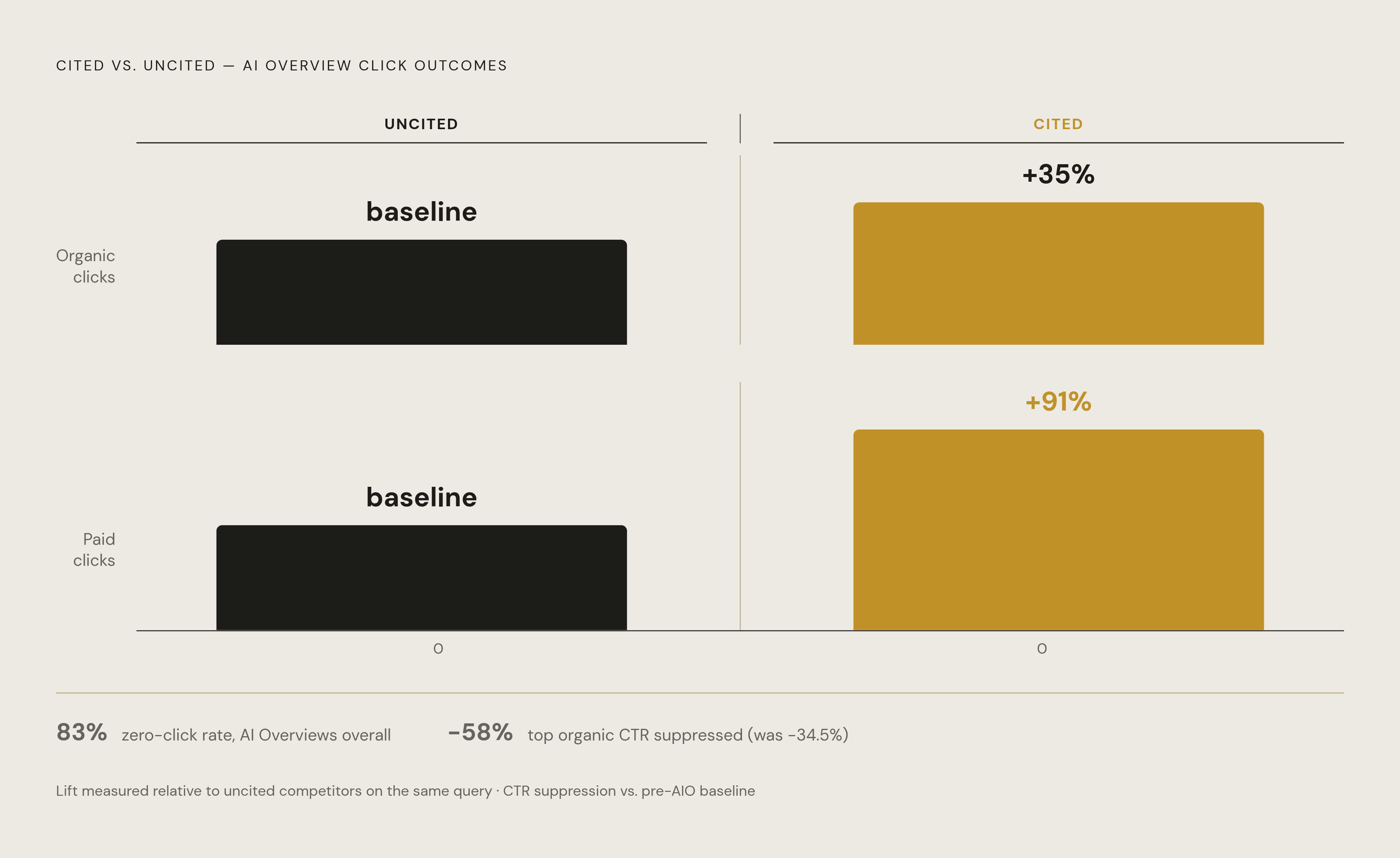
Semrush's Intent Study found informational queries carry a 74% zero-click rate, while transactional queries are just 31%. That gap is the whole ballgame for planning: the queries people research carry almost no click-through anymore, while the queries people use to buy something still send traffic. Layer in the Bain & Company and Dynata Generative AI Consumer Survey: when an AI Overview appears at all, 83% of those queries end without a single click, regardless of intent type.
AI Mode is a different animal entirely, and treating it like a bigger AI Overview misses the point. AI Overviews sit above organic results and summarize them; AI Mode replaces the results page with a conversational interface and doesn't show organic listings alongside it. Semrush measured a 93% zero-click rate inside AI Mode as of September 2025. Organic SEO has no reach into that experience unless a brand gets cited directly inside the AI-generated answer. The old fallback, "if paid underperforms, lean on organic," doesn't function here. There's no organic result to lean on.
AI Overviews already appear across a broad share of Google results pages, and the feature currently skews toward broad research queries. Agency buyers expect that skew to shift toward higher-commercial-intent territory over time, which is the queries advertisers actually pay for. The pressure to reach users on pages where an AI Overview shows up is reshaping how advertisers think about query targeting. That pressure feeds into the broader CPC inflation already under way.
What AI Overviews do to paid and organic CTR at the same time
Seer Interactive ran the most thorough study on this to date: 3,119 informational queries across 42 organizations, covering 25.1 million organic impressions and 1.1 million paid impressions. The findings settle an argument that's been mostly speculative until now.
Paid click-through rate on queries with an AI Overview present dropped from roughly 21.27% to 9.87%, a fall of more than half on the exact same query set. Organic CTR on those same AI Overview queries fell from 1.76% to 0.61% between June 2024 and September 2025, a 65% collapse. Combined, Seer found AI Overviews cut organic CTR by 61% and paid CTR by 68% on the same searches. Both channels take the hit at once, on the same page, from the same feature.
That simultaneity is the actual crisis, more than either number alone. The standard move when organic traffic drops is to shift budget into paid. When both collapse together on the identical query, that lever doesn't exist anymore. The only path back to visibility is earning a citation inside the AI Overview itself. That isn't a media buy; it's a content and structure problem.
Pew Research backed this up with behavioral data: 900 US adults, 68,879 tracked searches, browsing data collected in March 2025. Only 8% of users clicked an external link when an AI Overview appeared, versus 15% when it didn't, nearly a 50% drop. Just 1% clicked on a link embedded inside the AI Overview text itself. And 26% of AI Overview searches ended the entire Google session right there, compared with 16% for searches without one.
That 26% figure gets the least attention and deserves the most. That traffic didn't go to a competitor's site. It didn't go anywhere. The person got their answer and closed the tab, which is structurally different from every prior SERP shift, where lost clicks at least went somewhere measurable.
A follow-up study using a similar methodology found the position-one effect nearly doubled in eight months. Their study found AI Overviews suppressed the top organic ranking's CTR by 34.5%. By December 2025, that number had climbed to 58%. Ranking first on Google used to mean something close to guaranteed traffic. It increasingly doesn't.
How the budget math breaks down in practice: CPC inflation stacked on fewer clicks
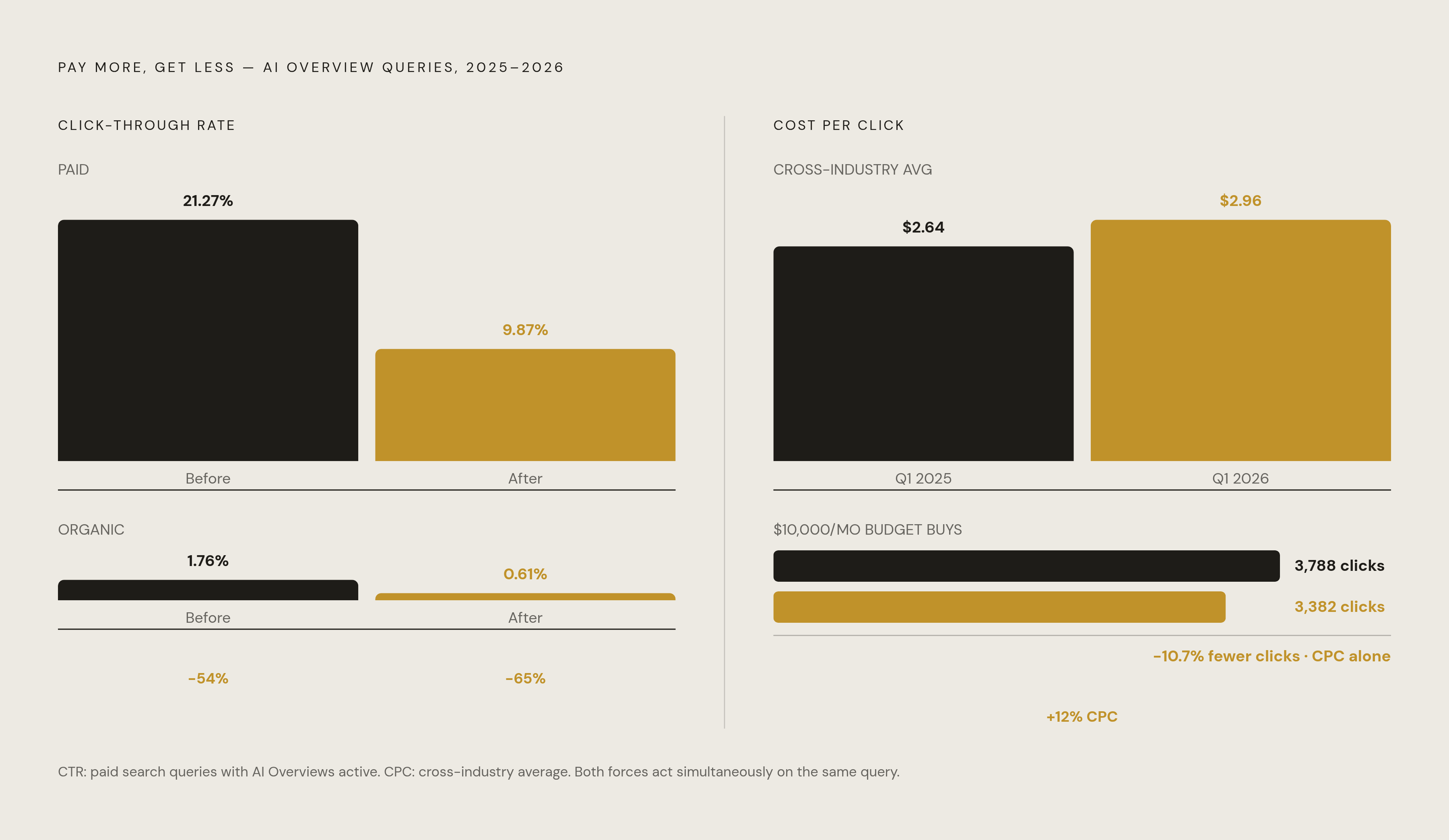
The cross-industry average CPC on Search hit $2.96 in Q1 2026, up from $2.64 in Q1 2025, a 12% year-over-year increase and among the steepest annual CPC rises in recent years. That number alone should worry anyone running a search budget on flat spend assumptions.
Run the arithmetic on a plain example. CPC inflation alone means a $10,000-a-month budget now buys roughly 10.7% fewer clicks than it did twelve months earlier, and that is before accounting for the shrinking pool of clicks available. Stacking the two effects, the real erosion in reach is considerably worse than either figure suggests on its own.
As the total click rate falls, individual ad CTR drops even when position stays fixed, and a lower CTR drags down the ad platform's internal quality rating, which drives the CPC rise. As the total click rate falls, individual ad CTR drops even when position stays fixed, and a lower CTR drags down the ad platform's internal quality rating. A weaker quality rating forces a higher bid to hold the same position, so advertisers end up paying more to stand still. Tinuiti recorded CPCs up 9% in Q2 2025 at the agency level, and practitioners at Media by Mother and NP Digital have described, in Digiday reporting, "everyone chasing the same queries" as AI Overviews push paid ads further down the page.
Between Q4 2024 and Q1 2025, search revenue fell 16.45%, part of a broader pattern of pressure across digital advertising channels. That spread suggests something broader than an issue specific to one search platform, though search is where the mechanism is clearest. Wpromote has responded by recommending short-term increases in paid spend on brand and non-brand keywords to protect high-conversion queries from erosion, a move the agency's own SVP of owned-and-earned media called a "band-aid" in that same Digiday reporting. It's an honest label. Bidding harder to defend a shrinking pool of clicks pushes CPCs up further still, which makes the fix part of the problem it's trying to solve.
Kinesso's Dan Toplitt has flagged Amazon's withdrawal from Google Shopping ads as a factor complicating the broader search market picture, on top of everything else. Isolating the zero-click effect from other market shifts happening at the same time isn't simple.
What the traffic data from real publisher casualties reveals about where the web traffic went
Across a panel of more than 75,000 websites, Google's share of referred traffic fell by roughly 22% between June 2025 and May 2026. Individual publisher stories behind that aggregate number make the abstraction concrete.
HubSpot's monthly organic visits fell sharply through late 2024 and into 2025, with reports of a 70–80% organic traffic drop across 2024 and 2025 combined. Business Insider saw significant organic search traffic losses over that period and cut about a fifth of its staff in May of that year. HuffPost also reported substantial losses in search referrals over the same stretch. The New York Times saw search's share of its site traffic decline meaningfully over the same period.
Smaller publishers without the Times' brand recognition or HubSpot's product-led traffic have fared worse, some closing. Self-reported losses across smaller sites range from 20% up to 90% of traffic and revenue, and that spread comes down to how dependent a given publisher was on informational-intent queries, the exact category taking the 74% zero-click hit.
AI referral traffic is growing fast on a percentage basis, just from a tiny starting point. AI platforms have begun sending meaningful referral traffic to publisher sites, and that volume is growing quickly on a percentage basis. But traffic from AI platforms combined still makes up a small fraction of total publisher traffic. The Previsible AI Traffic Report for 2025 found sessions from AI referrals grew more than fivefold year over year in the first five months of the year, which sounds dramatic until it's measured against the scale of what Google took away. It isn't close to offsetting the loss yet.
That asymmetry matters directly for paid budgets, not just publishers. Plenty of advertisers built funnels where content marketing drove organic visitors who then got retargeted through paid. If the organic top of that funnel is drying up, the retargeting budget downstream has fewer people to work with, no matter how well the retargeting itself is built.
The one signal the data keeps returning to: conversion quality on the traffic that remains
Seer Interactive's portfolio data across six verticals, tracked from December 2025 through May 2026, shows nonbrand impressions growing 28% while nonbrand CTR fell from 16.39% to 14.13%. More people see the ad. Fewer of them click it. That part fits everything above.
What's less expected: as CTR fell, the sessions that did arrive converted at a higher rate, most consistently in B2B SaaS and Healthcare. Seer's read on this is that zero-click search is acting as a filter. The low-intent browsers get answered on the results page and never leave it; the people who still click through have effectively pre-qualified themselves before they ever land on the site.
Direct traffic backs this up. It grew while organic search fell, and in Seer's portfolio data, direct traffic overtook organic search as the largest channel in November 2025. That's brand-aware users typing a URL or searching a brand name directly instead of running a broader query, a behavior that skips the zero-click gauntlet.
The C-suite commentary lines up with the data. Airbnb CEO Brian Chesky told analysts on the company's Q4 2025 earnings call that "traffic that comes from chatbots converts at a higher rate than traffic that comes from Google." Expedia CEO Ariane Gorin, in the same reporting window covered by Digiday, said AI search "opens up even more possibilities to reach more travelers," and that richer context in those searches gives Expedia "an opportunity...to better target and then...better convert."
Semrush and Seer Interactive both point to AI search visitors converting at somewhere between roughly four and nine times the rate of traditional organic visitors, though that range is wide enough to warrant real caution before treating it as a fixed multiplier. Industry and query type swing it hard. In Consumer and Retail, the rising conversion picture was "muddier," and in Insurance, the improvement was largely an artifact of tighter campaign targeting rather than genuinely better traffic. A rising CVR isn't automatically good news. It can just as easily mean the addressable audience got smaller and more self-selected, which is a different outcome than the channel getting more effective.
That's the tension sitting under all of this: volume is shrinking and quality, in some cases, is rising, but those two things moving in opposite directions isn't a strategy. Optimizing for conversion rate on a pool of traffic that keeps getting smaller just delays the reckoning with where the budget needs to go instead.
Where high-intent moments have migrated, and what the citation advantage reveals
Intent hasn't disappeared. It moved upstream, into the AI conversation itself, where the prompt a person types carries the signal that a matched keyword used to carry on a results page.
The clearest evidence for that shift is the citation asymmetry. Brands that get cited inside an AI Overview earn 35% more organic clicks and 91% more paid clicks than uncited competitors answering the exact same query. The same feature that guts click-through for everyone else lifts the brands that manage to get named inside the answer. That's not a small effect. It's close to a different game entirely, running on the same results page.
Transactional queries, the 31% zero-click segment, still send meaningful traffic. The erosion described throughout this piece concentrates almost entirely in informational queries at 74% zero-click. Buying decisions still generate clicks. Research does not.
WPP Media's global VP of SEO has described what's happening as consumer discovery and evaluation moving inside AI summaries, and Expedia's Gorin made a related point about AI search opening new paths to reach and convert travelers, in that same February 2026 Digiday coverage. Purchase still requires stepping out of the AI interface and onto a site, at least for now. But the moment where someone forms intent, decides what they want, compares options, has already relocated into the conversation before that final click ever happens.
ChatGPT's move into commerce shows how fast this is turning transactional rather than purely informational. Target, Sephora, Nordstrom, Lowe's, Best Buy, The Home Depot, and Wayfair are now integrated for in-ChatGPT product discovery through the Agentic Commerce Protocol. That's intent that used to express itself as a Google Shopping query starting to express itself inside a chat window instead.
Most of the industry hasn't caught up operationally. GoodFirms found that 43% of marketers say they're optimizing for AI search, but only 14% actually measure it, an 86% gap between what brands claim to be doing and what they can prove is working. Chasing the channel without measurement infrastructure in place is chasing it blind.
Whoever can read conversational context across AI surfaces, not one chatbot in isolation, and not a generalist retargeting tool trying to catch someone after the fact, is positioned to capture intent at the moment it actually forms. That's what paid search promised advertisers back in 2005, and it's the exact promise the zero-click era is quietly breaking.
The state of advertising inside AI interfaces: what each platform has committed to
Google has moved the fastest of the major platforms, and its steps so far are concrete rather than speculative. Ads expanded into AI Overviews on desktop starting in May 2025. Google has also launched advertising inside AI Mode itself, its conversational search product, and sponsored content now appears alongside roughly a quarter of all AI-generated answers on the platform.
What isn't settled yet is how far that ad footprint extends beyond Google's own product, and how other AI platforms plan to monetize the conversational layer where discovery is increasingly happening. That remains unannounced territory industry-wide, and any brand or agency treating it as resolved is getting ahead of what any platform has actually confirmed. The infrastructure for advertising inside AI conversation is being built in real time, not delivered as a finished product, and the budget decisions being made right now are decisions about a channel that is still, in the most literal sense, under construction.
Sources
- Media agencies scrutinize paid search adjustments amid zero-click signal confusion
- The Case of the Missing Click: What Zero-Click Search Actually Means for Paid Strategy
- Zero-click reality is rewriting the rules of search for brands
- AIO Impact on Google CTR: September 2025 Update
- seerinteractive.com
- digiday.com
- adexchanger.com
- sparktoro.com