Category Leadership in Emerging Ad Channels and First-Mover Brand Recall
Brands claiming early presence in AI chatbots lock in recall before costs rise.

Category leadership in advertising rarely goes to the brand with the biggest budget. It goes to the brand that appears first in the channel that will matter, before the cost of appearing there rises. That pattern is now repeating inside conversational AI, and the window for claiming it is measured in months, not years.
Early channel entry builds recall advantages that outlast the channel's maturity
A brand that commits to an emerging ad channel before it reaches scale is betting on timing, not the channel itself. It's betting on timing. Early presence shapes how a category gets mentally filed before competitive clutter arrives, and once a brand occupies that shorthand slot in a buyer's head, a latecomer needs far more spend to dislodge it than the original brand needed to build it.
This isn't the same as first-mover advantage in a product market, where someone has to invent the thing. A brand doesn't need to invent the channel. It only needs to inhabit it credibly before prices normalize and every competitor piles in with the same message. Early Google Search advertisers, early Facebook News Feed buyers, and early TikTok adopters all built awareness at low CPMs and locked in recall before their respective channels turned crowded and expensive. None of them were doing anything especially clever. They were early, and being early did the work.
Andrea Tortella framed the current moment explicitly in a conversation with Beet.TV: "Imagine being in the early days of the Google ads, Facebook ads, TikTok ads." The comparison is the thesis. It's the thesis. Novelty alone doesn't guarantee durable recall, since a channel can produce a short-lived bump that fades once the audience gets used to seeing ads there. Recall compounds when early presence lines up with high-intent moments rather than just high-visibility ones, and that's where conversational AI advertising differs from the channels that came before it: the intent signal running through it is sharper than anything search or social ever offered at launch.
Attention has migrated from search and social feeds into AI conversations
Attention is already moving into AI conversations. It has already moved, and the shift has specific dates attached to it. Two distinct phases mark AI's role in advertising. The first, which dominated through 2025, used AI to sharpen processes that already existed: smarter bidding, generative video, better creative testing. The second phase, underway now, places ads directly inside LLM environments themselves.
The audience is not a rounding error. ChatGPT crossed a billion monthly users by June 2026, a scale that makes the channel too large for a brand to keep treating it as a niche experiment to revisit next year.
Meanwhile, the channel it's displacing shows clear strain. Zero-click searches have climbed toward the majority of all queries, and paid click-through rates on queries where Google shows an AI Overview have fallen sharply over the past year. Discovery itself has compressed: where a search result once offered ten blue links to sort through, a user now gets one or two synthesized answers. A brand absent from that synthesis is absent from the decision, full stop, in a way that a brand ranked eleventh on a search results page never quite was.
None of this means chatbot advertising is already a mature market chasing mature dollars. Standalone chatbot ad spending is projected to reach $0.96 billion in 2026, a small slice of overall AI-adjacent ad spend but growing fast. The channel is in its earliest commercial phase. That's precisely the phase where entering early has mattered most in every prior cycle.
Conversational AI is a structurally different ad channel, not a repackaged version of search
Conversational AI advertising runs on a different targeting logic than search or social ever did, and that difference is why the first-mover advantage here should run deeper and last longer than it did in prior channels.
Search advertising has always resolved around a single keyword triggering a single bid. Conversational AI resolves around the shape of an entire session. Microsoft's "ad voice" mechanism inside Copilot draws on session-level context rather than the user's most recent query alone.
ChatGPT's advertiser tools work the same way, evaluated against live conversational context rather than a static keyword list. Advertisers write a natural-language context hint, capped at 280 characters, and the system checks it against what the user is actually discussing in real time. A precise advertiser working with a modest budget can outcompete a vague advertiser with a much larger one, an arrangement almost unheard of in paid media, where budget size has historically been the dominant lever.
None of it depends on cookies. Targeting draws on live conversational context, a fact with real weight as the industry moves away from third-party data. Tortella's phrase for it, quoted by Beet.TV in September 2026, is blunt: "the future of the cookie is actually context."
This channel is also distinct from chatbots that sell things directly (conversational marketing, a 2016 idea), AI-generated ad creative tools, and search ads placed next to an AI summary. The channel under discussion here is something narrower and newer: paid messages, contextually matched, placed inside the conversation itself.
Ad inventory inside AI platforms
Four major platforms looked at the same opportunity and landed in four different places, and those choices already define where a brand can claim an early position and where that door has closed.
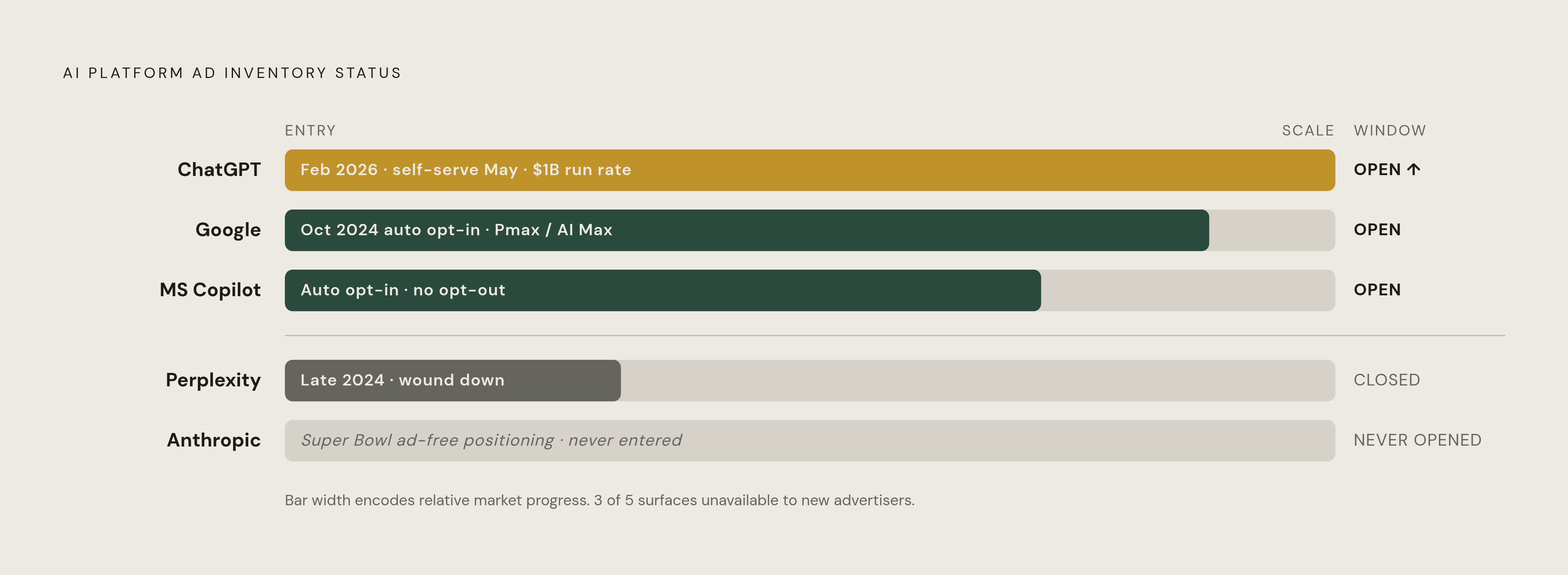
ChatGPT moved fastest and furthest. Ads launched February 9, 2026, appearing as labeled sponsored cards below an answer rather than inside it, and a self-serve Ads Manager opened on May 5, 2026 with spending minimums removed. The inventory reaches only logged-in adults on the Free and Go tiers; every paid subscription tier stays ad-free. Launch partners in the pilot included Target, Adobe, Williams-Sonoma, and Albertsons, at a premium CPM. Within months, ChatGPT ads reached a $1 billion annualized revenue run rate with tens of thousands of advertisers across dozens of countries.
Google took the opposite approach to consent: ads inside AI Overviews and AI Mode serve automatically from campaigns advertisers are already running, whether broad match, Performance Max, AI Max, or Shopping, with no opt-in or opt-out available. The rollout started in AI Overviews for mobile US users in October 2024, expanded to desktop in May 2025, and reached 11 additional countries by December 2025. New formats, including Conversational Discovery ads and Highlighted Answers, are in testing, though no segmented reporting exists yet to show how AIO or AI Mode placements perform on their own.
Microsoft Copilot works the same automatic way: every eligible campaign and ad type gets opted in, and advertisers cannot opt out. Microsoft has reported Copilot placements beating traditional search ads by substantial margins on both click-through and conversion rate, though that's a vendor's own claim about its own product and should be read with that in mind.
Perplexity offers the counterexample: it launched sponsored answers in late 2024, then stopped accepting new advertisers and wound the program down entirely. Leadership told the Financial Times that sponsored placement risks making users suspicious of the entire answer, not just the sponsored part. Anthropic never entered the category. Three weeks after OpenAI's ad announcement, Anthropic used the Super Bowl to reassure users Claude will remain ad-free, a deliberate brand positioning against the category.
The four major platforms have reached four different conclusions about AI advertising, and those divergent choices define where first-mover positions are still available to claim. OpenRTB 2.6 is emerging as the programmatic layer for these placements, though the auction dynamics differ from anything display or search advertising was built to handle. The surfaces still open to new buyers, chiefly ChatGPT and, by default, Google and Microsoft's automatic inventory, are where the first-mover window remains available. Perplexity's is closed. Anthropic's never opened.
Coca-Cola's early commitment to LLMs shows how brand equity gets built in this channel
Formalizing an early relationship with an AI platform builds something beyond a single campaign's performance numbers. It builds channel familiarity, creative fluency, and category association that a competitor arriving later has to buy at a markup, if it can buy it at all.
Coca-Cola is the clearest example of a brand doing this on record. By 2026, the company's use of large language models spans localized campaign variations across global markets, social content generation, and customer service interactions. It's a three-year-deep operating habit at that point.
The value of that habit isn't only measured in output. Early buyers accumulate the craft of writing context hints and building conversational ad creative during exactly the window when CPMs run high enough to discourage casual entrants but still low relative to where they'll sit once the channel matures. That skill compounds even as the channel around it grows more expensive to enter.
There's a second, quieter mechanism at work: brand-as-known-entity logic. Once a brand becomes a recognized entity to an AI system, its customer acquisition costs tend to fall, because the brand starts earning inclusion in synthesized answers instead of purely buying its way into them. Success is measured through branded search volume, direct traffic, and share of voice in AI-generated answers.
The flip side of Coca-Cola's head start is a warning to everyone in its competitive set. A rival waiting for the channel to prove itself at scale before entering won't just face a pricier auction. It will face a rival already sitting on two-plus years of data and creative refinement, an advantage that doesn't reset when the latecomer finally shows up.
Auction mechanics of conversational AI favor early, precise buyers over late, large ones
The relevance-weighted auction structure of conversational AI platforms temporarily inverts the normal paid-media power dynamic, giving early and precise advertisers an outsized return that will diminish as more sophisticated buyers enter.
The mechanics are specific. ChatGPT runs a second-price, relevance-weighted auction in which a more relevant ad can beat a higher bid outright. A small advertiser writing a sharp, specific context hint can outcompete a much larger advertiser running something vague, a structural feature that's genuinely unusual in paid media, where scale almost always wins.
That advantage exists partly because most of the current field hasn't learned the craft yet. Skilled hint-writing matters more right now than it will later, once competitors catch up.
Pricing reflects the early stage of the market too. The $60 CPM quoted in ChatGPT's pilot runs far above typical Facebook and Instagram CPM benchmarks for 2026. That gap points to premium early-adopter pricing rather than mature channel economics, and it won't hold at that level forever as scale increases and targeting tools improve.
The infrastructure side is scaling in parallel. One contextual-ad infrastructure provider building native units for generative AI conversations raised a Series A and, in just over a year, reported processing hundreds of millions of queries and delivering tens of millions of native ad impressions. As that kind of infrastructure matures, buying the channel gets easier for everyone, and the penalty for waiting grows rather than shrinks.
Publisher monetization of AI interfaces is creating new, uncontested inventory
The first-mover opportunity in conversational AI is not confined to ChatGPT, Google, and Microsoft. A wider ecosystem of AI publishers is building monetization infrastructure right now, and the inventory sitting inside it is still uncrowded.
The economics driving that build-out are different from anything the web publishing world dealt with. Every chat session burns real GPU-seconds. Where a mobile app treats a free user as costing almost nothing at the margin, an AI chatbot spends variable compute on every single session it serves, which turns a free user from a marketing expense into an ongoing cost center. That pressure is pushing AI publishers toward monetization on a faster timeline than comparable web publishers ever faced.
Some of that inventory is already live and priced, not theoretical. One contextual ad network is running at disclosed CPMs with partnerships that include Sovrn and LiveRamp, and counts a large publisher, HomeLife Brands, as its flagship case by monthly readership. A separate $20.5 million Series A raised for AI-native ad infrastructure signals that serious capital is backing the supply side of this market, and that access to this inventory won't stay open or cheap indefinitely.
What makes chat-based publishers unusual is how many monetization models they can run simultaneously: ads, affiliate revenue, content licensing, and subscriptions, often all at once. Every prompt inside a chat interface is a structured intent signal, which lets a publisher monetize the same traffic several different ways without diluting any one of them. For a brand deciding where to spend early dollars, that breadth of options across a growing publisher ecosystem is terrain that can still be claimed cheaply, the way early search and social inventory was before anyone else thought to look there.
The intent signal inside a conversation reveals what keywords and demographic profiles cannot
A keyword tells an advertiser what someone typed. A demographic profile tells an advertiser who someone probably is. Neither tells an advertiser what someone is actually trying to accomplish in the moment a decision gets made, and that gap is what conversational context closes.
A session-level context hint, evaluated against the live back-and-forth of a conversation, captures the arc of a person's reasoning rather than a single query stripped of everything around it. That's a richer signal than search advertising ever had access to, and it's the reason the recall a brand earns here should prove stickier than recall earned in a keyword auction. A user who encounters a brand at the exact moment they're working through a real decision, inside the conversation where that decision is unfolding, forms an association that a banner ad served against a demographic guess never could.
That's the whole case for moving now rather than waiting. The channels that came before conversational AI rewarded the brands that showed up before the crowd and before the price climbed. This one is already doing the same thing, on a faster clock, and the platforms have already drawn the map of where a brand can still walk in early.