Qualifying AI Conversation Inventory Before Your First Paid Placement Goes Live
Establish platform eligibility, audience reach.

A conversational AI advertising platform sells paid placements beside or within live AI conversations. ChatGPT, Google’s AI search surfaces, and Microsoft Copilot offer paid inventory, while Perplexity is not a buyable surface. Qualifying that inventory before launch requires a framework for format, audience eligibility, contextual matching, safety, and measurement, because a familiar paid-media checklist cannot establish whether the spend will produce useful learning.
Why AI conversation inventory is not just another programmatic channel
The unit of value in AI conversation inventory is a conversation state. That state combines what the user has said, what the AI has answered, the active topic, and the user’s apparent goal, evaluated in real time. Intent takes shape as the exchange goes on, beyond what a single query can show. Keyword coverage audits, audience size estimates, and quality-score diagnostics do not establish whether a placement fits that evolving context.
In ChatGPT’s documented model, response generation uses training and conversation context, while a separate ad-matching service runs concurrently. Advertisers cannot purchase influence over the answer. Relevance derives from the current conversation rather than historical browsing, so contextual targeting does not depend on persistent user identifiers or cross-site tracking. Without those cookie-based audience signals, buyers need to check what the platform uses for matching and who its eligibility rules allow them to reach before assuming their existing audience qualification methods will work.
The platform map buyers must audit before touching any budget
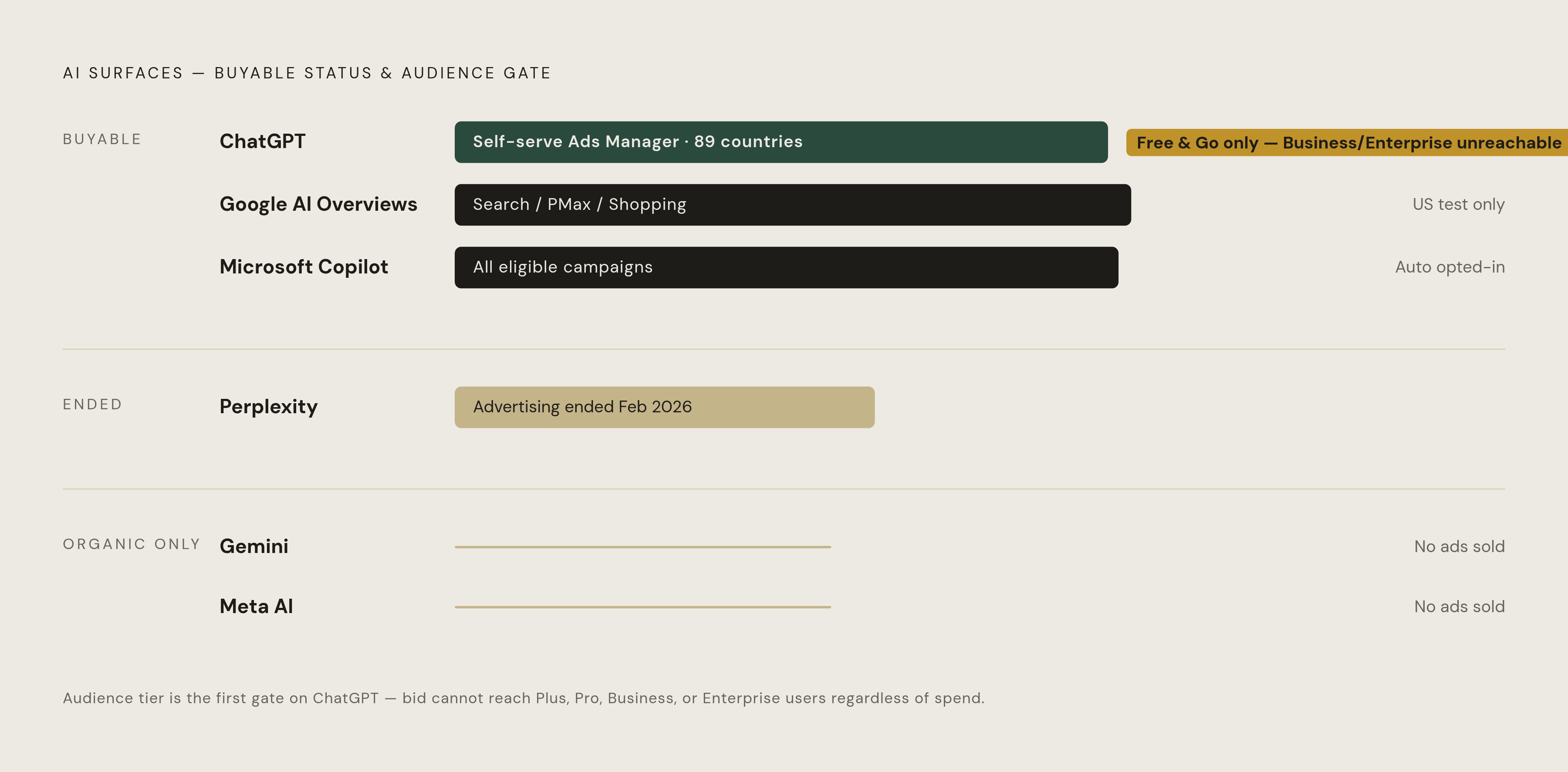
An inventory audit starts with existing campaigns. Google and Microsoft can place eligible campaigns on AI surfaces automatically, without a separate buying decision or surface-level opt-out. Google Search campaigns using broad match or AI Max, Performance Max, and Shopping campaigns can appear within AI Overviews and AI Mode as part of what is currently a US test. Search campaigns using only exact or phrase match qualify only above or below AI Overviews. Microsoft states that all eligible campaign and ad types are automatically opted in to Copilot delivery, making account eligibility and actual serving the first audit subjects.
Buyers can also buy directly from ChatGPT through its self-serve Ads Manager, which is available in many countries as of October 2026. Its labeled sponsored cards appear below the answer. Buyers supply contextual inputs, ad copy, and a landing page rather than treating an existing search keyword list as the targeting specification. Access is restricted to logged-in adults on Free and Go, while Plus, Pro, Business, Enterprise, and Education are ad-free. Go is paid but ad-supported, an important exception to any simple distinction between free and paid users.
Perplexity ended its advertising program in February 2026. It therefore belongs on the map as a non-buy. The Gemini app and Meta AI sell no ads and offer organic content opportunities only. A platform’s role in AI discovery does not establish that it sells conversation inventory, and an available advertising product does not establish that the buyer’s intended audience can see it.
Format transparency: what "labeled" actually means and what it does not guarantee
A sponsored label identifies commercial content, but its placement determines how clearly users can distinguish it from the answer. Jingyi Qiu and Qiaozhu Mei’s Generative AI Advertising as a Problem of Trustworthy Commercial Intervention characterizes documented deployment patterns as of May 2026. The academic taxonomy describes visible boundaries on ChatGPT, Google AI Overviews, and Microsoft Copilot. ChatGPT separates its sponsored unit from the response, as Copilot typically does, while an ad can appear within an AI Overview with the “Sponsored” label as its only visual boundary.
The same research examines a broader design space than these deployments. It discusses token-level auctions, RAG-based segment auctions, sponsored LLM summaries, and advertiser preference aggregation over generated replies. These are not interchangeable with current production formats. The paper also reports evidence that ads woven into LLM outputs often escape detection and can match or outperform ad-free outputs on perceived helpfulness. That finding gives buyers a reason to check how ads are disclosed, but it does not show that every live surface hides commercial influence.
The qualification task is therefore to establish both the visible format and the underlying separation of functions. OpenAI’s “Answer independence” principle states that ads do not influence ChatGPT’s answers. Buyers should ask any platform or network for the same promise in writing, along with documents that explain how ad matching relates to response generation. The rendered unit needs scrutiny as well. Its location, labeling, and disclosure must be assessed against regulatory expectations in each serving market, rather than accepted under a general promise that ads are labeled.
Audience tier constraints and who is actually reachable
Reachable inventory represents a subset of an assistant’s users, defined by subscription tier, login state, geography, and category eligibility. Aggregate usage is therefore an inadequate planning denominator. ChatGPT’s tier restrictions are platform architecture that remains fixed regardless of bid. When a B2B advertiser’s customers mostly use Business or Enterprise accounts provided by their employers, paid placement cannot reach those customers on that surface. That exclusion must be established before campaign construction, because broader reach or frequency targets cannot correct it.
OpenAI’s self-serve buying footprint covers 89 countries as of October 2026, so global buyers should compare intended markets with the available footprint before assigning regional budgets. Its ad content policy permits lifestyle and household goods, local services, travel and experiences, and digital products or education. Ads for financial services, healthcare & medicine, and legal services need case-by-case approval. Eligibility is not equivalent to market demand. Buyers must establish both that their category can advertise and that the people likely to buy are present in the ad-supported audience.
How contextual matching works and what it means for targeting inputs
ChatGPT targeting uses a natural-language context hint at the ad group level. The system matches that description against the conversational trajectory. OpenAI documents no hard character limit for the hint, and its API supports a large number of hints per ad group. A useful hint describes the problem a user is trying to resolve, whereas a comma-separated collection of product topics produces poor matching.
The auction evaluates topic category, intent stage, query specificity, and conversation depth. Research, comparison, and decision conversations therefore present different matching opportunities, with early exchanges attracting awareness-level ads and deeper threads attracting conversion-focused placements. Relevance also affects the competitive result. A more relevant ad can beat a higher bid, giving precision a role that spending alone cannot replace. Teams arriving from search need to develop problem narratives.
The landing page forms part of this targeting architecture because OpenAI reads and crawls it as a relevance signal during review. It is not only a post-click destination. Before launch, buyers should establish that the page is crawlable, aligned with the context hint and copy, and able to continue the user’s conversation with a destination suited to the user’s intent. They also need a process for testing and refining hints during the early weeks. This makes contextual writing an ongoing operational skill, subject to the reporting limits discussed below.
Brand safety and the specific risks that legacy suitability tools do not cover
A generated response has no stable page-level context that a blocklist can fully classify in advance. It varies by user, session, and conversational trajectory. Within a day, the same ad group can appear beside conversations about travel planning and sensitive personal finance. Understanding what qualifies an ad to serve must be paired with understanding which conversations the buyer can exclude.
Qiu and Mei identify four tiers of commercial influence, including product mentions, information framing, behavioral redirection, and long-term preference shaping. Production systems concentrate on the most observable and easiest-to-govern tier, but the taxonomy distinguishes visible placement from less visible influence. Framing and source selection can change without a sponsored object appearing. A buyer should therefore verify the implementation’s influence tier and treat an absent or ambiguous answer-independence policy as a disqualifying condition for brand-safe placement.
Buyers also need to know which controls are available before launch. ChatGPT buyers have raised negative targeting, including exclusions for conversation topics or intent signals, as an open gap. Sensitive-category advertisers should establish which controls exist and their granularity rather than assume legacy suitability settings are available. Buyers need to know whether an integrated partner can check the surface or whether verification relies on platform-reported data, and regulated advertisers must find out which category approval and review process they need to follow.
Measurement readiness: what is solvable now and what is not
Attribution becomes difficult when a user explores a problem through follow-up questions, leaves the assistant, and later converts through another channel. Last-click models systematically undercount that contribution. No cross-platform attribution standard for AI surfaces existed during the research period, so delivery across ChatGPT, Google AI Mode, and Copilot cannot be assumed to reconcile into one standardized view. Measurement readiness is consequently a go/no-go criterion. Stakeholders need an agreed attribution model and definitions of success over short, medium, and longer horizons before the first placement serves.
OpenAI expanded ChatGPT measurement on October 5, 2026, with Pixel and Conversions API, an Event Quality Score, and a one-day view-through attribution window. Its attribution partners include AppsFlyer, Triple Whale, Adjust, DV Rockerbox, Northbeam, Branch, Singular, Kochava, Airbridge, and Tenjin. Incrementality experiment partners include Haus, Measured, and WorkMagic. Buyers should set up Pixel and Conversions API, check event quality before launch, and find out whether an incrementality partner can help run experiments on the surface.
Buyers still lack prompt-matching visibility into the exact conversational context that triggered a placement, constraining performance-led refinement of context hints. Standardized negative targeting controls and cross-surface attribution also remain unresolved. Delivery, clicks, and conversions describe paid performance, while citation frequency, mention share, and sentiment describe earned visibility, and blending them can overstate returns or conceal whether a brand receives recommendations without payment.
The qualification framework as a pre-flight checklist
The platform and inventory audit is complete when the buyer has identified existing Google and Microsoft eligibility, examined current serving, and established each intended surface’s ad status, buying mechanism, and required assets. Audience qualification then requires a match between the customer profile and reachable tiers, permitted categories, and supported geographies. A direct ChatGPT purchase cannot compensate for a customer base concentrated in ad-free accounts.
Format transparency requires documented labeling, a clear account of where the commercial unit renders, and a verifiable answer-independence commitment. Contextual readiness requires problem-based hints and crawlable, aligned landing pages that continue the conversation. For brand safety, buyers need written details of the exclusion controls and must know what verification covers. Each gate concerns a distinct failure mode. A well-written context hint does not resolve an unsuitable adjacency, just as a visible sponsored label does not establish independence in response generation.
To be ready for measurement, buyers need to have event collection set up and checked, agree on an attribution model, define success criteria, and keep paid and earned reporting separate. These requirements apply across direct buying, existing search campaigns, and a DSP buying across AI surfaces. A cross-surface intermediary must answer at the surface level. Completing this process establishes the minimum basis for a structured learning investment. Its durable value is the institutional knowledge to qualify the next AI surface that opens.