GEO vs Paid Conversational AI Placements in Channel Planning
Marketers must split budget between organic AI visibility and paid conversational placements.
Search behavior is splitting into two different mechanisms, and most marketing teams are still funding them as if they were one. Gartner projects a 25% decline in traditional search by 2026, as queries move to conversational AI interfaces instead of a search box. Similarweb's Generative AI Brand Visibility Index found that 35% of US consumers now use AI tools at the product discovery stage, versus 13.6% who still start with search. The shortlist gets built before anyone types into Google, and that changes what a brand needs to fund and when.
That shift is fragmenting across surfaces rather than consolidating into one winner. Averaged over March and April 2026, ChatGPT held 62.6% of measurable B2B AI referrals, Claude took 18.5%, Gemini 10.6%, Perplexity 7.3%, and Copilot sat near 4%. No single AI surface commands the share Google once did with search, so the real planning question is how to split effort and budget across organic visibility (GEO) and paid placement inside these tools. Most teams are getting that split wrong, treating the two as interchangeable line items in the same budget when they behave nothing alike.
What GEO is, and what it can and cannot control
Generative Engine Optimization was formalized in a 2024 paper out of Princeton, Georgia Tech, the Allen Institute for AI, and IIT Delhi, and it entered the working vocabulary of marketing teams sometime in 2025. Most enterprise marketing organizations have some kind of GEO initiative running by early 2026. Most small and midsize teams haven't started one. That gap says something real: the discipline is new enough that skipping it is still a normal choice, but not new enough to excuse ignoring it much past this year.
Retrieval-augmented generation, or RAG, is the mechanism underneath GEO, producing the process that follows. An AI search engine indexes content, retrieves relevant pieces of that index in response to a prompt, then synthesizes a composed answer from what it pulled. Getting indexed is step one, and it buys nothing on its own. Content also has to be citeable, meaning structured and worded in a way the model can lift and attribute back to a source.
That changes what counts as success compared to old-school SEO, and this is where most teams are still stuck in the wrong mental model. Ranking first for a keyword doesn't matter here, because there's no ranked list of links to climb. Being cited inside the synthesized answer is the conversion event now. GEO optimizes for a citation with a source link, a brand mention inside the response, favorable sentiment attached to that mention, and share of voice across the prompts that matter to a category. That gap doesn't appear in Google Analytics. It needs its own measurement stack, one the industry is still building.
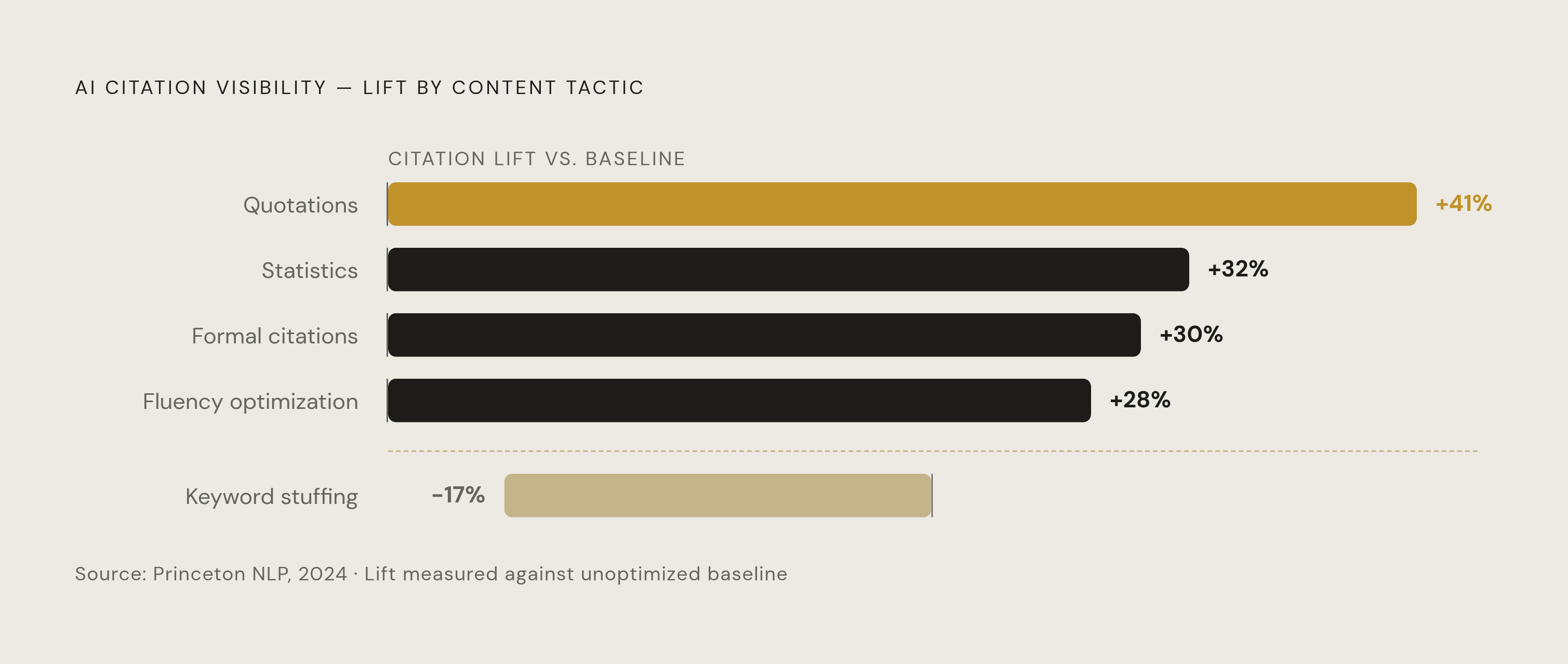
Princeton's research on what actually earns citation flips a decade of SEO habit on its head. Content with quotations saw a 41% lift in visibility inside AI-generated answers. Statistics added 32%. Formal citations added 30%. Fluency optimization added 28%. Keyword stuffing, the old SEO reflex, performed below baseline. Teams still running their AI content through an SEO checklist built for ranking pages are optimizing for the wrong target, and no amount of effort fixes a checklist aimed at the wrong outcome.
Part of that comes down to how differently people talk to these tools. A typical Google search runs about 3.4 words. Similarweb's GenAI Landscape report puts the average ChatGPT prompt at around 60 words. Users are describing a full problem when they type into these tools now, not hunting for a phrase to match. A brand that isn't cited in that exchange doesn't exist for that user in that moment.
GEO has real limits, and planners who ignore them will oversell it internally. It cannot guarantee a placement. It cannot control timing. It cannot fire in response to a specific high-intent moment the way a bid can. What GEO does is raise the probability of being cited across the relevant range of prompts over time. It builds odds, not certainty. Treating it like a campaign with a start date and an end date misreads what it actually is, and that misreading is the single most common mistake in how brands currently plan around it.
GEO, AEO, LLMO, and AIO get used interchangeably by practitioners and vendors, with no agreed academic definition as of early 2026. Google's own documentation treats this as a continuation of SEO, while other platforms and vendors have adopted varying terminology. None of that naming fight matters much. Track the capability being built, not which acronym a vendor happened to pick this quarter.
What paid conversational AI placements are, and how they work
Paid conversational AI advertising places a targeted commercial message directly inside an AI assistant or LLM interface, matched to what the conversation is actually about as it's happening. That's a different animal from a chatbot built to sell something, from AI-generated ad creative, and from a search ad sitting next to an AI-generated summary on a results page. The targeting unit here is the conversation itself.
The matching draws on the topic of the current exchange, memory of past chats, and history with previous ads, not third-party tracking pulled from across the web. Advertisers get a match, not a transcript, and never see the actual chat content. Machine learning models identify where a user sits in the decision journey, from early research to active comparison to right before a decision to after the purchase, and a brand shows up when signals such as specific product questions, sustained back-and-forth, or direct comparison requests point to real intent.
Advertisers specify the kind of conversation they want to appear in, and the model finds semantically similar user prompts to match against. That's intent-matching happening at the level of meaning, not at the level of a bid on a keyword string.
The stack behind this runs in four layers. Demand and auction decides where an ad gets served and at what price. Context and targeting handles the matching between ad and conversation. Creative generation produces the actual ad unit for whatever surface it lands on. Measurement and attribution tries to connect the exposure back to whatever happened afterward, and that last layer is the weakest link of the four by a wide margin.
Ad safety here isn't a one-time check before an impression fires, the way it works on a static webpage. LLM responses generate in real time, and the context window shifts as the conversation moves, so suitability gets evaluated continuously through live semantic analysis rather than a single classification made in advance.
Paid placements can switch on the instant a user shows high-intent signals, and that is the structural fact that matters most for a channel planner. GEO cannot. A brand can bid into a comparison-stage conversation happening right now. It cannot make an LLM cite it on demand. That asymmetry in timing separates these two channels more than anything else on this list, and it should drive nearly every allocation decision that follows.
The platform-by-platform reality of paid AI inventory in 2026
ChatGPT started showing ads to logged-in adult users on the Free and ChatGPT Go tiers in the United States on February 9, 2026. A self-serve ChatGPT Ads Manager opened to US businesses on May 5, 2026, closing out a roughly three-month move from a pilot that required $200,000 minimum commitments to a platform any business could access directly. CPM runs around $60, close to three times Meta's typical rate. Launch partners include Adobe, Target, Ford, Williams-Sonoma, Albertsons, Audible, and Mazda, with WPP, Omnicom, and Dentsu buying early inventory on behalf of clients, and Criteo signed on as OpenAI's first ad tech partner.
Rollout went US first, then Australia, the UK, Canada, New Zealand, Brazil, South Korea, Japan, and Mexico, with the UK expansion confirmed in May 2026. Paid tiers (Plus, Pro, Business, Enterprise, Education) stay ad-free, so reach through this channel caps out at free and Go tier users specifically. OpenAI's ad policy keeps moving: version 1.6 in September 2026 clarified OpenAI's right to decline ads that conflict with its advertising principles, version 1.5 in August opened up legal services advertising in the US, and version 1.3 in July added a dedicated advertiser policy section along with clearer rules for financial and health services categories. Anyone building a media plan around ChatGPT needs to check the current version before locking in creative. OpenAI hit a $1 billion annualized run rate in under 200 days across more than 40 countries.
Microsoft Copilot announced its ads business in March 2025 and launched Showroom ads, an interactive format that appears at the bottom of Copilot's answers with product images and details, triggered by buying-intent signals in the conversation. Dynamic filters let a user refine results without retyping a new prompt, and Microsoft has said future versions will include brand agents users can talk to directly inside the ad unit.
Perplexity is the cautionary tale of this whole sector, and planners should treat it as one. It launched sponsored follow-up questions in November 2024 with Indeed and Whole Foods among its launch partners, then paused new advertisers in October 2025. As of the most recent reporting, only the original launch partners are still testing the format. Two problems drove the pause: the ads felt interruptive inside a chat interface, and they created a perception that Perplexity's answers were biased toward advertisers. Measuring success across multi-turn conversations turned out to be genuinely hard. Blended cost-per-click varies significantly across AI answer engines, with reported figures ranging from around $1.10 on Microsoft's AI Max to $12 on Perplexity's Sponsored Answers, a spread wide enough that platform choice alone swings unit economics by several times over.
Gemini carries no ads right now, and planners treating a Gemini rollout as imminent are getting ahead of the facts. Dan Taylor, Google's global head of advertising, has publicly denied reports of an ads rollout, stating that the Gemini app currently has no ads and no plan to change that. Agencies say Google has floated the idea privately as a high-intent opportunity for ecommerce brands, but nothing is confirmed. Treat it as speculation until Google says otherwise.
Anthropic has stayed out of advertising entirely, opting to test partner plug-ins for B2B tooling instead of a paid placement product. Claude is not a channel a paid media plan can include, at least not today, and no amount of budget changes that fact.
Zoomed out, The large majority of AI advertising dollars in 2026 are landing next to AI-generated content, things like Google's AI Overviews, rather than inside an actual chatbot conversation. Standalone chatbot ad spend grew sharply in 2026, rising dramatically year over year off a small base. The in-conversation inventory is still a sliver of total AI ad spend, but it's the fastest-growing sliver on the board, and that gap between its size and its growth rate is the whole story of where this category is headed.
Where GEO and Paid Placements Operate in the Purchase Journey
GEO lives at discovery and consideration. When someone asks ChatGPT for the best email marketing tool, or prompts AI Mode for a rundown of attribution models, a cited brand picks up awareness without a single click landing on its website. It has zero say, though, over when that citation happens or which competitors get named alongside it in the same answer.
Paid placements live at the high-intent moment itself. Because the ML classification can detect when a user has moved into active comparison or is close to deciding, an ad can fire right then, using a signal richer than any keyword could ever supply, since the model has the entire conversation to draw context from.
The two run on completely different clocks, and that's the mistake most teams make first. GEO takes months of sustained content work before citation authority builds up enough to matter. Paid placements can go live today and get paused tomorrow. Budgeting for one like the other is the most common structural error in AI channel planning right now: treating a compounding asset and an on-off switch as though they answer to the same quarterly review.
Zero-click behavior changes how GEO's return should get framed. Zero-click rates run 34% for plain Google Search, climb to 43% when an AI Overview is present, and hit 93% inside Google's AI Mode. A GEO citation can deliver real brand exposure with no click required at all, so the metric that matters is share of model, not sessions or traffic. Any team still reporting GEO performance through a traffic dashboard is measuring the wrong thing.
A study from Seer Interactive, covering 3,119 search terms across 42 client organizations, found paid click-through rate ran 91% higher when a brand was cited in an AI Overview versus when it wasn't. That doesn't prove one causes the other, but it's a strong hint that GEO visibility and paid performance aren't separate tracks anymore. They're tangled together, and a plan that funds one while ignoring the other is likely leaving performance on the table in the channel it does fund.
Paid placements have one structural edge GEO can't touch: contextual targeting spots high-intent conversations even when the user never names a product category. A long back-and-forth about team coordination headaches reads as a signal for project management software, without the word "software" ever appearing. No keyword list or demographic segment gets close to that precision.
GEO's edge runs the other direction. It works on surfaces where paid inventory doesn't exist at all, Claude being the clearest case, and it compounds, since citation history feeds into how future model training and retrieval treat a brand. The surfaces genuinely don't overlap: ChatGPT sells ads, Claude doesn't, Perplexity has stopped taking new advertisers, and Google's AI Overviews carry ads while the Gemini app carries none. A plan built entirely on paid placement has nothing to say about the surfaces where paid inventory simply isn't for sale, which is reason enough on its own to fund both channels rather than pick one.
Zero-Click Behavior and Its Reshaping of "Performance" for Both Channels
The old click-based scorecard for paid search is falling apart in real time. Seer Interactive tracked paid CTR on queries with an AI Overview present dropping from 19.70% to 6.34% between June 2024 and September 2025. Queries without an AI Overview also fell, from 19.1% to 13.04%, over the same stretch. This isn't isolated to one surface: AI in search results depresses clicks wherever those results show up.
Search Influence's reporting put zero-click behavior at 93% inside Google's AI Mode. At that level, impression share and on-page visibility stop being nice-to-haves and become the primary thing paid search has left to measure in AI-adjacent environments.
GEO's scorecard looks nothing like a paid dashboard, and teams that try to force one onto the other will misread their own results. Share of model, citation rate, sentiment attached to a brand mention, and coverage across the relevant prompt set make up the list, and none of it lives in a standard analytics tool built for tracking sessions. That's the bar for telling real signal from noise in GEO, and dashboards built for SEO simply don't clear it.
Paid conversational placements carry their own open problem: standard last-click attribution can't capture an ad seen mid-conversation that shifts someone's thinking before they buy somewhere else entirely, days later, through a different channel. Attribution in assistant-mediated discovery is genuinely unsolved territory right now. Perplexity's own experience backs this up directly: its sponsored follow-up questions ran into both an interruption problem and a measurement problem inside multi-turn chats, and the industry still hasn't converged on a framework that fixes either one.
Planners should run two separate measurement systems side by side rather than force one unified dashboard. GEO gets tracked through share-of-model and citation data. Paid conversational placements get tracked through conversation-phase attribution and whatever downstream conversion signal is available, imperfect as that signal currently is.
Budget Allocation Across the Two Channels in a Channel Plan
GEO and paid conversational placements solve two different problems, and conflating them is how budgets get misallocated. GEO builds the odds that a brand sits inside the consideration set the moment someone opens a conversation. Paid placement captures a user at one specific high-intent instant. Both deserve funding. Neither should get resourced like the other, and any plan that runs them off the same quarterly logic is going to underfund the slower one every time.
Treat GEO as infrastructure. Princeton's research already showed the payoff curve: content with added statistics saw up to 41% higher visibility in AI-generated answers, and quotations added roughly 28% on their own. That advantage isn't a one-time bump. It compounds as a brand's citation history builds up over time. Budgeting for GEO in quarterly campaign cycles misreads what it actually is, closer to building a content asset that appreciates than to running a promotion that ends.
Paid placement is a demand-capture tool, and it should get judged against the cost of missing a high-intent moment entirely, not against the sticker price of a display impression. At close to $60 CPM on ChatGPT's inventory, that's a real cost per exposure. Weigh it against what a missed comparison-stage conversation is actually worth to the business, not against what a banner ad used to cost on a webpage a decade ago. Judged by that older yardstick, paid conversational placement will always look expensive. Judged against the cost of losing a buyer at the exact moment they were ready to decide, it looks like the cheaper option most of the time.