Brand Penalty for Late Adoption in Social Advertising 2012 to 2016
Brands that delayed paid social adoption paid permanently higher costs.
Between 2012 and 2016, Facebook dismantled the free-distribution model it had spent years selling to brands, and the timing of a company's entry into paid social during that window set its cost structure for years afterward. Facebook's original pitch was straightforward: build a Page, gather followers, and reach them at no cost. Agencies built entire content strategies on that premise, and brands like Louis Vuitton used the promise directly: they shared catwalk presentations with fans and treated the Page as an owned channel, not a rented one. A luxury brand went further and launched a 24-hour customer service operation through social messaging, the kind of investment a brand only makes when it believes the audience it's building will stay reachable.
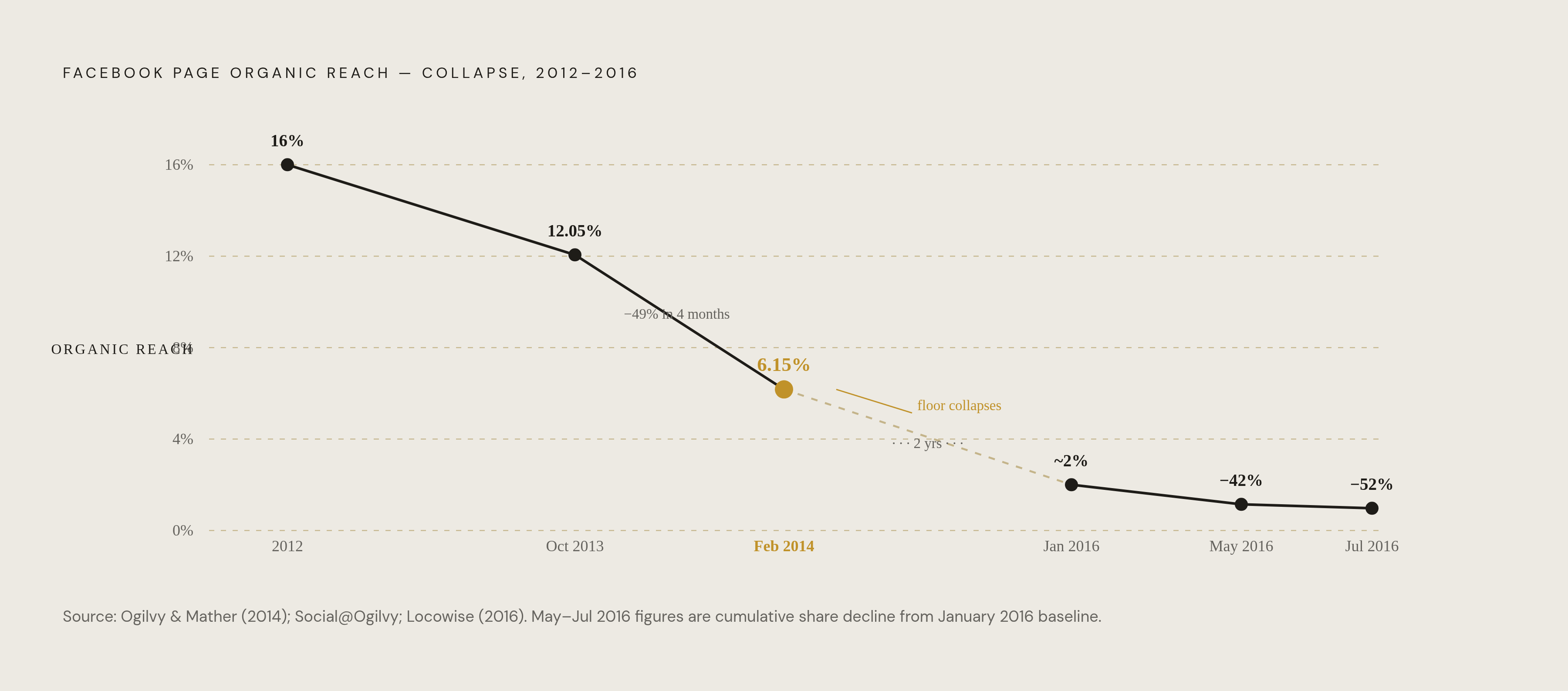
In 2012, organic reach already meant you got less than full access to a brand's following. Roughly 16 percent of a Page's followers saw any given post, a fraction of the audience a brand had technically earned. But 16 percent was enough. It supported organic social as a primary channel, not a supplement to paid media, and brands planned budgets and content calendars around that number as if it were stable.
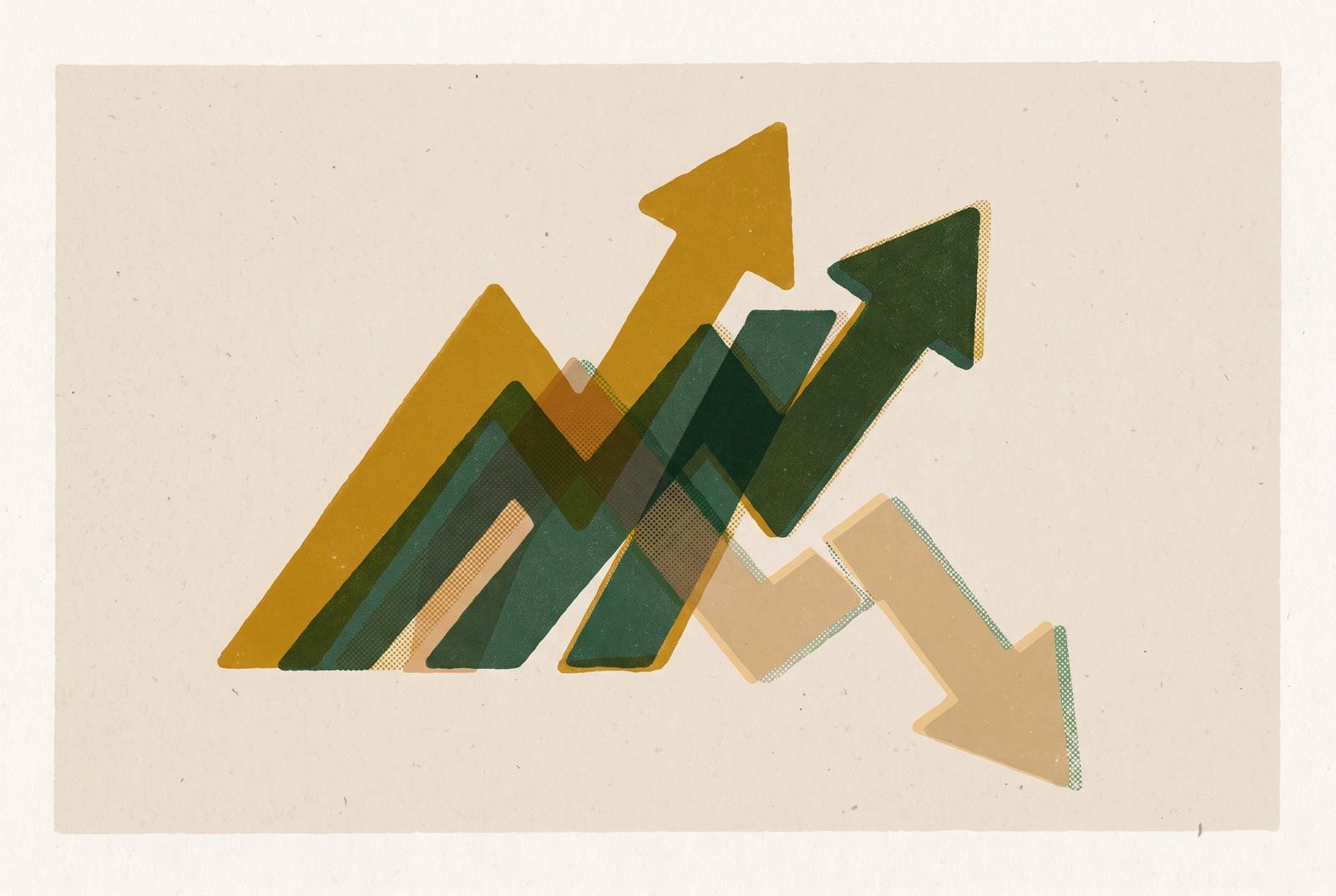
Organic reach, far from stable, fell from 12.05 percent in October 2013 to 6.15 percent by February 2014, a 49 percent decline, and the sharpest drop came in December 2013, when Facebook changed its algorithm in ways that were widely reported. The decline continued over the following years: SocialFlow tracked a 42 percent fall in organic reach between January and May 2016 alone, and a cumulative 52 percent drop from January through mid-July of that year. Facebook's engineering director Lars Backstrom said in a Newsroom post that the News Feed algorithm had changed, and that change reduced how much organic content users saw. The mechanism was not a bug or an unintended side effect. It was a redefinition of what a follower was worth, executed by the platform that had sold brands on the opposite premise.
The compounding economic logic that turned a timing decision into a structural gap
Once organic reach collapsed, brands were left with two options, and neither was free. They could post more frequently to compensate, chasing a diminishing return on a treadmill that got more expensive, or they could pay for distribution. There was no third path back to the original bargain.
Paying for distribution meant entering an auction, and auctions get more expensive as more buyers show up to bid. A brand that waited until 2015 or 2016 to start buying Facebook ads was bidding in a market far more crowded than the one available to brands that had started in 2012 or 2013. The price of entry rose with every new advertiser who joined. The cost of delay didn't just shift forward in time. It compounded.
There's a real irony in which brands got hurt worst by this shift. The brands that had followed the original rules most faithfully, building large, engaged Pages through years of organic content investment, were the ones most exposed when the rules changed, because they had the most invested in a model the platform was actively walking back. That wasn't a punishment for doing something wrong. It was the structural result of building on a foundation the platform itself controlled and later altered. Late entrants faced higher prices for the same reach. Early, organically-focused brands faced a different problem: an asset they'd spent years building was quietly repriced to near zero, and the path back to equivalent reach now ran through the same expensive auction everyone else had to use.
The cost of the paid social market for late arrivals
By the time organic reach had fully collapsed and the advertiser base had grown dense, the prices facing a new entrant reflected years of accumulated competition that early buyers had simply never faced. By the third quarter of 2016, the average U.S. Facebook cost-per-click stood at 27.29 cents, and the average cost-per-thousand-impressions stood at $7.19. Those numbers describe a market that had matured well past the thin-competition conditions of 2012 and 2013, when early buyers secured reach at rates a 2016 entrant could no longer access at any price.
The increase in cost didn't move in a straight line, and it didn't move for a single reason. It tracked two forces moving in the same direction at once: the advertiser base kept growing, which pushed auction prices up, while organic reach kept shrinking, which pushed more of every brand's distribution into that same paid auction. Supply and demand moved against late entrants simultaneously. More advertisers chased the same fixed inventory in the News Feed, and less of a brand's reach came free, so the portion of total reach that had to be bought kept growing right as the price per unit of that reach kept rising. A brand entering in 2016 wasn't just paying more per click than a brand that had entered four years earlier. It was paying more per click for a much larger share of its total audience exposure, because the free portion had largely disappeared.
What early movers locked in
Brands that entered Facebook advertising early didn't just get cheaper CPMs, real as that pricing gap was. It extended to three accumulated assets that the platform delivered at low or zero cost during the open window, and none of them could be purchased after the fact at any price: audience relationships, first-party data, and brand-content associations built up over years of early engagement.
Audience equity is the clearest of the three. Brands that built large, engaged Pages before the 2014 throttling had acquired that following cheaply, through content and organic reach. Once the algorithm changed, rebuilding an equivalent audience from scratch required buying it at whatever price the auction demanded at that moment, a price that had only risen since. Louis Vuitton's early use of Facebook to broadcast its catwalk shows, including a live stream of its SS2010 womenswear show, built exactly this kind of following during the period when that reach still came largely for free. A luxury brand's 24-hour social customer service operation did the same thing through a different mechanism, and it built engagement history at a moment when that history cost little to accumulate.
Data compounding worked alongside audience equity. Advertisers who had been running campaigns since 2012 or 2013 had years of targeting refinement behind them: tested audience segments, trained lookalike models, and creative performance data that told them what worked and what didn't. None of that could be shortcut by a late entrant with a larger budget. A brand starting in 2016 could buy more impressions, but it could not buy four years of campaign iteration.
Platform favor reinforced both. Facebook's algorithm rewarded Pages with strong engagement histories, so if a Page had years of accumulated interaction signals, it ranked ahead of a newer Page that published equivalent content. Grafik Agency's analysis found that early adopters captured structural advantages in cost, audience data, and platform standing that later entrants could not close. The channel behaved as a first-mover market for the duration of that window, rewarding the brands that showed up before the rules changed and leaving everyone else to compete under the new ones.
The strongest objection: fast followers with better tools could close the gap
The case for early-mover advantage has a serious counterargument that deserves to be taken on its own terms. Research on adoption timing finds that late-majority adopters often wait on purpose: they watch early-majority peers absorb the risk of experimentation first, and they stay skeptical and cautious until most of their peers have already moved. That caution isn't irrational. A brand entering Facebook advertising in 2015 had access to targeting capabilities, creative formats, and measurement tools that were simply more developed than what had existed in 2012, when brands experimenting on the platform were working with cruder instruments.
Data backs the idea that execution quality, not just timing, drives outcomes. Research published in Frontiers in Psychology found that owned social media exposures have a stronger effect on purchase value than earned exposures, with the purchase increase from an additional unit of owned exposure running more than twice that of an equivalent unit of earned exposure. That finding suggests creative quality and channel mix discipline mattered on their own terms, independent of when a brand first showed up.
The objection holds, but only within a specific boundary. Better tools and more mature measurement helped a late entrant run a more efficient campaign once it arrived. They did nothing to recover the audience a brand hadn't built while Pages were cheap to grow, and they did nothing to undo the auction prices that had already been set by brands who got there first. A 2015 entrant could buy a better ad unit than a 2012 entrant had access to. It could not buy back the follower base that would have cost a fraction of the price three years earlier, and it could not retroactively access the 2012 or 2013 auction rates that no longer existed. The fast-follower advantage is real for the cost of experimentation. It doesn't offset the structural cost of having missed the window when audience accumulation was cheap.
The reusable lesson beyond the specific platform
What happened on Facebook between 2012 and 2016 wasn't a quirk specific to one platform's algorithm decisions. This pattern recurs whenever a new distribution channel opens to advertisers. A platform offers you free or low-cost distribution to pull brands in and build its own base of content and engagement. If brands show up early, they accumulate audience relationships and targeting data during that open phase. As the advertiser base grows, the platform shifts toward a paid model, because a denser base of users and advertisers makes a paid auction more profitable than giving reach away. Auction prices then rise as more competitors bid for the same fixed inventory. By the time the window closes, new entrants are competing at prices they had no part in setting, against competitors who built their position before the costs went up.
The penalty facing late entrants during this cycle is the compounded opportunity cost of not accumulating cheap audience relationships, first-party signal, and platform favor while that accumulation was still available at low or no cost. Each of the three advantages early movers built, cost, data, and audience equity, reinforces the other two. If a brand has lower historical CPMs and years of accumulated targeting data, it runs more efficient campaigns than a brand without that history. If algorithms reward engagement and performance, then more efficient campaigns earn stronger platform favor. Stronger platform favor then compounds the original cost and data advantage, so the gap widens and a later entrant cannot close it just by spending more.
This template applies wherever three conditions hold at once: early access to a channel is open and inexpensive, the platform transitions toward an auction model as its advertiser base grows, and audience relationships and intent data accumulate as assets the advertiser owns. Conversational AI advertising sits at a structurally similar moment today. Intent signals captured inside AI conversations function much like early Facebook Pages did: a form of audience relationship currently available at low competition, before the advertiser base in that channel grows dense enough to push prices upward through the same auction dynamics that reshaped Facebook advertising after 2014. If brands establish a presence in that channel now and accumulate conversational intent data while competition stays thin, they occupy roughly the position Facebook advertisers held in 2012. Brands that wait will eventually enter a more competitive, more expensive auction, and they will do so without the years of accumulated data and platform familiarity that the early movers will have already locked in.