Programmatic Display's Commoditization and What AI Channel Scarcity Means Now
Programmatic display hits a ceiling as AI conversations offer scarce, high-intent inventory instead.

Programmatic display has not shrunk. It has filled its container completely, and that completion is now the problem. Basis's 2026 programmatic trends report puts US programmatic display on track to surpass a new high this year, growing year over year, though the report describes the moment as a shift "from volume-driven growth to a more disciplined, accountable phase. A channel does not need discipline imposed on it when it is thriving on its own terms; it needs discipline when growth has stopped being proof that the system works.
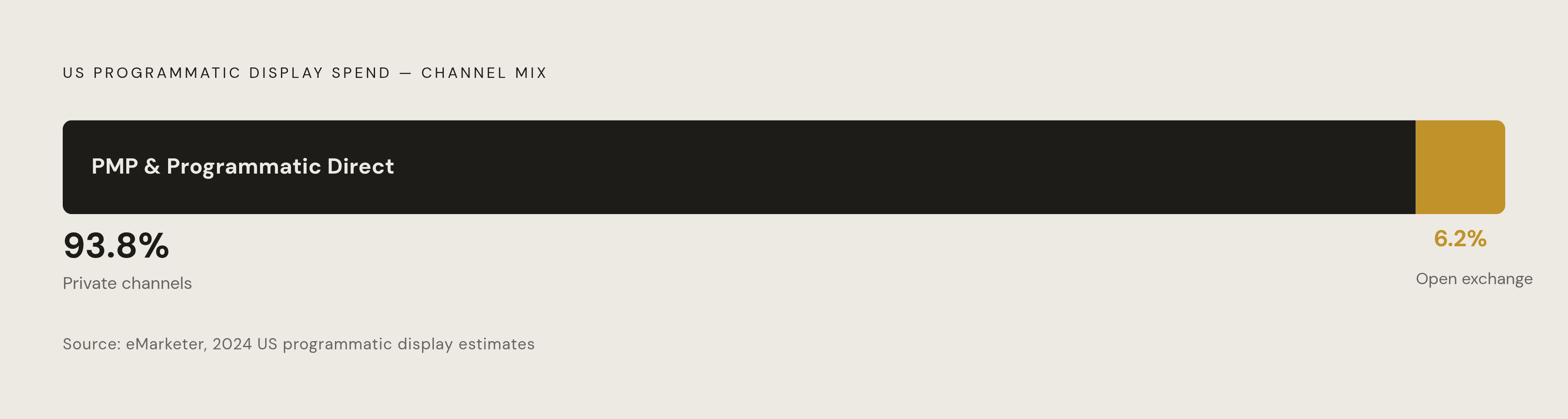
The clearest evidence of that strain sits in price. Open-exchange CPMs have fallen hard against what private marketplace inventory commands. The gap between the two is a multiple, far wider than the small spread you'd expect between a premium product and a budget one, the kind of gap that signals two different markets operating under one label. Advertiser Perceptions' Programmatic Intelligence data puts PMP and programmatic direct at roughly 93.8% of US programmatic display spend, showing where the money has already gone. Traditional insertion-order buying was once the default way display got bought and sold, but most planners no longer build strategies around it; it has become a residual category.
The flight to private marketplaces makes sense for any single advertiser deciding where to spend this quarter, and it makes the overall market worse. If you move to a PMP to protect brand safety, you bid up the same shrinking pool of premium inventory that every other cautious buyer is chasing, and the open exchange is left to absorb whatever nobody wants. Generative AI has made that problem harder to manage, not easier. Synthetic content now floods the supply chain fast enough that distinguishing legitimate publisher inventory from low-quality or fabricated placements has gotten genuinely difficult, and that difficulty pushes more buyers toward curation or toward simply accepting risk they can't fully price.
Put those pieces together: a channel keeps growing in dollars while its ceiling, what it can actually deliver in intent quality and safe brand environment, keeps getting lower. This is not a price floor eroding; it is a performance ceiling that commoditization has pressed down from above. With the dominant display channel's upper limit shrinking even as spend keeps rising, the question is whether any other channel runs the opposite way: constrained supply, but a rising ceiling on what each unit of inventory can deliver.
What drove display's commoditization: the mechanics of race-to-the-bottom inventory
Display didn't commoditize by accident. It commoditized because its targeting logic was built around the page, not the person. Contextual targeting reads the content sitting next to an ad slot, the words on the page, the category of the site, the keywords in an article, but it has no access to what the actual viewer in front of that slot is trying to do. The auction compounds the problem: more impressions, more publishers, more exchanges all add reach, and every one of those additions adds a layer of opacity between the advertiser and the environment the ad actually lands in. The system rewards volume, but advertisers say they want quality, and volume works against that.
Retail media shows this most sharply, carrying a signal that the programmatic middleman layer itself is at risk even in the part of the ecosystem that has been display's most dependable source of demand, not just a brand-safety story confined to news publishers and content farms. Retailers are starting to cut programmatic intermediaries out of their media models, and the savings from doing so are large enough to count as strategy, not a line-item tweak. Walmart's AI shopping assistant Sparky is testing a format called Sponsored Prompts, and Amazon's Rufus already supports conversational product discovery. Both represent retailers routing around the programmatic stack entirely in favor of surfaces where the conversation itself carries the intent signal. It's a different transaction model, one where what the shopper says replaces what the page says as the thing being targeted.
The features that made display commoditize, page-level context instead of person-level intent, anonymous bulk auctions, and an abundant, largely undifferentiated supply, are exactly the features that conversational AI inventory does not have. That inversion builds a channel on scarcity and relevance.
Why conversational AI inventory is structurally scarce
AI assistant inventory is scarce because the product being sold is the conversation itself, and ad load is kept deliberately low to protect the thing that makes the surface worth using. ChatGPT's monthly user base has reached mass scale, so the audience is not the constraint. The constraint is placement frequency, which is being held low on purpose. ChatGPT's first ad format, Sponsored Answers, appears as a chat card at the bottom of the interface, offered as a contextually relevant next step and kept visibly separate from the AI-generated response itself. The design choice is conservative by intent: interrupt the conversation as little as possible.
Demand has already outpaced that limited supply. ChatGPT reached a substantial annualized ad revenue run rate of $100 million within weeks of the format's launch, which says the appetite from advertisers is real while the available inventory stays tightly gated. Not every AI surface is choosing to open that inventory. Perplexity pulled out of advertising entirely in February 2026 after its executives concluded that ads would make users doubt the objectivity of AI-generated answers. One major conversational surface choosing to carry no ads at all caps the total pool of conversational inventory across the category, structurally, not temporarily.
The auction mechanism driving that inventory doesn't map onto the programmatic infrastructure built for display, so it adds a second layer of scarcity on top of limited ad load. There's no keyword bidding in the ChatGPT system. The main buying lever is a context hint, a natural-language description of the kinds of conversations where a given ad belongs, matched in real time against what the user is actually discussing. Placement runs through a relevance-weighted, second-price auction, where a highly relevant ad can beat a higher bid from a less relevant one, flipping the price-first logic that has governed the open exchange for years. Budget alone doesn't buy access. Relevance and contextual fit set a ceiling on how many advertisers can compete effectively, regardless of how much capital they're willing to put behind a bid.
That shortage is already pulling in the infrastructure that institutional buyers expect from a mature channel. Integral Ad Science announced on October 5, 2026 that it is one of the first media quality partners supporting ChatGPT Ads, giving independent brand safety and suitability measurement, and that marks one of the first formal extensions of open-web verification tooling onto an LLM surface. IAS's involvement tells large buyers this channel now carries the same kind of controls they expect from display, which accelerates the case for allocating real budget to it. It also marks the scarcity window as temporary: as that infrastructure matures and more institutional dollars arrive, the inventory that exists will get bid up accordingly.
The conversational signal versus the page impression
A prompt typed into an AI conversation carries purchase intent at a level of specificity and recency that no page-level or behavioral signal in display can match. Display's contextual targeting reads what sits around an ad slot. A conversational interface reads the live back-and-forth itself, not a static page but an evolving, in-progress statement of what the user is actually trying to get done.
Microsoft Copilot illustrates the gap in practice. Its session-context model weighs an entire conversation within a session rather than matching against a single query in isolation, and it uses a feature called "ad voice," a short transitional line that tells the user how the ad about to appear connects to what they've been discussing. Microsoft reports that search ads on Copilot get stronger click-through rates and higher conversion rates than traditional search placements do.
That signal captures something search built on branded keywords simply cannot see: category-level consideration before a brand has entered the conversation. A large share of initial prompts in AI conversations are unbranded, with users exploring a category before they've settled on who to buy from, which makes this a genuinely upper-funnel signal that still carries high intent, a combination display has never been able to offer in one package. Adidas saw a lift in branded search after turning up in LLM conversations, a small but concrete sign that visibility inside AI answers, whether earned or paid, feeds back into search behavior and extends beyond the chat window.
The honest complication is that paid and earned visibility inside these surfaces don't move together. Whitebox monitoring across a large sample of sponsored placements found that only a small fraction of the brands ChatGPT names in its answers have ever advertised on the platform, and most brand-name queries never surface that brand's own ad. Paid placement and organic mention behave as nearly independent variables. That complicates any assumption that buying an ad guarantees visibility the way buying a keyword does in search. The signal quality available through paid placement remains real on its own terms, even though it doesn't buy the kind of coverage search advertisers are used to, and paid and earned visibility need to be pursued as separate efforts.
Where the upper-funnel erosion is hitting hardest
The erosion of upper-funnel search efficiency caused by AI Overviews is sharpest in the verticals built around considered, research-heavy purchase decisions, which happen to be the same verticals where conversational AI advertising performs best. When a Google AI Overview appears on a results page, search ad click-through rates have dropped sharply, though more recent 2026 data shows paid CTR has partially recovered. Publishers and advertisers spent years building strategy around this traffic, but it's increasingly absorbed directly into the AI-generated answer before a user ever clicks through.
Healthcare and financial services advertisers face that pressure from both directions at once. Their upper-funnel programmatic value is eroding fastest, and their customers are exactly the kind of researcher who turns to AI conversations for detailed, comparative recommendations before they buy. So these two verticals become the most urgent candidates for reallocating budget toward conversational surfaces, ahead of categories where purchase decisions are faster and less research-driven.
A related dynamic now ties brand recognition directly to paid performance in a way search never required. When a brand is cited inside a Google AI Overview, paid click-through rates for that brand run substantially higher than when the brand is absent from the AI-generated answer. Brand authority inside AI responses and paid search performance are linked now, not separate line items. The same pattern extends into conversational surfaces: these systems recommend what they already recognize, so brands without strong recognition signals in the training data lose the auction before a bid is ever placed, no matter the size of the budget behind it. Brand investment, long treated as a separate line from performance marketing, is turning into a prerequisite for performance inside AI-mediated channels. For marketers who have kept brand and performance budgets in separate silos, that's a structural argument for closing the gap between them, not just a philosophical one.
Google's own AI Overview ad placements amount to an acknowledgment, from the platform that built the dominant search interface, that the interface itself has changed and the ad model has to change with it. Advertisers who are waiting for conversational AI channels to mature before committing budget can watch the largest incumbent in search already move its own ad products toward that same conversational model.
What attribution and measurement look like right now
Early conversational AI advertising is producing behavioral signals consistent with a genuinely high-intent audience, but no cross-advertiser benchmark data exists yet at a scale that supports confident, standardized planning. Early ChatGPT ad testers report that users who arrive through conversational placements engage more deeply with landing pages, submit forms at higher rates relative to how many pages they visit, and return to the site more often than traffic from other channels tends to. That pattern is consistent with the idea that intent declared inside a conversation carries more weight than intent inferred from a click.
None of that amounts to an established, repeatable benchmark the way display has built up over two decades of auction data, attribution modeling, and standardized reporting. The measurement infrastructure for conversational AI advertising is still being built in parallel with the inventory itself, and anyone allocating budget into this channel right now is working from early signal, not settled data. That gap doesn't undercut the structural argument for moving budget toward scarce, high-relevance conversational inventory while open-exchange display keeps compressing toward its ceiling. It does mean the allocation case has to be made on the strength of mechanism, intent specificity, and the early behavioral evidence available, not on the kind of standardized, cross-advertiser performance data that took display years to accumulate.