Mobile Ad Adoption Timing and the Brands That Missed the Window
Early movers in AI advertising are building advantages later entrants cannot replicate.

The brands that missed the mobile advertising window did not miss it for lack of information. What they misjudged was the speed at which early-mover advantages would compound into something structurally difficult to replicate from a later starting point. Each cycle of that work built on the last, so a brand entering two years later was not simply behind on a calendar. It was paying a premium to climb a learning curve that the leaders had already cleared and could no longer be purchased at the original price.
Two distinct failure modes produced this outcome. Some brands delayed outright, because they reasoned the format needed to mature before serious money went in. Others got in early but treated mobile as a permanent test budget, so it never grew into core spend, even as the channel matured around them. Both approaches rested on the same assumption: that the window would stay open long enough for a measured, incremental entry to still count as timely. The window was not a single date on a calendar. It was a period during which inventory was cheaper, competition was thinner, and the cost of climbing the learning curve was still reasonable. Then the period ended, and the brands that had been waiting for clarity discovered that clarity had arrived at a much higher price than the one early movers had paid.
What "late-entry tooling" cost brands that waited on mobile
When the brands that waited finally committed to mobile, they discovered that the tooling built for late entrants was never a true substitute for what early movers had learned by doing. Late entrants paid higher CPMs, because by the time they joined, the auction had grown far more competitive. Their creative was frequently adapted from desktop formats rather than built natively for mobile, a mismatch that cost performance even when the targeting itself was sound. These were three compounding disadvantages operating simultaneously, not three separate problems that could be solved in sequence.
Platforms sold late entrants managed services, templates, and automated campaign tools, and these were meant to close the gap on paper. Those tools closed access, not understanding. The advantage early movers held was never just that they could buy mobile inventory. It was the accumulated fluency in reading the channel: knowing which placements converted, which audiences responded to which creative, and which publisher relationships were worth deepening. The lesson from mobile is that specific categories of advantage, channel fluency, audience data, creative learning, and publisher relationships, are time-dependent assets that cannot be reconstructed from a later starting point regardless of budget, not that speed itself carries virtue.
Conversational AI advertising differs structurally from the channels that preceded it
Conversational AI advertising removes the foundational assumptions behind both search and social advertising and replaces them with something neither channel had: a single live conversation serving as the targeting surface and the placement surface at once. Search advertising was built around a results page: a query, a keyword auction, a slot on the page, and a trackable click. Almost none of that stack ports over to advertising inside a large language model, because the page itself disappears, the keyword loses its function as the unit of targeting, and the click often never happens in the way search measurement expects. Social advertising was built around an interest and behavior profile, one that cookies and pixels assembled and then auctioned into a feed. Inside an LLM you find no feed, no persistent cross-site identity to build a profile from, and no single evergreen creative that performs the same way across every conversation a user might have.
The targeting primitive that replaces all of this is the conversation itself. Microsoft's own documentation for its Copilot advertising API states that the system considers "the context of the entire conversation, not only the last prompt," in order to connect brands to people's conversations in a more relevant way. The four-layer architecture behind any LLM advertising operation, demand and auction access, context and targeting, creative generation, and measurement, resembles the shape of prior ad stacks in outline only. Each layer behaves differently in practice, and that is why early movers are building a fluency now that you cannot simply buy later.
The structural signals that the AI advertising window is already open and accumulating
The claim that an AI advertising window exists is a description of what opened in early 2026, with real inventory, real spend commitments, and early movers already accumulating advantages that later entrants will not be able to purchase retroactively. The pilot program required a minimum commitment of $200,000, with launch partners including Target, Adobe, Williams-Sonoma, and Albertsons. Those brands are now running live campaigns, accumulating channel-specific learning, building audience signal data, and iterating creative, work that a competitor entering in 2027 cannot backdate no matter the size of the budget it brings.
The scale underneath this is not speculative. ChatGPT crossed one billion weekly users in 2026, making it one of the largest advertising surfaces on the internet at the moment advertising began appearing on it, not years into a slow ramp toward relevance. You do not need to meet a six-figure pilot threshold to get access. Self-serve campaign budgets on ChatGPT start at $25 per day per campaign, with no account-level minimum spend, so the floor for entry sits low even as the ceiling accommodates large commitments. The surfaces carrying this inventory are multiplying across several platforms. The industry's own vocabulary is shifting to match. The CEO of Instrument has described 2025 as the year agencies could label almost anything an experiment and get away with it, and has argued that the sandbox era has closed, with 2026 as the year to move past experimentation and build real systems.
Conversational intent signals as a different category of targeting data
A prompt typed into a conversation with an AI assistant carries a specificity of purchase intent that keywords and behavioral profiles were never built to capture. A keyword is a proxy: the advertiser infers intent from a word or phrase and bids against the probability that the query correlates with readiness to buy. A conversational prompt is frequently a direct statement of the problem, the constraint, the comparison criteria, and sometimes the decision timeline, all offered voluntarily by the user. That difference in kind, not just in volume, is what separates conversational intent data from every targeting primitive that came before it.
The conversational trajectory deepens this signal further. A user might describe a problem at length without ever typing the word that a keyword-trained system would need to match against, and a sophisticated contextual system has to recognize that problem narrative as a high-intent signal on its own terms. So advertisers who try to port search logic directly into this channel will misread the signal, not simply underuse it. A brand entering in 2027 does not start behind on budget. It starts with no equivalent baseline.
Where the conversion argument stands
The performance case for conversational AI advertising rests on the quality of the conversion rather than the volume of clicks, and the fairness of that case depends on being honest about what the measurement infrastructure can and cannot yet prove. A straightforward click-through comparison against search advertising overstates the channel's weakness, because a user arriving from an AI conversation has usually been through a recommendation process, not a cold click on a results page. That user arrives pre-sold on the category, sometimes on the specific product, in a way a search click rarely guarantees. A lower click-through rate feeding higher-quality traffic can outperform a higher click-through rate feeding cold intent, and Microsoft reports that Copilot placements generate both higher click-through rates and higher conversion rates than traditional search ad placements, a result you would expect from a format that uses full session context rather than matching against a single query in isolation.
The attribution gap in this case should not be minimized. The honest position is that the infrastructure is immature and that immaturity creates real uncertainty for anyone trying to prove ROI with precision. The same was true of early search advertising and early mobile advertising, and the brands that waited for fully mature measurement before entering those channels paid a premium to enter later, after the measurement had caught up and the inventory had gotten more expensive. The pressure on the alternative is also mounting. AI Overviews have driven a meaningful increase in Google usage, but a significant share of searches now end without a visit to any website. The existing measurement stack advertisers have relied on for two decades is already degrading on the legacy channel it was built to measure. Waiting for perfect measurement of a new channel while the measurement behind the old one erodes is a bet that the degradation stops before the opportunity cost compounds.
What industry-specific exposure looks like
The timing pressure described throughout this piece does not hit every industry the same way. Travel carries a similar concentration of intent. A user planning a two-week trip to Japan with family reveals destination, budget range, party composition, and timing within a single multi-turn dialogue, a density of purchase-relevant signal that search queries, split across dozens of disconnected sessions, never assembled this cleanly.
Regulated categories face a different calculus, not a closed door. In finance, FINRA Rule 2210 requires that all member communications be fair, balanced, and free of false, exaggerated, or misleading statements, and FINRA Rule 2220 imposes comparable standards specifically for communications about options. In healthcare, the central risk is inadvertent exposure of health data: if ad targeting incorporates health condition signals that an AI platform surfaces in the course of a response, HIPAA obligations are triggered, and advertising should never reference personal health conditions or specific patient testimonials without proper consent. Topic sensitivity functions as its own targeting signal in this environment: conversations touching health, financial advice, or legal guidance carry reputational exposure that calls for stricter brand-suitability thresholds even where no regulation explicitly demands them.
What brands that move now need to build
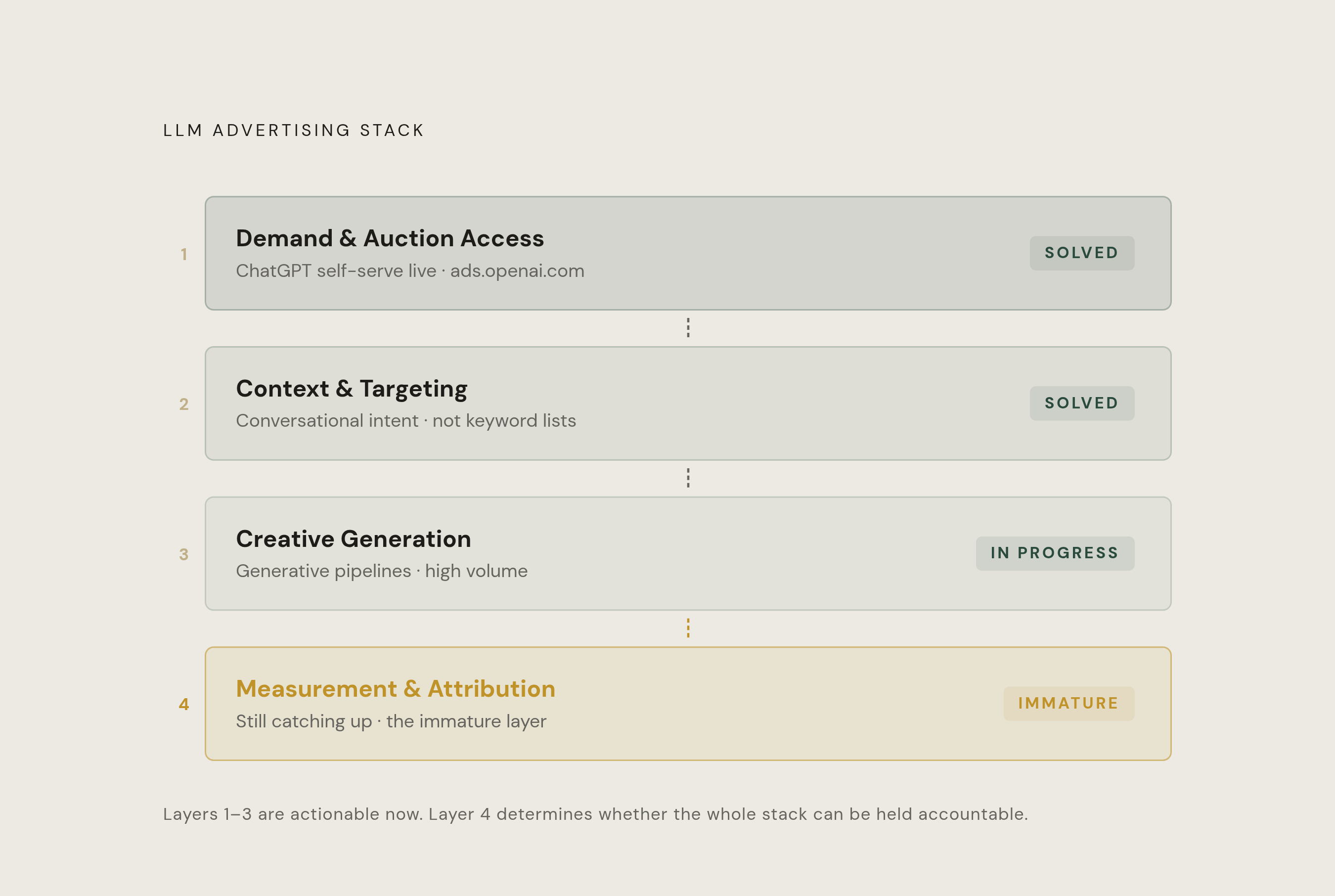
Acting on the timing argument requires building four specific capabilities, and being clear-eyed about the fact that one of them is still maturing while the other three are already decisive. Every LLM advertising operation runs on the same four layers: demand and auction access, which determines which assistants and surfaces a brand can actually buy into; context and targeting, which requires matching against conversational intent rather than keyword lists; creative generation, which has to produce on-brand assets at a volume conversational placements demand; and measurement and attribution, which connects spend to outcomes across the gap a conversation leaves behind.
Demand access is largely solved already. ChatGPT's self-serve advertising platform is live at ads.openai.com, with OpenAI describing the rollout as a beta self-serve Ads Manager that lets advertisers sign up and purchase ads to appear directly in ChatGPT. Because each assistant renders ads in its own native format and conversational relevance rewards specificity over generic messaging, the number of distinct creative assets a campaign requires expands well beyond what display or paid social demanded, a volume only achievable through generative production pipelines that take real time to build and calibrate.
Measurement, honestly and unavoidably, is still catching up. Brands should build measurement discipline now rather than wait for a fully mature solution that may not arrive before the opportunity narrows further. The infrastructure question for serious advertisers extends past whether they can buy inventory on a given surface. A demand-side platform built to operate specifically across AI surfaces, reading conversational context rather than placing against a page or a keyword, is a structurally different tool than a generalist buying platform retrofitted onto a new surface, or a single-surface AI ad network that reads context well but cannot offer reach across platforms. A brand's ability to buy intelligently across the surfaces where its audiences are actually having these conversations is what matters.
The compounding already underway for brands still treating AI as a test
If brands are still calling conversational AI advertising an experiment in late 2026, that is not caution. The experiment frame had real justification in 2024, when inventory was scarce and formats were unproven. Calling that an experiment at this stage is a category error, not a risk-management strategy.
Industry leadership is already naming the shift directly. The CMO of Chinese Laundry described the moment as a move from curiosity to accountability, calling it the AI "show-me-the-money" era and stating that "marketers aren't looking for more experimentation, they're looking for proof. The compounding that language points to is already measurable in practice. Brands that entered the ChatGPT pilot in February 2026 have since run multiple campaign cycles, iterated their creative, learned which conversational contexts convert, and begun assembling proprietary intent-signal baselines that did not exist a year earlier. A brand entering this channel in 2027 will face a more competitive auction with no equivalent baseline to draw on, the same structural gap that separated early and late entrants into mobile a decade earlier.
The mobile comparison running through this piece is a structural parallel, not a rhetorical flourish. Channel fluency, audience data, creative learning, and publisher relationships behaved as time-dependent advantages in mobile, and they are behaving the same way here. They cannot be purchased from a managed service at the price early movers originally paid. The difference this time is that the signals are harder to miss. In mobile, the window's closure was recognized mostly in hindsight, after the cost of entry had already risen. In conversational AI advertising, the inventory is live, the early movers are named, the compounding mechanisms are visible in real time, and the industry's own voices are already saying the experiment era is over.