Innovation Budget Structures That Allow AI Channel Testing
Early AI ad buyers need protected budgets to test channels before they mature.

AI advertising is no longer a watch-and-wait proposition. Sponsored placements inside conversational AI surfaces are live, buyable today, and already scaling. The brands that build the budget infrastructure to test them properly now will accumulate learning that becomes materially more expensive to acquire as the channel matures.
Why AI advertising surfaces are live buying options, not experiments to watch
ChatGPT launched sponsored placements on February 9, 2026, for logged-in U.S. adults on the Free and Go tiers, and the self-serve Ads Manager opened on May 5, 2026, with spend minimums removed. Google AI Overviews has carried ads inside AI-generated answers since 2024. The question is no longer whether the channel exists. It is whether a given organization is reading the results from placements it may already be running.
The market is being built now, and the scale signals are unambiguous. eMarketer projects U.S. AI search ad spend rising from just over $1 billion in 2025 to nearly $26 billion by 2029. The ChatGPT pilot reached roughly $100 million in annualized run-rate within six weeks of launch, which is a useful measure of advertiser appetite rather than long-term channel quality. Perplexity wound its ad program down after concluding that sponsored placement risked making users suspicious of everything, an instructive failure that shows the channel's trust dynamics are real and must be taken seriously by any brand considering entry.
How conversational AI advertising works mechanically, and why it requires different skills to buy
Buying ads inside AI conversations requires a different set of skills and inputs than search or social. There is no keyword layer in ChatGPT ads. The primary targeting control is natural-language context hints, a JSON array of up to 2,000 per ad group, written at the ad group level, with no officially documented per-hint character limit, matched against the live conversation.
The targeting system evaluates the entire conversational trajectory, not just the most recent query. Contextual signals the system reads include topic category, intent stage across research, comparison, and decision, query specificity, and conversation depth. A user asking "what's a good CRM?" signals different intent than "compare HubSpot and Salesforce pricing for a 10-person team," and the system captures that distinction.
The placement mechanics are deliberately conservative. On Google and Microsoft, AI placements run automatically from existing campaigns with no opt-out, so auditing what is already running is a precondition for budgeting anything new. Microsoft Copilot uses session-level awareness of the conversation's direction, not just the last query, to trigger ads, and introduces those ads via a feature called "ad voice" that explains how the sponsored section connects to the conversation.
What the intent signal from AI conversations reveals, and why it changes how to measure value
Visitors who arrive from AI conversations are qualitatively different from search or social traffic. Social media and CTV provide fragmented signals about a user's interests. AI search engages customers in conversation about explicit, in-the-moment needs, which makes the signal structurally richer.
The downstream behavior confirms this. A lower raw CTR feeding traffic that converts at multiples of search economics can out-earn a higher CTR feeding cold clicks. Surface-level benchmark comparisons mislead teams into undervaluing the channel.
Attribution is structurally harder here. Microsoft Copilot is reported to deliver substantially stronger CTR and higher conversion rates than traditional search ad placements, a vendor claim that should be treated as directional rather than definitive but is consistent with the qualitative difference in intent signal. The implication for budget governance is direct: a team judging an AI channel test by its CTR relative to Google Search will almost certainly pull budget from a channel that is actually performing. Success criteria must be set before spend begins.
Why AI channel tests fail when run inside the existing media budget
The most common reason AI channel tests produce inconclusive results is not the channel. Always-on campaigns optimized for proven channels have established quality scores, audience signals, and optimization history. A new channel test running alongside them will always look worse in the short term, even if it is actually working.
When innovation spend is drawn from the same pool as core performance spend, the first sign of underperformance triggers reallocation back to proven channels. The test ends before the platform's learning period completes. Cut a test at four or six weeks and you draw conclusions from incomplete data.
The creative production blind spot compounds the problem. The structural problem is that existing budget governance is built to defend proven performance, not to generate learning from new channels. These are different objectives that require different structures.
The 70/20/10 framework and how practitioners are adapting it for AI channels
The standard 70/20/10 budget allocation framework provides a useful starting structure. It allocates 70% to proven strategies, 20% to emerging tactics with some track record, and 10% to new high-risk innovations. In practice this maps to Core Performance Channels at 60 to 70 percent, Growth Opportunities at 20 to 25 percent, and Testing and Innovation at 10 to 15 percent.
Practitioners are actively expanding the experimental bucket for AI channels. Markacy co-founder Christopher Jones reports the experimentation share is getting closer to 25%, up from an 80/20 split historically. A 7% allocation that is genuinely protected and governed generates durable insight.
The adaptation practitioners are making is not just moving dollars. It is attaching distinct success criteria, distinct timelines, and distinct measurement rules to the experimental bucket, a governance change more than a math change. For AI channels, you also need the experimental allocation to cover creative production. The context hint and the landing page continuity are targeting inputs, not just messaging decisions, and funding them only from general creative resources is the most common blind spot.
A phased budget structure for AI channel testing that protects always-on performance
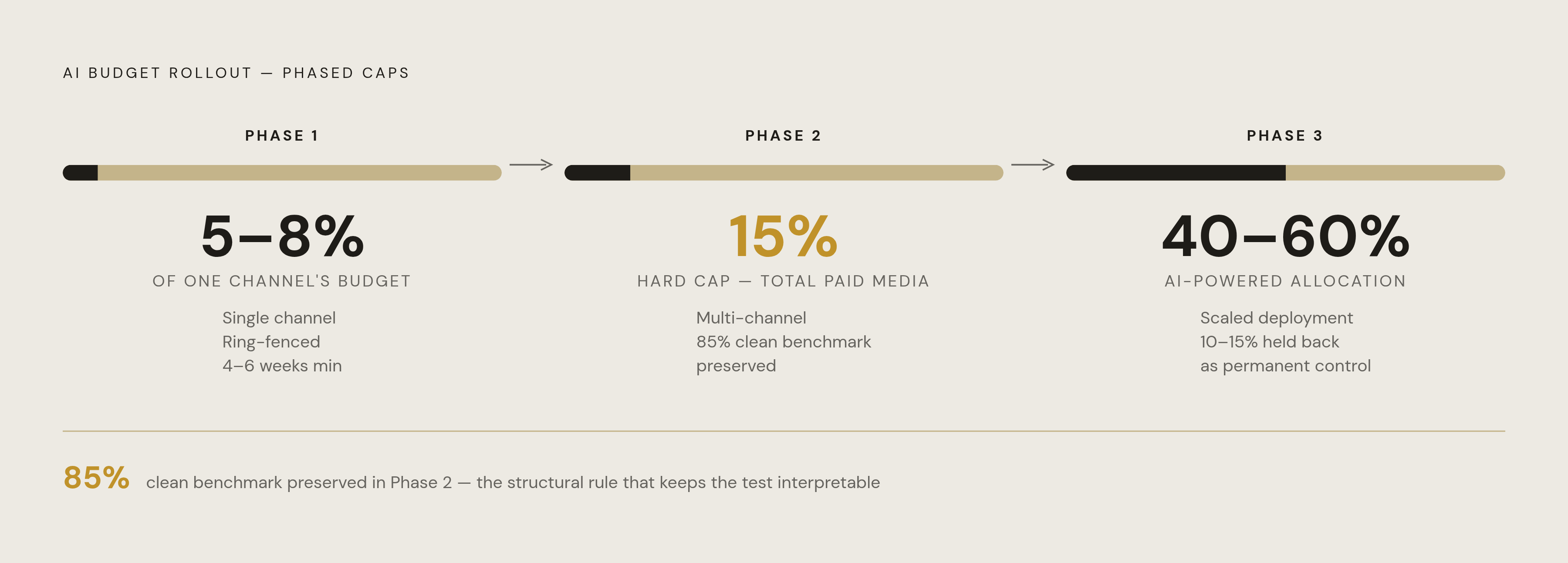
A phased rollout structure, with hard caps at each phase and a clean benchmark preserved throughout, is the governance model most compatible with both CFO scrutiny and genuine learning. The phases are defined by what the test is supposed to learn, and each phase has a cap that limits downside while preserving the signal the test is trying to generate. Phase One: Sandbox Validation. Start with 5 to 8 percent of a single channel's monthly media budget, ring-fenced separately from always-on campaigns, run for a minimum of four to six weeks. What conversion events are measurable?
Phase Two: Controlled Multi-Channel. Hard cap at no more than 15% of total paid media budget inside the AI testing framework, with the untested 85% preserved as a clean benchmark. Without it, you cannot isolate the AI channel's contribution from broader performance variation.
Phase Three: Scaled Deployment. 40 to 60 percent of total paid media spend through the AI-powered allocation model across core channels, with 10 to 15 percent held back as a permanent control group, refreshed quarterly. The permanent control group is not a hedge against the channel. It is the measurement infrastructure that makes continued optimization possible as the channel scales.
Minimum viable entry thresholds are a practical decision tree. Between $5,000 and $15,000 a month, one controlled ChatGPT test measured on assisted conversions is appropriate. Above $15,000 a month, run ChatGPT paid placements and organic Answer Engine Optimization in parallel.
Success criteria must be set before spend begins, not after. A new channel at equivalent efficiency to a proven channel in its first 90 days is actually outperforming expectations. Make creative production budget a line item within the testing budget, not general creative resources, because the context hint and landing page continuity are targeting inputs, not afterthoughts.
How success criteria should differ by industry vertical and audience type
The same budget structure applies across verticals, but the success criteria, the context hint strategy, and the measurement approach must be calibrated to the conversational intent patterns specific to each category. E-commerce. AI chat delivers substantially higher conversion rates than non-AI-engaged traffic, and AI-referred retail visits convert meaningfully better than non-AI traffic per Adobe Analytics data via Digital Commerce 360, July 2026. Context hints for e-commerce should target comparison and decision-stage conversations, not broad category awareness. The landing page must continue the specific conversation. A user deep in a product comparison needs a different landing experience than a user in early research.
B2B and SaaS. B2B success criteria should weight Microsoft Copilot more heavily, given its position inside Microsoft 365 workflows and its structural exposure to business audiences. Priority context hints for B2B should be questions with explicit commercial intent signals: "best for," "vs," "alternatives," "pricing," "security," "migration," and "integrations."
Health and finance. Legal services remain prohibited, and legal was not permitted until August 31, 2026. Brand safety risk is higher in these categories, because ads may appear adjacent to conversations that stray into medical, legal, or financial advice territory, and alongside hallucinations or misinformation. For health and finance tests, include brand safety monitoring as a primary metric alongside conversion outcomes. A test that hits CAC targets but generates brand safety incidents is not a success.
Travel and hospitality. This vertical has some of the strongest Google Search conversion benchmarks and ROAS, which makes it a useful comparison point when setting the 2× CAC threshold for AI channel tests. Teams in this category should use their existing search performance as the benchmark, not a generic cross-category average.
What the measurement stack needs to look like before the first dollar is committed
A team that commits budget to an AI channel test without first deciding how it will measure results will end the test with data it cannot interpret. Measurement infrastructure is a precondition for the test, not a cleanup task afterward. The minimum measurement stack for a ChatGPT test as of October 2026 includes OpenAI Pixel and Conversions API for on-platform signal, a one-day view-through attribution window available since October 5, 2026, and an Event Quality Score to assess signal fidelity.
Attribution partners including AppsFlyer, Triple Whale, Adjust, DV Rockerbox, Northbeam, Branch, Singular, Kochava, Airbridge, and Tenjin are now integrated with OpenAI's measurement infrastructure. Incrementality experiments are available through Haus, Measured, and WorkMagic. Last-click models systematically undercount AI channel contribution because of the conversation gap. Users research in the chat, leave, and convert later, and teams that rely only on last-click will undervalue the channel and pull budget prematurely.
The clean benchmark preserved in Phase Two, the untested 85%, only generates useful data if the measurement methodology is consistent across the AI test and the benchmark. Set one attribution rule across ChatGPT, Google, Meta, and other channels before the test begins. For Google and Microsoft AI placements, audit what campaigns are already serving inside AI answers before the test launches. These placements run automatically, and their results are already in the account data whether or not the team has been reading them as AI placements. The measurement problem in AI advertising is genuinely unsolved at the edges, and being honest about what the current stack can and cannot measure is a precondition for interpreting test results fairly rather than optimistically. Demand-side platforms built specifically for conversational AI surfaces, as opposed to generalist DSPs retrofitted for the format, can read conversational context signals that inform both targeting and measurement. Teams evaluating buying infrastructure should assess whether the platform can read context across surfaces, not just execute the auction on one.
How the learning from early AI channel tests compounds into structural advantage

The brands that build AI channel testing infrastructure now are not just running experiments. They are accumulating context hint libraries, creative learnings, and measurement baselines that become harder for later entrants to replicate as competition increases. The relevance-weighted auction rewards craft over raw spend. A precise advertiser with a well-developed context hint library and matched landing pages can outcompete a larger budget that is less contextually specific.
Context hint development is an accumulated asset. The process of testing which natural-language descriptions match the right conversational moments generates institutional knowledge that is not transferable from search keyword lists. eMarketer forecasts U.S. AI search ad spend rising from just over $1 billion in 2025 to nearly $26 billion by 2029. Teams entering the auction later will face more competition for conversational contexts their early-moving competitors have already learned to win.
The compounding mechanism is direct. Each test cycle gives you better context hints, better landing page continuity, better measurement baselines, and clearer success criteria for the next cycle. The structural advantage is not the channel itself but the learning infrastructure built around it. Brands that treat AI as a distribution channel today, building the budget governance, the context hint craft, and the measurement stack now, are building the category leadership position that will be harder to acquire once the market is more competitive. The budget structure described here is not a short-term tactical decision. It is the foundation of a durable capability.