Early Mover Dynamics in Google Search Advertising 1999 to 2004
Early bidders locked in lasting advantages when Google rewrote its auction rules.

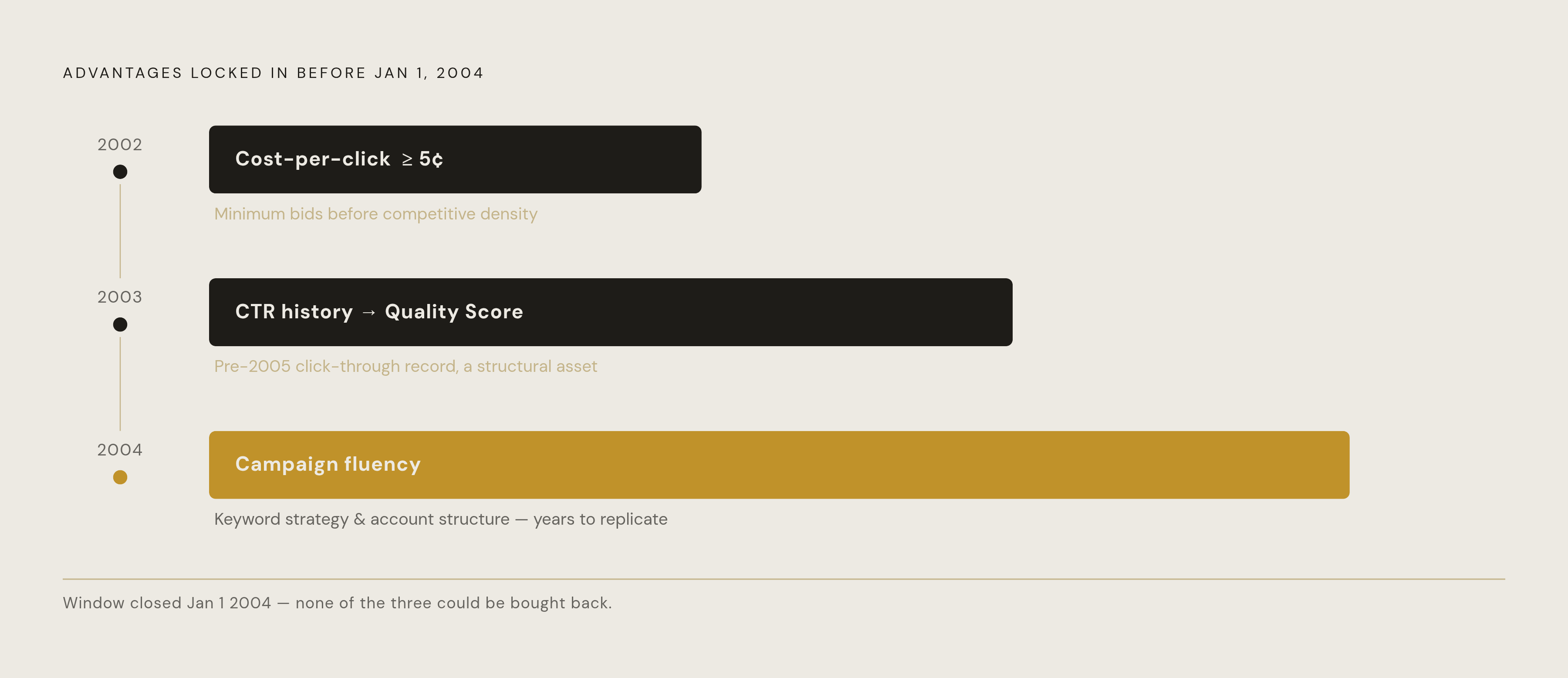
Between 1999 and 2004, advertisers had a single, non-recurring opportunity: to build keyword ownership, click-through-rate history, and auction fluency before the rules of the auction itself had fully hardened. That window did not reopen, and it could not be bought back once it closed. What made the period different from ordinary market growth was not the pace of adoption or the size of the ad budgets flowing in. The platform's core mechanics were still being written while advertisers were already using it, and the people inside the system during that stretch locked in advantages that later became self-reinforcing. Minimum bids sat as low as five cents, and because competitive density had not yet arrived, you could get high-intent commercial terms that now cost multiples of that figure at the floor price. Account history and click-through-rate baselines built during this stretch fed directly into the Quality Score calculations formalized in 2005, so the relevance data an early advertiser built up became a lasting structural asset, not just a temporary head start. The window's close is dated precisely: effective January 1, 2004, Google terminated its Premium Sponsorships program and folded every advertiser into the AdWords cost-per-click model, a detail confirmed in the company's 2004 S-1 filing. By that point Google was handling more than 300 million queries a day and had indexed billions of web pages, the scale at which keyword auctions turned genuinely competitive and erased the low-cost conditions that early entrants had exploited. Everything that follows in this account, who won, who lost, and why, has to be read against that five-year span and its hard closing date.
GoTo.com's Invention of the Click Auction
The category that Google's early advertisers eventually entered was not built by Google. It was built by GoTo.com, which charged advertisers only when a user actually clicked an ad, with placement set by auction: more desirable keywords commanded higher prices, while less competitive terms went for as little as a penny per click. By 1999, GoTo.com's self-serve platform had scaled to many thousands of advertisers, proof that a keyword-auction model could work commercially at real scale. That proof is what Google was watching before it built its own version of the idea.
GoTo.com's model carried a structural flaw that would matter enormously later: top placement went purely to the highest bidder, with no regard for whether the ad actually answered the user's query. Advertisers could bid up irrelevant terms and pay only when someone clicked, which created a constant incentive toward bid manipulation and a search experience that degraded as more money chased the same keywords. That flaw is the hinge on which the rest of this story turns. When relevance entered the auction as a factor, rather than money alone, advertisers who had already built tightly targeted, high-click-through accounts found themselves structurally ahead of competitors who had simply spent more. GoTo.com invented the auction; the weakness in how it ran the auction is what gave the next mover room to win differently.
What Google launched in October 2000 and why it attracted almost no early movers
Google's AdWords launch in October 2000 is often folded into the same story as the 2002 pivot that followed, but the two products had almost nothing in common. The October 2000 version was a cost-per-thousand-impressions product with a small initial advertiser base, fixed monthly budgets, and no auction weighted by relevance. Advertisers paid whether or not anyone clicked. There was no pay-per-click pricing, no self-serve bidding, and no quality-based ranking of any kind, which made the product structurally closer to the banner ads it was meant to replace than to the search-ad business Google would later become known for.
First-year revenue from this version of AdWords came to $70 million, a real sum but a modest one next to what followed, and a sign that a flat cost-per-impression model had not yet found the commercial logic that would make search advertising a different kind of business. Google had first planned to route its ad inventory through DoubleClick, which was then the largest banner-ad company in the industry. The banner-ad market collapsed in the spring of 2000 as the dot-com bust set in, and that collapse is what pushed Google to build its own advertising product rather than hand the business to someone else. Because the October 2000 product ranked ads purely by bid, with no click-through-rate component, an advertiser who joined that year built nothing durable. Their position on the page depended entirely on how much they paid, and any later entrant with a bigger budget could knock them off that position overnight. The product gave advertisers no reason to arrive early, because arriving early bought them nothing that a richer competitor couldn't immediately undo.
The February 2002 pivot: how Quality Score changed the rules mid-game and who benefited
Everything changes with AdWords Select, launched in February 2002. Google switched from charging by impression to charging by click and introduced an auction weighted by click-through rate, and this became the direct precursor to what would formally become Quality Score in 2005. It rewrote the rules of the auction in a way that reached backward and rewarded advertisers who had already built relevant, high-performing accounts, while making it structurally harder for a new entrant to simply outspend their way to the top, so this was far more than a product update.
AdWords Select borrowed Overture's pay-per-click pricing but added one critical change: ad position was no longer set by bid alone, but by bid multiplied by click-through rate. In its own announcement of the product, Google stated: "AdWords Select ranking is determined by a combination of ad performance (click-thru rate) and how much an advertiser agrees to pay per click." Pricing worked on a modified second-price basis: an advertiser paid just enough to beat the next-ranked competitor rather than their full bid, so relevance, not raw spend, became the lever that determined efficient cost-per-click. Hal Varian, recruited around this period as Google's Chief Economist, had a hand in designing these auction mechanics, so Quality Score was not an industry convention that Google happened to adopt. It was deliberately engineered economic architecture.
The compounding effect that followed is the core of the entire early-mover story. If you got in early, built a tightly targeted keyword list, and established a strong click-through-rate baseline, you could reach a lower cost-per-click than a much larger competitor who bid more money but carried a weaker relevance record, and that gap widened as more advertisers entered the auction and competition intensified. Google turned its first annual profit in 2001, with revenue reaching $440 million that year on the strength of a self-serve platform that scaled to thousands of advertisers, confirming the commercial model worked at exactly the scale that would make the auction competitive for anyone arriving later.
A fair objection to this argument deserves a direct answer. Google was not first to paid search: it improved on a category GoTo.com had already built, so calling early Google advertisers "early movers" can sound like a misnomer. The objection is correct about the broader category's history, but it misses the mechanic that actually mattered. The advantage in question did not belong to whoever arrived first in paid search generally. It belonged to whoever arrived first inside the specific Quality Score auction that opened in February 2002 and had hardened into a low-margin, high-competition environment by 2004. One early Google marketing executive said the company's leadership viewed GoTo.com's highest-bidder model as fundamentally broken, because advertisers could bid up irrelevant terms and pay only on clicks whether or not the ad served the user. That view is what Quality Score was built to correct, and it is why the advertisers who adapted to relevance-based ranking before their competitors understood it held an advantage that had nothing to do with when paid search as a category began.
The AOL Deal and AdSense: Extending the Early-Mover Window to Publishers and Distribution
The same dynamic that rewarded early advertisers inside the auction also played out on the distribution and publisher side, in roughly the same window. Two moves, one in 2002 and one the following year, extended the advantage beyond keyword bidding: the AOL partnership shifted premium search inventory away from Overture and toward Google almost overnight, and AdSense opened a new channel for publishers whose earliest participants locked in favorable terms before the network grew large enough for those terms to become competitive.
In May 2002, Google took over AOL's search and advertising services, guaranteeing AOL $100 million in revenue and sharing a substantial portion of ad revenue, with AOL receiving warrants for millions of shares in the deal. The agreement moved premium search inventory from Overture to Google, and it sped up Google's distribution just as AdWords Select was gaining traction among advertisers. If you were already running campaigns on AdWords Select, the AOL deal expanded your reach instantly, with no changes required on your end. It functioned as an unearned dividend for existing participants and simultaneously raised the cost of entry for any new advertiser trying to compete for the same inventory afterward.
The parallel between the buy side and the sell side is direct. If keyword buyers got in before the auction grew dense, they locked in low costs per click. If publishers joined AdSense before the ad network reached its later scale, they locked in revenue-share terms that would not have been available once the network matured. Both outcomes are expressions of the same structural fact: early presence inside a system whose rules have not yet settled produces an advantage that the system itself later makes unavailable.
Overture's Fate and the Cost of the Wrong Structural Advantage
Overture's acquisition by Yahoo in 2003 is instructive precisely because Overture, not Google, invented the click auction. Being first to a category is not the same thing as holding a durable early-mover advantage. Overture's advantage rested on a highest-bidder structure that was permanently weaker than the quality-weighted auction Google built on top of the same basic idea, and no amount of market share or advertiser volume could make up for that difference in architecture.
The flaw was structural. Advertisers on Overture's platform could bid up irrelevant keywords and pay only when someone clicked, so they had a constant incentive toward bid manipulation, and that consistently put low-quality advertisers in top positions, regardless of how good a legitimate advertiser's campaign actually was. Once Google weighted its auction by click-through rate, relevance could outrank a bigger bid, so Overture's core advantage was no longer just weaker. It had become incompatible with the standard advertisers and users now expected from a search ad. The lesson for reading any early-mover story is specific: the advantage that compounds over time is the one attached to the platform whose underlying mechanics turn out to be right. Early presence on a platform built on the wrong mechanics does not transfer to a competitor, and it offers no protection once a structurally superior alternative appears.
Entering a New Ad Channel Before Its Mechanics Are Settled
The arc from GoTo.com's invention through Overture's acquisition produces a precise definition of early-mover advantage, one that has nothing to do with simply showing up first. The advantage belongs to whoever commits to the right structural mechanics before the auction becomes competitive, and the window in which that commitment pays off compounding returns is shorter than it looks from the outside while it's happening.
Three distinct advantages compounded for advertisers who got into AdWords Select early: lower costs per click before the auction grew dense, a click-through-rate and Quality Score baseline that became more protective as competitors arrived, and a working knowledge of campaign structure and keyword strategy that took latecomers years to match. None of these three could be bought back once the window closed on January 1, 2004. Overture's story is the negative proof of the same rule: early commitment to a platform built on the wrong mechanics produces gains that feel real in the short run and turn out to be worthless once a better-architected competitor arrives. Arrival order matters far less than structural correctness.
This pattern recurs each time a new advertising surface opens, as every new channel passes through a pre-competitive window in which the auction mechanics are still unfinished, prices are at their structural floor, and no one has yet built the account history that later becomes a durable asset. In every instance on record, that window closes faster than most advertisers expect it to, which is the entire reason the 1999–2004 period rewards this kind of close study rather than casual recollection.
Sources
- DIGITAL MARKETING TOOLS: THE HISTORY OF PPC — UNBXD
- A History of Google AdWords and Google Ads: Revolutionizing Digital Advertising & Marketing Since 2000 - PPC Hero
- Quality Score
- Google Inc. - Form S-1/A - FY2004
- Sponsored search: A brief history - Fain - 2006 - Bulletin of the American Society for Information Science and Technology - Wiley Online Library
- OVERTURE SERVICES INC - Form 10-Q - FY2002
- OVERTURE SERVICES INC - Form 10-K - FY2001
- Sponsored search: A brief history - Fain - 2006 - Bulletin of the American Society for Information Science and Technology - Wiley Online Library