Shifting Channel Budget Toward the Moment a Buyer Types a Purchase Question Into an AI
Brands are shifting ad budgets to reach buyers the moment they ask AI assistants what to buy.

A conversational AI advertising platform places paid messages in live AI conversations. ChatGPT, Google AI Mode and AI Overviews, and Microsoft Copilot offer distinct routes to those placements. The budget case is to redirect marginal spend toward expressed purchase intent, then scale on downstream value.
Where purchase intent is now being revealed first
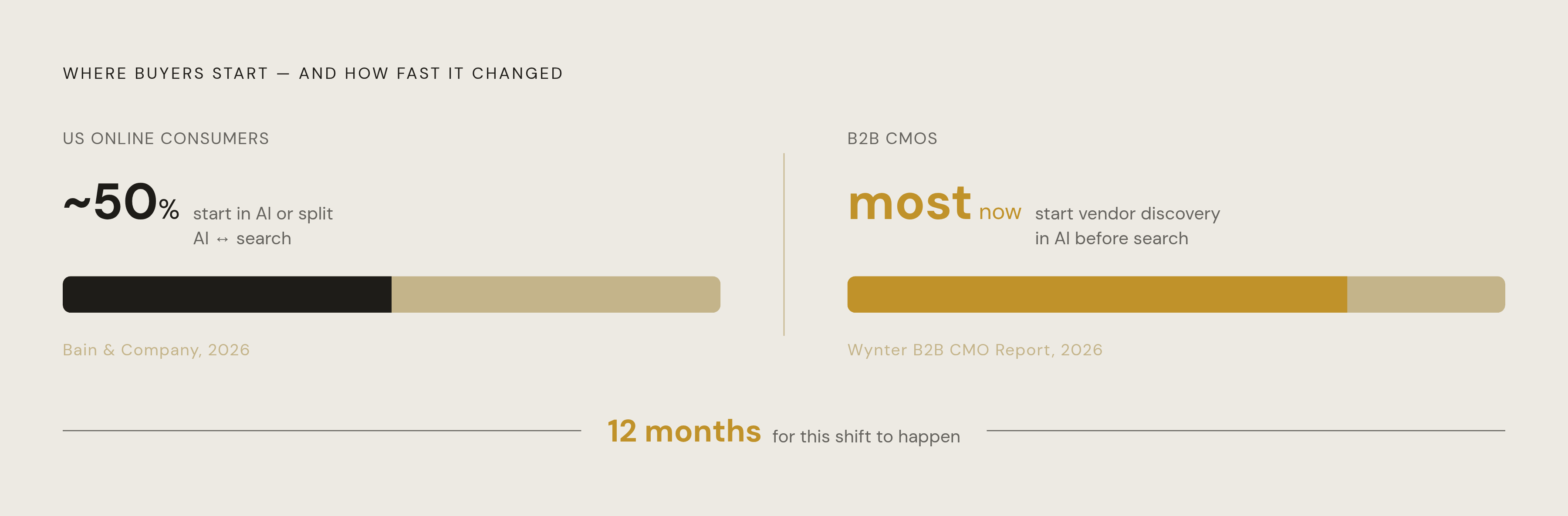
Bain & Company’s 2026 survey found that nearly half of US online buyers mostly start their journey in an LLM or split their search between AI tools and traditional search engines. Wynter’s 2026 B2B CMO Buyer Journey Report found an even sharper shift among business buyers. A large majority of CMOs now use AI tools for vendor discovery, and most start with AI before opening a search engine. The change happened in roughly 12 months. Discovery has acquired a new starting point.
That starting point makes intent legible before a buyer names a category or brand. A question about reducing churn in a SaaS product reveals a problem and a priority that a demographic profile cannot express. Follow-up questions can then expose constraints and purchase readiness. The signal develops through the exchange itself. This creates a new unit of advertising value, the high-intent conversational moment.
What the same shift is doing to the channels where the budget currently lives
When AI shapes a buyer’s view before a search visit, the role of the later placement changes. Search and social budgets meant to show buyers their options may now reach someone who is already making a shortlist. The placement still has a commercial function. But its position in the decision process is different, so an allocation that was rational in 2024 cannot simply inherit the same assumptions about marginal return.
The consequence is a case for correcting the existing allocation. Search can still capture demand, but AI assistants play a growing role in shaping which products buyers want. Social impressions remain further upstream than a buyer explicitly asking what to buy. Teams must decide whether the next increment of spend should fund another impression or reach the buyer when the problem, constraints, and interest in a solution become explicit.
What makes the AI purchase moment a structurally different unit of value
Search targeting uses a keyword as an approximation of intent. Conversational targeting can use the full dialogue, including the buyer’s question, the assistant’s response, and the follow-ups that reveal where the discussion is heading. Consider a buyer describing coordination problems, missed deadlines, and remote collaboration friction across six exchanges. The buyer never types “project management software.” Yet the conversation reveals a purchasing situation that matching that category keyword would miss.
The technical distinction is discourse coherence: interpreting each turn in relation to the preceding exchange. “What about vegetarian options?” has little targeting value without the earlier discussion. Because relevance can come from the live conversation rather than browsing history, this architecture does not require a persistent identifier. That privacy-preserving property applies specifically to the signal.
The commercial consequence is the pre-sold visitor. Someone arriving after an AI recommendation has already received a reason to consider the product, unlike someone clicking before a comparison. This changes the proper unit of evaluation. A lower click-through rate can produce better economics if those visitors convert more efficiently.
How the targeting mechanics actually work — and why they require a different setup
ChatGPT’s ad system uses a context hint. This is a freeform description of the conversations where an ad belongs, written at the ad group level and capped at 280 characters. The system matches it against the live conversation. A comma-separated topic list is a poor substitute for describing a buyer situation. The creative task is to express when the offer becomes relevant.
Matching evaluates topic category, intent stage, query specificity, and conversational depth. These distinctions go beyond broad, phrase, and exact match because the same topic can appear during research, comparison, or a decision. The targeting stack must also work within milliseconds. Placement design therefore has to respect the flow of an ongoing exchange.
Google and Microsoft work differently, automatically serving ads inside their AI surfaces from eligible campaigns and assets already in place. That difference changes the preparation required before spending. Teams need to tell which exposure comes from campaigns they already run and which comes from newly purchased inventory, while writing the descriptions of conversations that ChatGPT requires. The ramp-up requires learning. Experience with Search helps teams judge what will sell, but they still need to learn how to write a context hint.
What platforms let brands place ads inside live AI chatbot conversations?
ChatGPT has its own space for ads, with a labeled sponsored card below the assistant’s answer. The card’s pilot required a $200,000 commitment at roughly $60 CPM, with launch partners including Target, Adobe, Williams-Sonoma, and Albertsons. OpenAI reported $1 billion in annualized advertising revenue run rate on August 31, 2026. By Q3 2026, availability covered 60+ countries and 31 European markets.
Access to the audience is more restricted than that footprint suggests. Ads reach logged-in adults on the Free and Go tiers only, while Plus, Pro, Business, Enterprise, and Education remain ad-free. This is a consequential constraint for B2B advertisers. OpenAI announced an Ads Manager plugin, AI creative suggestions, Shopify and HubSpot integrations, and a Sponsored Agents test on September 16, 2026.
Google AI Mode and AI Overviews use Search campaigns already in place with broad match or AI Max, Performance Max, and Shopping campaigns, and all require smart bidding. Eligible campaigns serve without an opt-in or opt-out control. Microsoft Copilot likewise automatically includes eligible campaigns and assembles ads from existing account assets. Its position inside Microsoft 365 workflows makes it relevant to business audiences. These routes differ from buying a dedicated ChatGPT placement.
Amazon Alexa for Shopping, formerly Rufus, provides a commerce-native alternative. Amazon uses a seven-day rolling attribution model to track delayed conversions after those interactions. Not every prominent assistant is buyable, however. Perplexity launched sponsored answers in November 2024, ended new advertiser acceptance by October 2025, and publicly announced its full exit in February 2026. Claude has never sold ad placement, and the Gemini app is still ad-free even though Google shows ads in its separate AI Overviews surface.
How AI purchase moment performance benchmarks against search and social
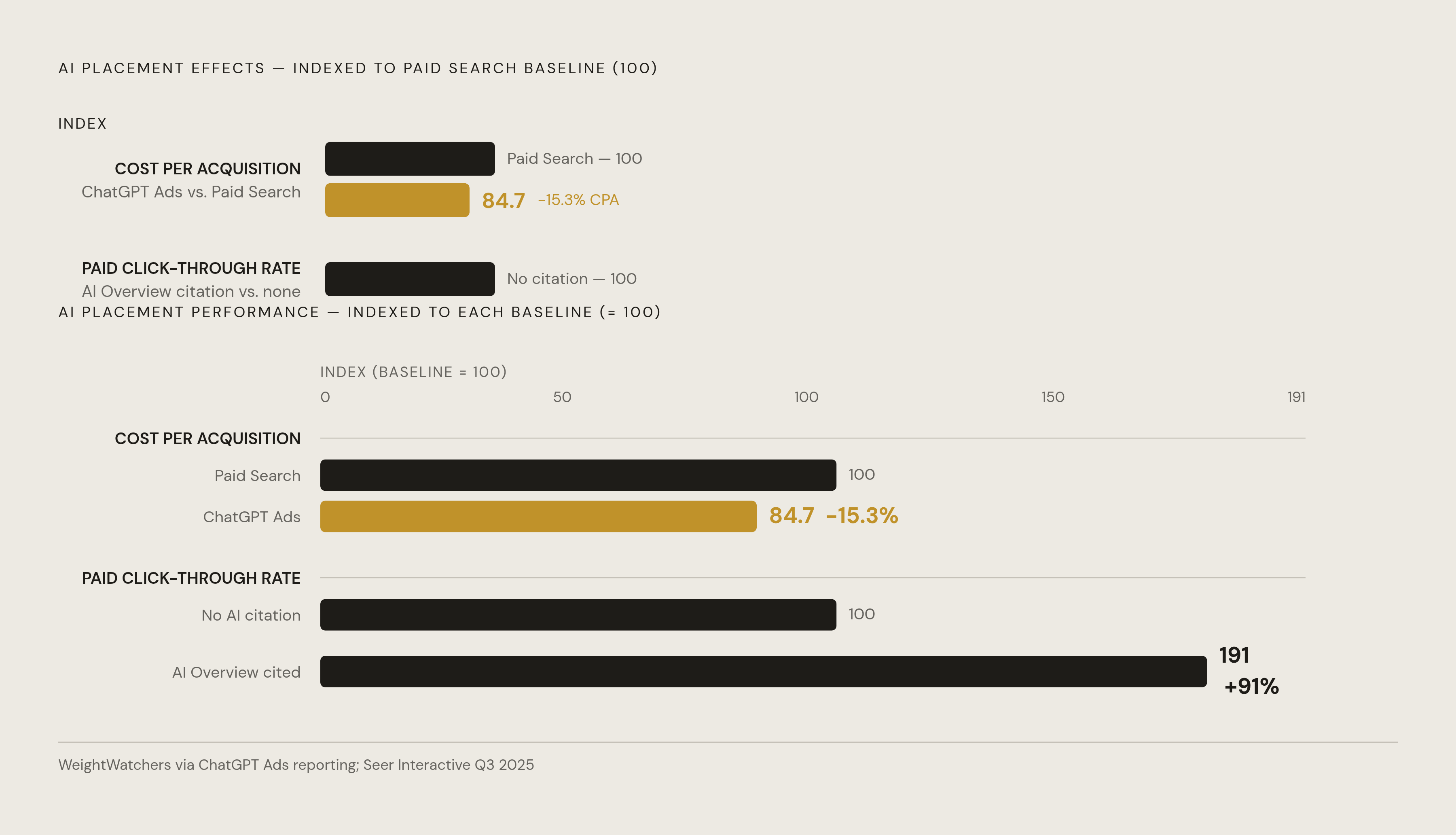
WeightWatchers reported a CPA through ChatGPT Ads 15.3% below its blended paid search CPA. DV Rockerbox’s measurement, published by OpenAI on October 5, 2026, provides a concrete comparison against an existing acquisition mix. This comparison shows why a lower-volume source can justify budget when the visitors it delivers are closer to purchase.
Seer’s Q3 2025 research found that paid CTR was 91% higher when a brand was cited in an AI Overview than when it was not. Microsoft also reports that Copilot placements outperform traditional search ads on click-through and conversion. Those are platform-reported results and warrant that qualification. The evidence here supports a search comparison more directly than a broad claim of superiority over social.
Attribution across multi-turn conversations, view-through measurement, and cross-surface incrementality are still unresolved. OpenAI introduced Pixel and Conversions API only in October 2026, while incrementality testing through Haus, Measured, and WorkMagic remains in early stages. The infrastructure is young, but it is developing. Early buyers are learning how to track attribution while they face few competitors, rather than waiting for the certainty they get from mature search.
Industry sectors where the AI purchase moment concentration is highest
Retail has the clearest link between a conversation and a purchase. Alexa for Shopping provides a commerce-native environment, while Shopify is ChatGPT’s first ecommerce partner integration. Retail also featured among ChatGPT’s pilot launch verticals. Inventory is the constraint on that opportunity. AI shopping assistants have fewer placements and higher CPCs than traditional search results, but reach buyers further into the decision process.
Travel has a natural fit with multi-turn planning because itineraries, comparisons, and logistics require connected questions. The category’s estimated search spending in 2026 is $5.55 billion, roughly 60% of its total digital spending, the highest search share of any category. Its opportunity is therefore both behavioral and financial, with conversational planning adjacent to a large existing allocation. Travel was also a ChatGPT pilot launch vertical.
Technology and electronics fit because high-consideration purchases involve detailed comparisons. A continuing exchange can expose requirements that a short query leaves implicit. Technology was another ChatGPT pilot launch vertical. Financial services presents a more constrained case, despite consumer AI usage nearly matching retail and substantial search spending. Adjacency to AI-generated financial advice or regulatory hallucinations makes targeted tests more appropriate than primary reallocation until brand safety controls mature. Healthcare and pharma call for the same care because of the rules that govern them.
What being citable by an AI changes about brand presence strategy
Organic citation and paid placement are complementary investments. The citation effect in Google’s ecosystem shows that the answer surrounding an ad can strengthen its performance. A large majority of B2B buyer interactions with AI tools are zero-click, so the response may be the brand’s first and only impression. Website traffic alone cannot describe that exposure.
The strategic response is to become citable before using paid placement to reinforce that presence. The supporting investments are category fame, accurate third-party portrayal, and content structured for AI readability. Generative Engine Optimization addresses discoverability and trust within AI-powered systems. It is distinct from traditional SEO, which remains necessary but insufficient. Evaluation consequently expands to AI visibility, citation frequency, recommendation rate, and AI share of voice across key questions, rather than treating every non-click as an absence of influence.
How to structure an actual budget reallocation toward AI purchase moments
The allocation framework begins with an audit of existing exposure. Google and Copilot may already be serving eligible campaigns inside AI answers. Product feeds, landing pages, and creative also contribute to relevance scoring on those systems. Improving those assets is a zero-new-budget lever. ChatGPT requires attention to the destination as well, because OpenAI crawls the landing page as a relevance signal during ad review.
A pilot should then have a defined spending limit and enough volume to generate statistically meaningful conversion data. It should not begin as a primary channel. Pixel and Conversions API should be in place before scaling, with planned iteration cycles for context hints comparable to creative testing in paid social. This separates the cost of learning from the case for expansion. The latter depends on downstream conversion rate and CPA justifying the placement cost.
The clearest source of marginal funding is non-branded search on queries where AI Overviews appear. That redirects money around the same underlying intent rather than treating conversational advertising as an unrelated experiment. Blended paid search CPA is a better way to judge the results than click volume. Delayed conversions also need room in the model, as Amazon’s attribution approach illustrates. Financial services and healthcare advertisers should keep more of their budget in channels they can control until AI brand safety tools improve further.
Scaling across ChatGPT, Google AI, and Copilot requires infrastructure that accommodates distinct creative inputs, targeting logic, and measurement approaches. A generalist DSP cannot read conversational context, while a single-surface AI ad network cannot provide cross-surface reach. Measurement tolerance therefore belongs in the initial budget thesis. Requiring mature-search certainty before any allocation defers both spending and learning. Teams that build attribution infrastructure and conversational targeting skills now gain a structural advantage as the channel scales, because that learning cannot be transferred from search experience alone.