Mapping Live AI Conversation Ad Inventory Against Traditional Channel Equivalents
AI conversation ads require new buying strategies beyond traditional channel frameworks.
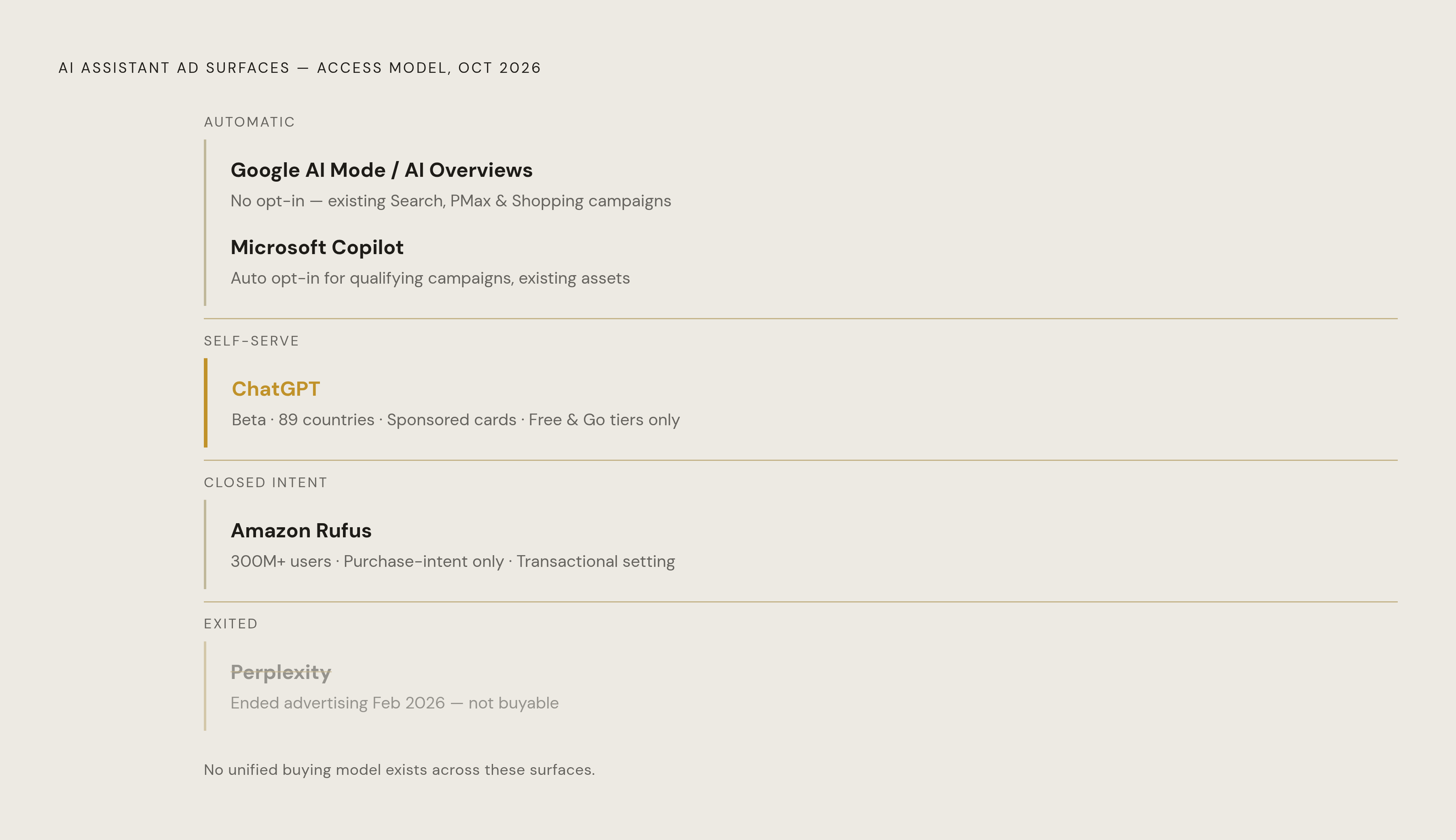
Conversational AI advertising places paid messages in live AI assistant interfaces, matched to the conversation in progress. As of October 2026, live surfaces include ChatGPT, Google AI Overviews and AI Mode, Microsoft Copilot, and Amazon Rufus, while Perplexity is not buyable. These placements resemble search, native, display, and pre-roll, but conversation-based targeting makes each analogy an incomplete buying framework.
Why AI conversation inventory is emerging as a distinct ad channel
OpenAI had roughly 900 million weekly active users around its February 2026 advertising launch, but only a small fraction were paying subscribers. That imbalance created a structural financing gap for a large-scale assistant. Advertising offered a way to fund unpaid use. Yet an assistant produces answers through dialogue rather than presenting a fixed page of results, so its commercial surface required decisions about where advertising belongs and how it relates to the answer.
The platforms made different calls about that opportunity. OpenAI built a distinct advertising product, while Google and Microsoft routed AI surfaces through campaigns advertisers already run. Perplexity ended advertising in February 2026, and Claude sells no placements. These are different business choices. Their divergence shows why AI conversation inventory cannot yet be treated as a standardized extension of an established channel.
What platforms let brands place ads inside live AI chatbot conversations today
OpenAI’s ChatGPT Ads Manager is a self-serve beta live in 89 countries as of October 2026. Its ads render as labeled sponsored cards below the assistant’s answer, never inside it. OpenAI’s documentation limits exposure to logged-in adults on the Free and Go ($8/month) tiers. Plus, Pro, Business, Enterprise, and Education remain ad-free. The tier boundary defines who can receive a placement, regardless of how relevant the conversation appears.
Google AI Mode and AI Overviews have no ad product of their own. Search campaigns using broad match or AI Max, Performance Max, and Shopping campaigns serve automatically, with smart bidding required and no opt-in or opt-out control. Microsoft Copilot also uses automatic opt-in for campaigns and ad types that qualify. Its ads use assets already in the advertiser’s account.
Amazon Rufus logged more than 300 million users in 2025, with monthly users up substantially year-over-year. Amazon reports that users who engage with Rufus are meaningfully more likely to complete a purchase, giving this inventory a specifically transactional setting. Other named assistants are not available to buyers. Perplexity ended advertising in February 2026, while Claude and Meta AI sell no placements. Facebook and Instagram ads can reach Meta AI users, but those are not in-conversation placements.
Dappier has announced Sponsored Conversations, a format that lets advertisers put a custom brand agent into AI chats on publisher sites. This is a different supply-side model from platform-direct cards and automatically eligible campaign placements. Its announced format makes the brand a conversational participant.
The four traditional channel types that AI inventory most closely resembles
Search is the closest analogue for active intent. ChatGPT and Google AI Mode meet users who are asking questions and solving problems, while native advertising explains the non-interruptive placement of a commercial unit beside an answer. Programmatic display provides the comparison for context-based targeting and relevance-weighted auctions. In-stream pre-roll supplies the less obvious analogy, because the content being consumed establishes commercial relevance across a session. Each comparison explains a different part of the product, namely intent, format, allocation, or eligibility.
Where AI inventory resembles search and where the resemblance breaks
Conversational ads share search advertising’s goal-directed moment of exposure. A user is actively working through a problem, and the text provides evidence of intent. ChatGPT Ads Manager also supports cost-per-click and outcome-optimized bidding, so buyers can focus on performance in a way they know. The resemblance is strongest at that level. It weakens when a buyer moves from identifying demand to specifying how an ad should qualify.
ChatGPT has no keyword layer in its primary targeting control. Instead, an advertiser gives a natural-language context hint at the ad group level, which feeds a relevance-weighted second-price auction. A keyword describes the words someone might type. A context hint describes what someone is trying to accomplish and why the offer could help.
For example, a user might discuss team coordination failures, deadline tracking, and remote collaboration without typing “project management software.” The conversation can still show a strong link to a possible purchase. Its trajectory also distinguishes research, comparison, and decision mode without relying on query syntax. Depth adds another signal to that assessment. Early in a chat, awareness-level advertising may fit, while deeper in the thread, conversion-focused placements may work.
Google presents a different break with the search analogy. Existing campaigns can serve in AI answers without keyword changes or an opt-in, but smart bidding is required, and buyers cannot audit or control qualifying creative and feed quality as they would a keyword list. Microsoft reports that Copilot placements outperform traditional search ads, but that remains a vendor claim without independent verification. It does not establish ChatGPT performance expectations. The surface defines the relevant comparison.
Where AI inventory resembles native advertising and where the resemblance breaks
Native advertising is the closest match for the format of ChatGPT’s sponsored card. The tinted box sits beside the answer without interrupting or becoming part of it. OpenAI’s “Answer Independence” principle states that ads do not influence ChatGPT’s answers and remain separate and clearly labeled. Like an editorial native unit, the placement fits its environment without changing the underlying editorial content.
A travel article about Paris hotels can be classified before a reader arrives, allowing native buyers to target a stable content category. A conversation has no such fixed editorial frame. A restaurant recommendation can become trip planning, then a budget discussion, then transportation logistics. Each turn can change which offer is relevant, making advance classification an inadequate description of the opportunity.
That shift also separates conversational relevance from behavioral profiling. Current dialogue supplies the context, so this form of matching does not require persistent user identifiers or cross-site tracking. Each conversation is a discrete targeting setting. Dappier’s Sponsored Conversations pushes the native analogy further by making a custom brand agent part of the exchange. That announced format differs from an adjacent card, even though both derive their relevance from the surrounding conversation.
Where AI inventory resembles programmatic display and where the resemblance breaks
ChatGPT’s targeting and auction structure are closer to programmatic display than to keyword search. Advertisers define relevant contexts, and relevance weighting means a precise advertiser can beat a higher bidder whose offer is less closely matched. Budget alone does not determine the result. The second-price auction charges just above the next competing bid rather than the advertiser’s full bid, making auction discipline and contextual precision transferable programmatic skills.
Conventional contextual display evaluates a stable page against predefined categories such as the IAB taxonomy or an equivalent. Conversation-state evaluation changes each time the user takes a turn. There is no settled classification taxonomy for those shifting contexts. As a result, familiarity with page-level content analysis does not automatically provide sound judgments about conversational brand safety or suitability.
Conversation depth also changes the meaning of funnel-stage targeting. Programmatic buyers recognize the distinction between awareness and conversion placements, but here the stage comes from dialogue. The landing page has a targeting role too. OpenAI’s system reads it as a relevance signal and crawls it during review. That makes the destination part of the contextual match, rather than an afterthought once the impression has been won.
Where AI inventory resembles in-stream pre-roll and where the resemblance breaks
The pre-roll comparison is less obvious than the others. Its value is not the timing of the ad but the use of a broader content experience to establish commercial context. A cooking video signals food and kitchen relevance before the viewer submits a search query. Similarly, Microsoft Copilot’s “ad voice” uses session-level awareness of the conversation’s direction and intent to shape advertiser eligibility.
The analogy breaks because video categories are declared and stable before serving, while a dialogue can pivot. Copilot must infer its session context in real time. Copilot units appear below the organic response. For campaigns managed through Microsoft Advertising, the implication is that asset quality and message coherence across the session have greater importance than in a standard keyword-triggered placement.
What breaks across all four analogies: measurement and attribution
All four comparisons become less useful when exposure and conversion separate across a conversation. A user may see an ad, ask several follow-up questions, leave the assistant, and later convert through another channel. Last-click attribution then undercounts the conversational contribution. View-through models face the related task of connecting exposure to later action without mistaking sequence for influence.
OpenAI’s August 31, 2026 system description includes a Pixel, a Conversions API, cost-per-click and outcome-optimized bidding, and more than 50 technology and measurement partners. Those components provide infrastructure for click-based attribution. They do not resolve sessions that end without a click. On October 5, 2026, OpenAI expanded measurement with an Event Quality Score, a one-day view-through window, and incrementality experiment partners including Haus, Measured, and WorkMagic. The expansion acknowledges a measurement need whose resolution remains unproven.
Seer’s 2026 data adds another complication to attribution. Informational queries with a cited brand averaged higher paid CTR than queries where the brand was not cited. Paid and organic signals are therefore not cleanly separable. Models that treat them as independent channels risk missing their relationship, while the observed difference alone does not settle causality. Incrementality testing offers a more appropriate direction, but it cannot be presented as a complete answer to every multi-turn measurement problem.
What buyers need to replace the legacy assumptions that no longer hold
The practical response is to replace keyword lists with intent-narrative targeting where the platform supports it. Buyers should define the user’s problem and the circumstances in which an offer becomes useful, grouping intent by problem domain. Context hints are the targeting primitive in ChatGPT. Buyers should also check how well the landing page fits, because the platform uses it to judge the match.
Brand suitability requires a corresponding shift from static classification to continuous context evaluation. Buyers need decisions that account for a context window changing with each turn, rather than relying only on a pre-impression category. Creative needs the same surface-specific treatment. A ChatGPT card should cohere with the answer’s problem context, while a Copilot placement should cohere with the session arc. A repurposed banner or isolated search headline does not address either requirement by itself.
Buyers should focus measurement on incrementality, using the experiments and view-through tools available without claiming that they fill every gap in attribution. Audience access remains a separate constraint. Before committing B2B budgets, buyers should account for ChatGPT’s restriction to Free and Go, especially when they want to reach senior decision-makers and could instead use Copilot’s Microsoft 365 session context.
Finally, platform selection should turn on context-reading capability and cross-surface reach. The demand-and-auction layer is foundational because a generalist DSP or single-surface network does not supply both capabilities together. Inventory access alone is not the buying framework. The relevant infrastructure must interpret conversational intent across surfaces while preserving the distinctions in audience, placement, and measurement that make each surface commercially different.