Ad Disclosure Requirements for Sponsored Content in AI Conversations
Brands must navigate five overlapping compliance layers to disclose ads in AI conversations legally.

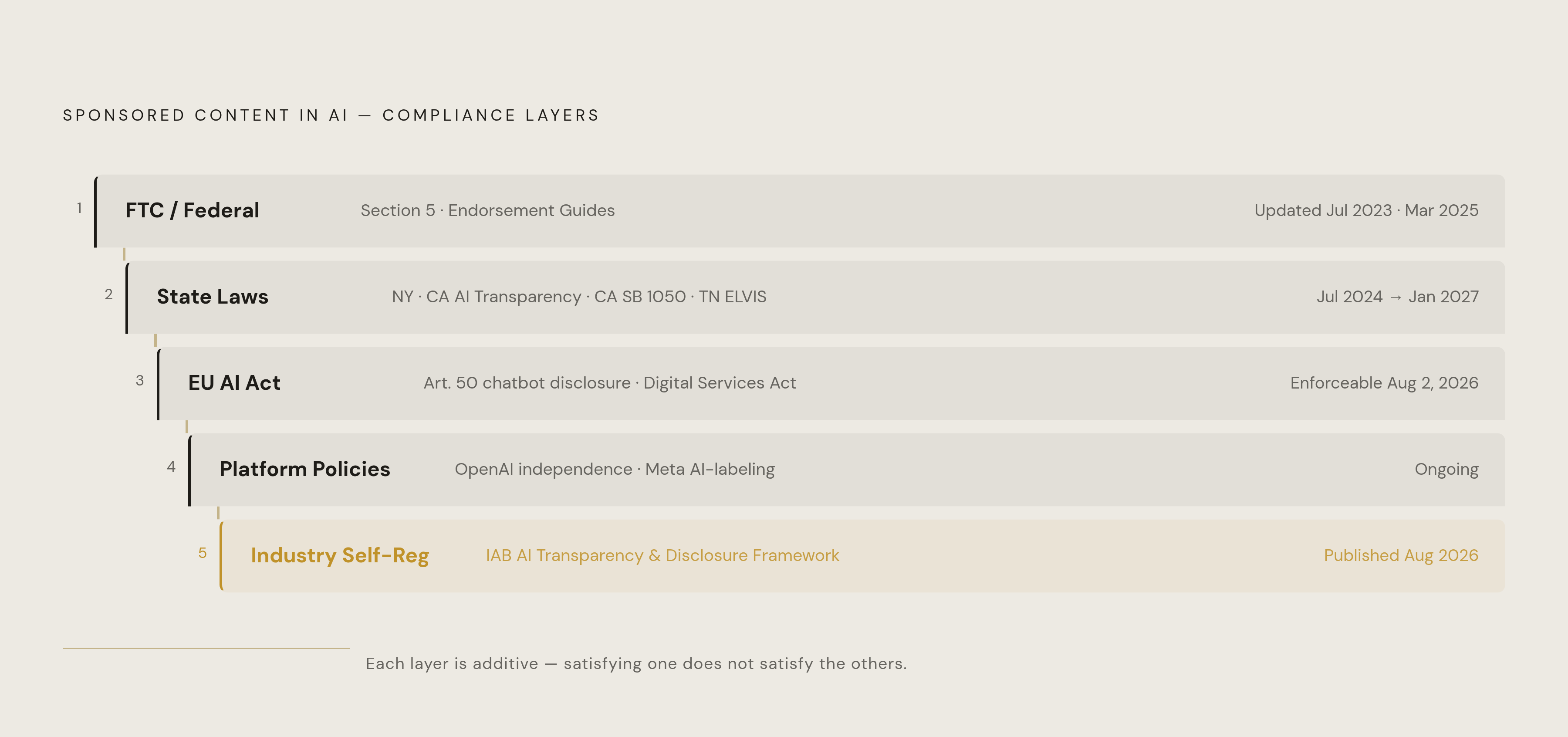
Ad disclosure requirements for sponsored content in AI conversations demand more than a familiar label in a new placement. Brands and agencies must account for five overlapping layers, including federal rules, state laws, EU obligations, platform policies, and industry standards. The central requirement is to build disclosure into the campaign before production, with labels and placement designed for how people actually read a conversation.
Why ad disclosure rules written for static formats don't map cleanly onto AI conversations
Traditional search and social advertising give consumers a recognizable visual boundary between paid and organic content. A “Sponsored” label sits apart from the surrounding results or posts. In a chat interface, however, a sponsored message enters the same conversational stream as the AI’s answer. The reader’s frame shifts from advertising to advice. That shift makes the relationship between the answer and the advertisement a compliance concern, even when they are technically separate.
OpenAI’s “Answer Independence” principle attempts to preserve that separation by requiring that ads not shape what the model says. A user may read a sponsored unit immediately below an answer as an endorsement by the AI. The FTC’s.com Disclosures framework predates conversational AI advertising, so its principles translate without prescribing every implementation choice for chat. Brands therefore cannot simply transfer an existing disclosure workflow and assume that it fits this format.
The FTC framework that governs AI-conversation ads right now, before any new statute passes
Section 5 of the FTC Act prohibits unfair or deceptive acts and practices, providing authority over AI advertising without a new AI-specific statute. There is no exemption for the technology. The FTC is already using existing consumer-protection authority against undisclosed AI advertising content. Deception depends on whether a reasonable consumer would find the omitted information material to a purchasing decision, rather than whether a tool technically generated the content.
The FTC’s updated Endorsement Guides, which took effect in July 2023 and were clarified in March 2025 staff guidance, cover advertising content that is AI-generated or AI-substantially-modified. When AI produces what appears to be a personal endorsement or testimonial, its involvement must be clearly disclosed. Disclosure does not make a fake testimonial lawful. A post marked “#ad” does not satisfy the separate AI disclosure requirement, while “AI-generated” does not identify the commercial relationship.
The FTC’s “clear and conspicuous” standard requires proximity, prominence, plain language, and an unavoidable disclosure. A hashtag buried among other tags fails that test. Language such as “ChatGPT recommends” or “as the AI suggests” creates a further concern because it implies an endorsement. Such wording can be deceptive under Section 5 and can also conflict with platform advertising policies.
What the FTC's materiality line means in practice: which AI uses require disclosure and which do not
For campaign teams, the practical test is whether AI’s role changes how a reasonable consumer interprets the content’s authenticity, origin, or claims. AI authorship alone is not the governing distinction. AI-written advertising copy, generated images, voice cloning, generated testimonials, and advertising translations require disclosure where that role is material. Grammar and formatting tools fall outside that substantive use.
Personalized marketing generated by a chatbot requires disclosure of the interaction’s AI nature. The commercial relationship remains a separate disclosure question. They must identify what the message is selling and whether AI’s role changes where it seems to come from or how authentic it seems. Neither label substitutes for the other when both requirements apply.
Disclosure belongs at the beginning of the ad unit or immediately adjacent to the content. The FTC has consistently held that post-hoc disclosures will not necessarily correct a deceptive presentation of material information. Terms such as “Partner Content,” “#partner,” “ambassador,” or branded substitutes obscure the commercial relationship.
State laws that stack on top of the FTC baseline, with different triggers and separate penalties
New York’s Synthetic Performer Disclosure Law, codified in General Business Law section 396-b, adds a specific trigger for advertisements containing synthetic performers. Governor Hochul’s announcement identifies June 9, 2026 as its effective date, following its signing in December 2025. It covers digitally created people who appear real but are not identifiable real individuals, including avatars, digital spokespeople, and simulated extras. Real people filmed on camera are outside that definition. Exemptions include audio-only advertising, ads for expressive works such as films and games, and AI used only for translation.
Liability in New York rests with those producing or creating the advertisement, including brands, agencies, and production companies, and requires actual knowledge of the synthetic performer. Disseminating platforms are explicitly exempt. Penalties increase after a first violation and apply per advertisement. The law reaches advertising targeting New York consumers regardless of the advertiser’s location.
California’s AI Transparency Act, which has been in force since August 2, 2026, requires AI-generated content to carry hidden provenance data. It applies to AI providers and licensees who strip disclosures, with separate penalties for each day a violation continues. Filmed, non-AI content is outside its scope. California’s SB 1050, signed by Governor Newsom on September 16, 2026 and effective January 1, 2027, separately covers ads prominently featuring synthetic performers, including audio-only ads. Those who create and publish the ad can be held liable for false advertising and likely can face private lawsuits.
On October 7, 2026, Pennsylvania’s legislature moved toward requiring disclosure when synthetic content gives consumers a false impression of the goods or services in an ad. The measure requires AI-generated or AI-modified content to be identified in a clear and conspicuous way, whether or not its use is knowing, reckless, or willful. Tennessee’s ELVIS Act, which has been in force since July 1, 2024, deals with consent. Unauthorized AI cloning of an identifiable person’s voice or likeness is a criminal misdemeanor, exposing creators, brands, platforms, and tool providers to penalties including just under a year in jail and a fine.
These rules attach to different features of the same campaign. A national supplements campaign using AI-generated testimonials can face the FTC’s fake reviews ban, New York’s performer disclosure rule, and potentially Tennessee’s voice-likeness restrictions. While federal preemption remains unsettled, the lowest-risk posture is compliance with the strictest applicable standard across active jurisdictions.
The EU AI Act obligations that apply to any brand serving European users inside AI interfaces
The EU AI Act extends the disclosure map beyond the advertiser’s home jurisdiction. It reaches providers and deployers whose systems enter the EU market or whose outputs are used in the EU, regardless of where those entities are established. Article 50 chatbot disclosure rules became enforceable on August 2, 2026. Serving users in another jurisdiction therefore introduces obligations that a US-only review will miss.
The Act requires labeling of AI-generated or manipulated advertising images, audio, and video. Its machine-readable marking requirements also make provenance part of the compliance workflow for generated output. The EU Digital Services Act governs transparency requirements for AI systems used in advertising targeting, separately from the AI Act.
Platform policies as a fourth compliance layer, illustrated by what OpenAI and Meta require of advertisers
Platform advertising policies impose contractual requirements independent of statutory duties. Their enforcement can precede any action by a regulator. A campaign that satisfies applicable law can still lose access to a placement if its creative or conduct breaches platform rules.
OpenAI’s independence principle has direct implications for creative and targeting, which must not attempt to circumvent the separation between ads and model answers. Meta requires advertisers to label AI-generated content under its own rules as well as those set by law. Neither requirement replaces the other compliance layers. Because platforms can update policies unilaterally and without notice, requirements reviewed during planning may differ from those governing a live campaign.
The IAB's August 2026 framework and how industry self-regulation interacts with the regulatory layers
The IAB’s AI Transparency and Disclosure Framework, published August 2026, supplies an operational standard for paid, sponsored, and brand-controlled marketing communications. Its consumer-facing disclosure trigger is AI that materially shapes content in ways that could mislead a reasonable consumer about authenticity, identity, or representation. That aligns its approach with FTC materiality. It does not treat every use of an AI tool as equally significant.
The framework specifies prelaunch compliance checklists, a recommended sparkle icon or equivalent text labels, and C2PA metadata capture for machine-readable provenance. Those practices can be implemented immediately. Capturing metadata helps meet the provenance requirements under California law and the EU framework, while labels that readers can see help them understand the content. These mechanisms complement one another and serve distinct functions.
Self-regulation does not preempt enforcement or establish an automatic legal safe harbor. Documented adherence can nevertheless indicate good faith in FTC proceedings. The framework also gives legal, creative, and operations teams a shared vocabulary, including “materially shapes content,” “reasonable consumer,” and “provenance data.” That shared language makes it easier to turn the other layers into rules for production, so each team need not work out what the regulatory text means on its own.
What "clear and conspicuous" disclosure actually looks like inside a chat interface, given the format constraints
For implementation, the disclosure specification must address the ad as a unit within an unfolding conversation. A tinted box below the organic answer can create a visible boundary. A labeled card with “Sponsored” in the header can make the commercial relationship apparent before the user reads the message. Both treatments distinguish the advertisement from an answer whose visual style might otherwise imply the same origin or authority.
Plain wording is essential to that distinction. “Ad,” “Sponsored,” and “Paid Advertisement” identify the commercial nature directly, while “Partner Content,” “Promoted,” and branded terminology do not provide the required clarity. When the creative needs both disclosures, the unit must show its commercial label and its AI-content label together.
A disclosure at the start of a session may be too remote from an advertisement appearing many turns later. The disclosure may therefore need to travel with each sponsored unit. The IAB’s sparkle icon or equivalent text label belongs on the unit itself, even when it also appears in a profile, footer, or separate disclosure page.
Building a pre-campaign compliance workflow that covers all five layers before a brief leaves the agency
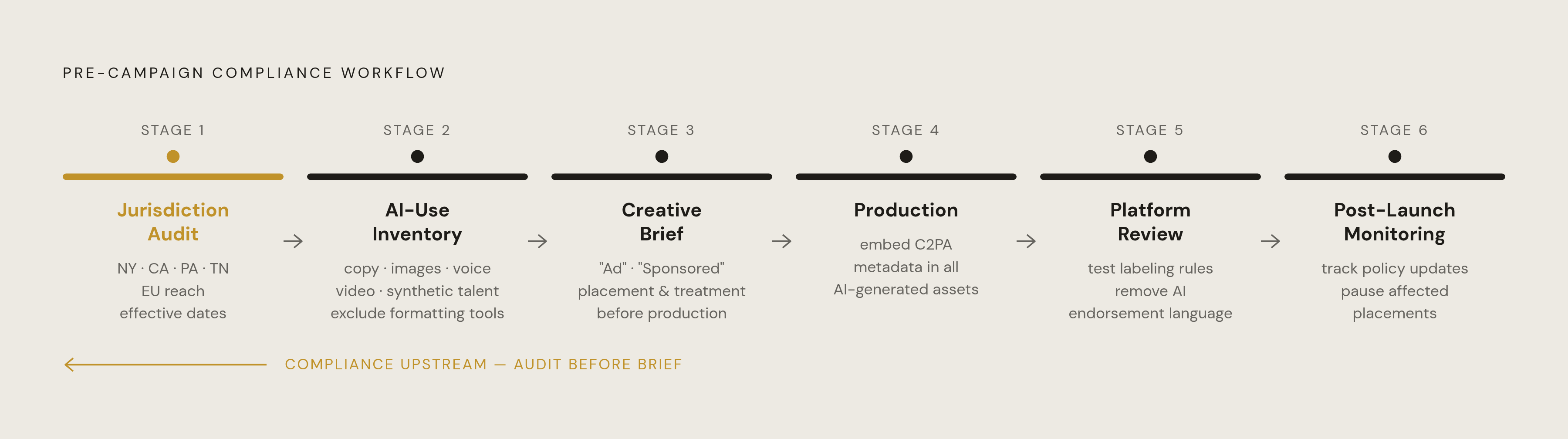
The lesson for agencies is to begin with jurisdiction, before the brief is written. The audit should identify every targeted state and whether the campaign will reach EU users. It should establish which New York, California, Pennsylvania, and Tennessee requirements apply, distinguishing effective laws from pending measures and future effective dates. This defines the campaign’s legal scope. It also prevents a national campaign from being reviewed as though one state’s trigger governs every placement.
At the brief stage, the AI-use inventory should document generated or substantially modified copy, images, voice, video, and synthetic performers. Grammar and formatting assistance can then be excluded. The safer default is to document the use before deciding that it needs no disclosure. Before production, the creative brief should spell out what the label says, where it goes, and how it looks, so the production team has the disclosure requirement in advance and avoids a late change from legal.
During production, C2PA metadata should be embedded in AI-generated assets to address machine-readable provenance obligations. At trafficking, the platform review should test the final creative against current labeling rules and remove language implying AI endorsement. Timing is part of this control. A policy review performed only when the brief was approved does not account for unilateral changes before the advertisement runs.
After launch, monitoring must cover platform updates and state laws taking effect during the campaign. Affected campaigns must be updated or paused. This assigns compliance decisions to the stages where they can change the work, from jurisdiction selection through production and live delivery.